


Landmark discovery: Homo naledi buried their dead 250,000 years ago, according to newly updated research. The controversial claim that Homo naledi buried their dead has received new evidence in a 2025 study.
Homo naledi, an extinct relative of modern humans whose brain was a third the size of a modern human’s, buried its dead and left traces on cave walls about 250,000 years ago, according to a new study.
The findings challenge long-held theories that only modern humans and our Neanderthal ancestors could perform these complex tasks.
Evidence of burial practices among this early hominin would be a “landmark discovery,” according to a team of researchers who published their hypothesis in the journal eLife in 2023. However, their theory has been controversial, with multiple experts saying there is not enough evidence to conclude that H. naledi buried or memorialized their dead.

Using bone scans, paleoartist John Gurche spent about 700 hours reconstructing the head of Homo naledi. Mark Thiessen, National Geographic
In a revised study published March 28 in eLife, the researchers laid out 250 pages of evidence for intentional burial that they said convinced more people.
Archaeologists first discovered the remains of H. naledi in the Rising Star cave system in South Africa in 2013. Since then, more than 1,500 bones from different individuals have been found in the 2.5-mile (4-kilometer) long system.
The anatomy of H. naledi is well known, thanks to the remarkable preservation of its remains. They were bipedal, stood about 5 feet (1.5 meters) tall, and weighed about 100 pounds (45 kilograms). They had dexterous hands and a small but complex brain—traits that have led to debate about the complexity of their behavior.
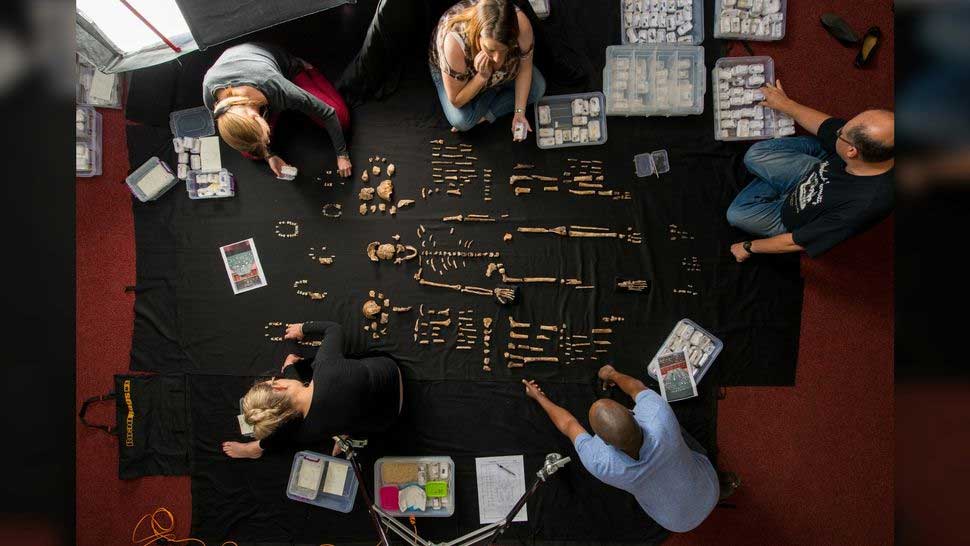
An overhead view of Homo naledi bones laid out by researchers at the University of the Witwatersrand’s Institute for Evolutionary Studies. The team that discovered the new species of human relative deep inside a cave near Johannesburg, South Africa, was led by National Geographic Explorer-in-Residence Lee Berger of the University of the Witwatersrand. Robert Clark, National Geographic
In a 2017 study published in the journal eLife, the Rising Star team first proposed that H. naledi intentionally buried their dead in the cave system. And then, at a press conference in 2023, paleoanthropologist Lee Berger, the director of the Rising Star program, and his colleagues backed up that claim with three studies posted to the preprint server bioRxiv that together provide the most substantial evidence to date that H. naledi intentionally buried their dead and created meaningful rock carvings above the burials.

The study described two shallow oval pits in the floor of one cave chamber that contained skeletal remains consistent with the burial of bodies with flesh covered in sediment that had since decomposed. One of the burials may even have included a funerary offering; one stone artifact was found in close contact with the bones of the hand and wrist.
At a 2023 press conference, Berger said: “We think they pass the litmus test of human burials or archaic human burials.” However, many experts did not buy the researchers’ interpretations, which would push back the earliest evidence of intentional burial by 100,000 years — a record previously held by Homo sapiens.
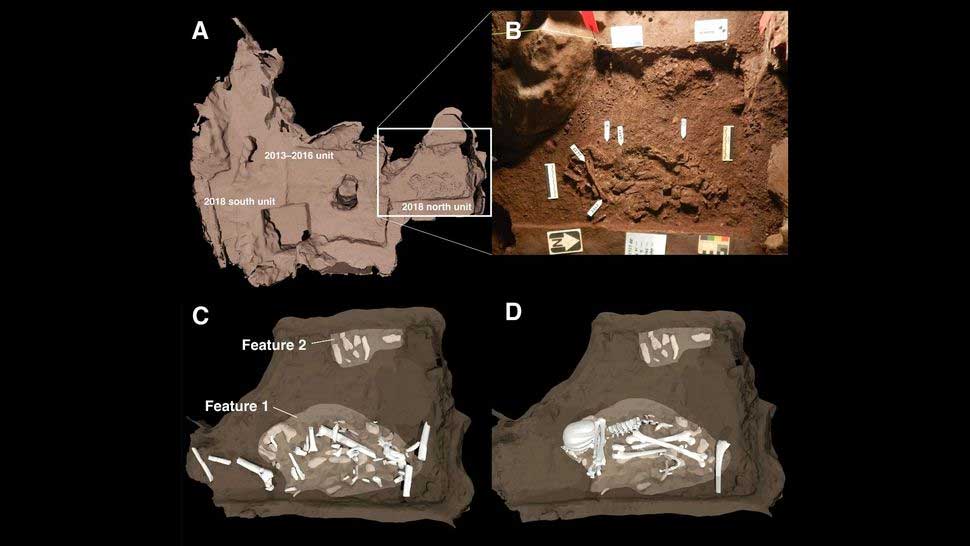
A diagram of two burial objects found in the Dinaledi Chamber of Rising Star Cave. (A) The position of the burials relative to the 2013–2016 excavations is indicated by the square area. (B) This is a photograph of the main burial objects. Object 1 is the body of an adult Homo naledi. Object 2 shows at least one juvenile body at the edge of the burial site. (C) and (D) are illustrations showing how the bones were arranged within the graves. Berger et al., 2023/National Geographic
In response, members of the Rising Star team collected additional evidence to support their claim of intentional burial, which they published — along with new peer reviews — in eLife. These revisions included the addition of a comprehensive reconstruction of how the H. naledi bodies ended up in the cave system, including a timeline from death to decomposition.
One expert who reviewed the 2023 study and declared it inconclusive reviewed the new study and wrote: “I now believe the authors have provided sufficient evidence for ‘repeated and patterned’ intentional burials” of H. naledi.
However, a second reviewer wrote that the new paper remains unconvincing, noting that while “the world is deeply concerned about H. naledi hominins and their history,” it would be helpful if other, independent groups conducted a full analysis “since science is about replication.”
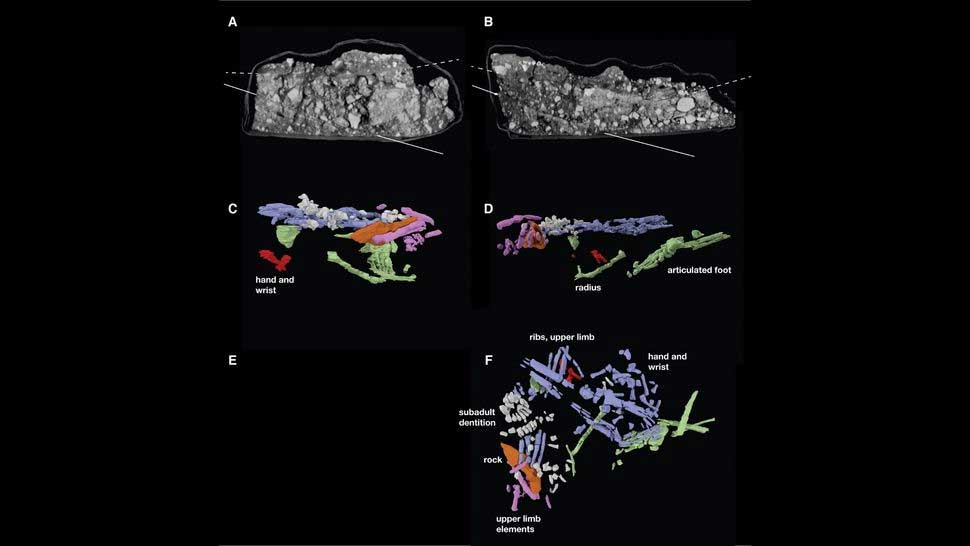
The burial of an adolescent and a potential stone tool were found in the mound’s antechamber. Images A and B are cross-sectional CT scans of a plaster shell removed from the chamber. CFs are 3-D digital reconstructions of the bones in the burial, as well as a tool-shaped stone (orange) near the 13-year-old’s hand. Berger et al., 2023/National Geographic
To date, two other H. naledi preprints published by Berger’s team in 2023 have not been fully revised.
See also... New method for observing individual atoms confirms century-old quantum mechanical theory |
One 2023 study suggested that the discovery of abstract engravings on the rock walls of the Rising Star cave system also signaled that H. naledi had complex behavior. These lines, shapes, and “hashtag”-like figures appeared to be made on specially prepared surfaces created by H. naledi individuals grinding the rock before engraving with a stone tool. The depth of the lines, composition, and order suggested that they were intentional rather than naturally occurring.
“There are burials of this species right underneath these engravings,” Berger said, suggesting that this was the cultural space of H. naledi. “They had greatly modified this space through miles of underground cave systems.”
In another preprint that has not yet been published, Agustin Fuentes, an anthropologist at Princeton University, and colleagues explored why H. naledi used the cave system.
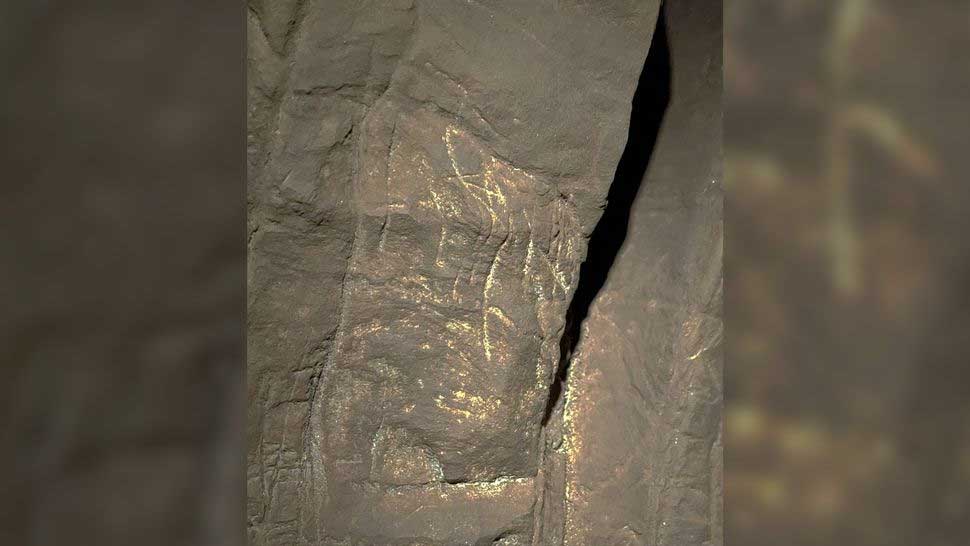
The burial chamber at Hill Antecamber contains engravings, such as one in the shape of an inverted cross. There is also surface material that highlights non-geometric images in low light, although this has not yet been analyzed. Berger et al., 2023/National Geographic
“The communal and planned burial of multiple bodies in the Rising Star system” and the engravings suggest that these people shared a common set of beliefs or assumptions about death and may have been memorializing the dead – “what might be called ‘common grief’ among modern humans,” they wrote.
However, other researchers are not entirely convinced by such interpretations.
“It is also difficult to prove that they are intentional or represent forms of abstract thinking,” Atreya said in 2023.
Questions also arise about how H. naledi got into the Rising Star cave system; the assumption that it was complex underlies many interpretations by researchers of intelligent behavior.
See also... Complete list of HTML/Javascript event handlers with examples List of required documents for a website in the Russian Federation |
Related Posts
Archaeologists in Norway have discovered an ancient cemetery where mostly children were buried
Archaeologists in Norway have discovered a cemetery dating from 800…
The Gunung Padang archaeological site in western Java was built by a civilization 25,000 years ago
Researchers from Indonesia claim that the archaeological site of Gunung…

