Since the first exoplanet orbiting a Sun-like star was confirmed in 1995, scientists have discovered more than 5,000 such distant worlds. More than half of these discoveries were made by NASA’s Kepler space telescope, launched in 2009 to determine the prevalence of Earth-like planets in the Milky Way galaxy. Kepler was decommissioned in 2018, having discovered more than 2,600 exoplanets.
Discovering the first true “alien Earth” has long been a dream of astronomers, and recent exoplanet discoveries have shown that our galaxy is full of small, rocky worlds like our own.
For a planet to be considered potentially habitable, it must be relatively small and rocky, and orbit within the habitable zone (Goldilocks zone) of its star. This zone is roughly defined as the region where liquid water could exist on the planet’s surface. As telescopes improve, other factors are taken into account, such as the planet’s atmospheric composition and the activity level of its parent star. The closest known analogs of our home planet, as of January 2024.
Gliese 667Cc is located just 22 light-years from Earth and, according to NASA’s Jet Propulsion Laboratory, its mass is at least 4.5 times that of Earth.
Gliese 667Cc orbits its star every 28 days, but that star is a red dwarf, significantly cooler than the Sun, so the exoplanet is thought to be in the habitable zone. However, Gliese 667Cc, discovered using the European Southern Observatory’s 3.6-meter telescope in Chile, may orbit close enough to its red dwarf to be scorched by flares.
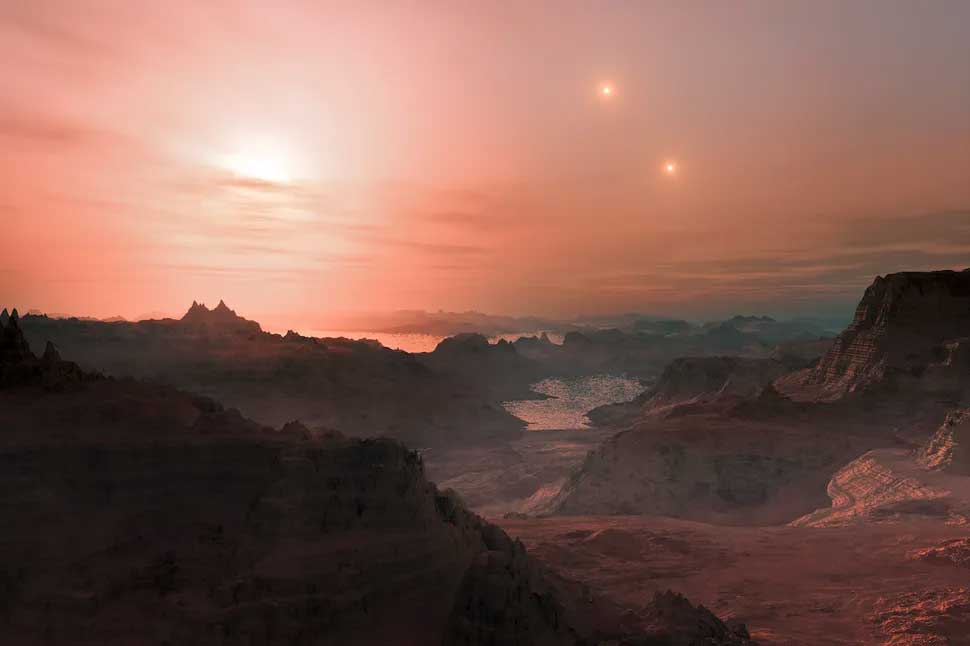
Artist’s impression of the surface of Gliese 667Cc. ESO/L. Calçada
Kepler-22b is 600 light years away.
This is the first planet from the Kepler catalog discovered in the habitable zone of its star, but this world is significantly larger than Earth—approximately 2.4 times the size of our planet. It is unclear whether this “super-Earth” is rocky, liquid, or gaseous.
Kepler-22b’s orbit is 290 days, quite close to Earth’s (365 days). The exoplanet orbits a G-class star similar to our Sun, but smaller and cooler than Earth.
Kepler-69c, located approximately 2,700 light-years away, is approximately 70% larger than Earth. Therefore, researchers are again uncertain about its composition.
The planet orbits the Sun every 242 days, making its position in the Solar System similar to that of Venus. However, since the star Kepler-69c is approximately 80% as bright as the Sun, the planet is likely located in the habitable zone.
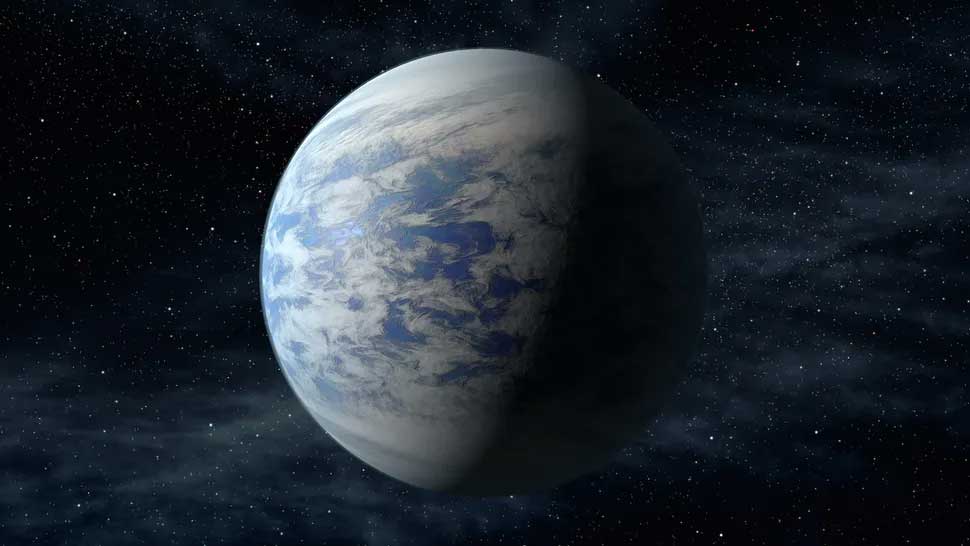
Artist’s illustration of Kepler-69c. NASA Ames/JPL-Caltech/T. Pyle
According to NASA, Kepler-62f is about 40% larger than Earth and orbits a star significantly cooler than our Sun.
However, its 267-day orbit places Kepler-62f squarely within the habitable zone. Although Kepler-62 orbits closer to its red dwarf than Earth does to the Sun, the star emits much less light.
Kepler-62f is located about 1,200 light-years away and, due to its large size, is considered a potential rocky planet that could host oceans.
This planet is at most 10 percent larger than Earth, and it also appears to be in the habitable zone of its star, albeit on the outer edge of the zone; Kepler-186f receives from its star only a third of the energy that Earth receives from the Sun.
Kepler-186f’s parent star is a red dwarf, so this alien world is not a true twin of Earth. The planet is located approximately 500 light-years from Earth.
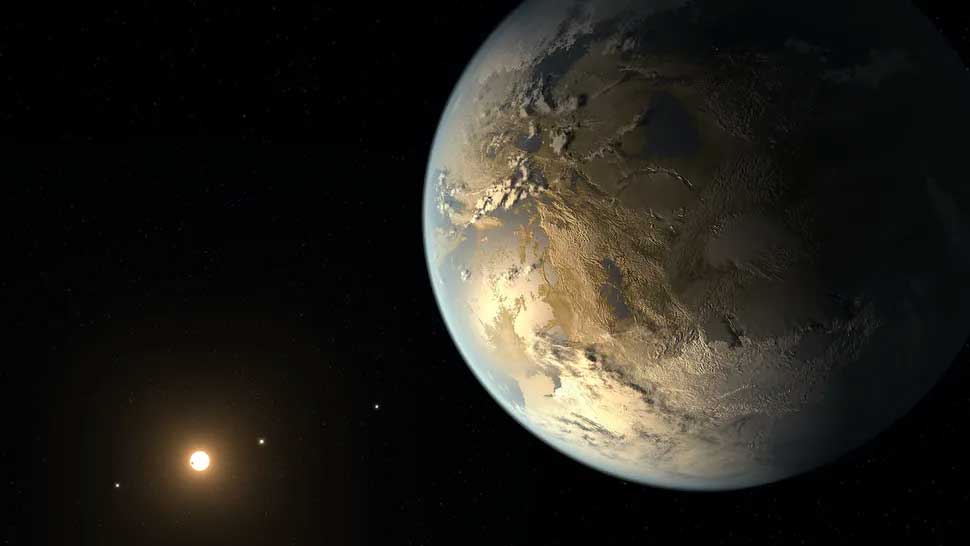
A planet the size of Kepler-186f is likely to be rocky. NASA Ames/JPL-Caltech/T. Pyle
According to a NASA press release, Kepler-442b is 33% larger than Earth and orbits its star once every 112 days.
The discovery of Kepler-442, located 1,194 light-years from Earth, was announced in 2015.
A study published in the journal Monthly Notices of the Royal Astronomical Society in 2021 found that this exoplanet could receive enough light to support a large biosphere. Researchers analyzed the likelihood of photosynthesis on various planets and found that Kepler-442b receives sufficient radiation from its star.
This world, whose discovery was announced in 2015, is the first Earth-sized planet orbiting a Sun-sized star, according to NASA exoplanets. Kepler-452b is 60 percent larger than Earth, and its parent star (Kepler-452) is 10 percent larger than the Sun. Kepler-452 is very similar to our Sun, and the exoplanet orbits in the habitable zone.
According to its discoverers, Kepler-452b, which is 1.6 times larger than Earth, has a “more than even chance” of being a rocky planet. Kepler-452b is located 1,400 light-years from Earth. Kepler-452b orbits its star just 20 days longer than Earth.
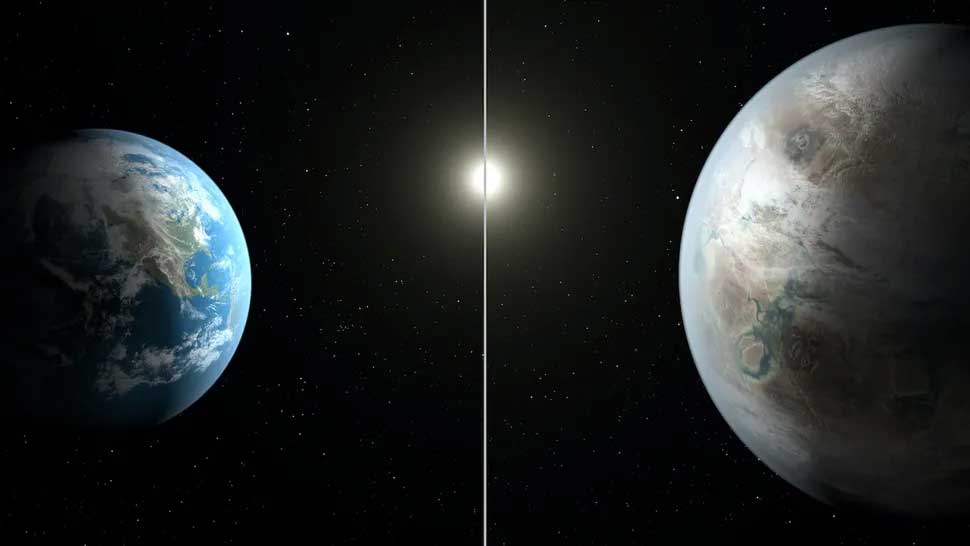
An artist’s comparison of Kepler 452b with Earth. NASA/Ames/JPL-Caltech/T. Pyle
In a reanalysis of data from NASA’s Kepler space telescope, scientists have discovered an exoplanet named Kepler 1649c.
It was found that this exoplanet is similar in size to Earth and orbits in the habitable zone of its star.
According to NASA, during the initial collection of data from the telescope, a computer algorithm incorrectly identified the astronomical body, but in 2020 it was discovered to be a planet.
Kepler-1649c is located 300 light-years from Earth and is only 1.06 times larger. By comparing the light the two planets receive from their stars, scientists found that this exoplanet receives 75% of the light Earth receives from the Sun.
According to NASA, Proxima Centauri b is just four light-years from Earth, making it the closest known exoplanet to Earth.
Discovered in 2016, this exoplanet has a mass 1.27 times that of Earth.
Although the exoplanet is located in the habitable zone of its star, Proxima Centauri, it is exposed to extreme ultraviolet radiation. This is due to its close proximity to its star and its orbital period of only 11.2 days.
The star TRAPPIST-1 is orbited by planets larger than Earth ever discovered in the habitable zone of a single star. This planetary system consists of seven worlds.
The water on most of these planets likely evaporated early in the system’s formation. However, a 2018 study found that some of these planets may contain more water than Earth’s oceans. One of the worlds, TRAPPIST-1e, is considered the most suitable for life as we know it.
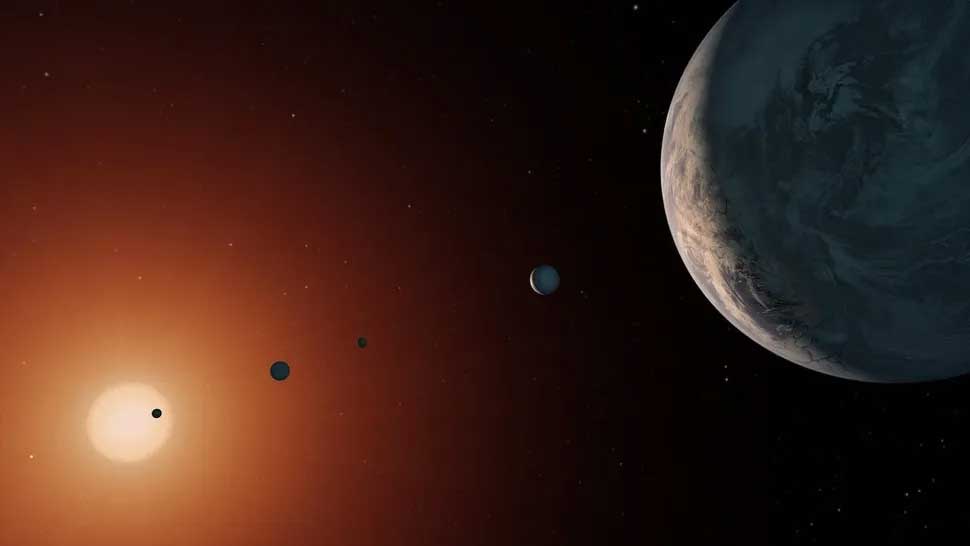
This illustration shows the TRAPPIST exoplanets closest to their star. NASA/JPL-Caltech
Gliese 12 b is an incredibly close and moderately warm planet located just 40 light years away from us around a red dwarf star.
Scientists using NASA’s Space Telescope have discovered a fascinating world. Roughly the size of Earth, it’s located extremely close to our Solar System and may be habitable as we know it.
An extrasolar planet, or “exoplanet,” named Gliese 12 b orbits a small, cool red dwarf star located just 40 light-years from Earth in the constellation Pisces. Discovered by a team using NASA’s Transiting Exoplanet Survey Satellite (TESS), the exoplanet is estimated to be approximately 1.1 times the width of Earth, making it similar to both our planet and Venus, often referred to as our solar system’s “twin.” The two teams’ research was published on May 23, 2024, in The Monthly Notices of the Royal Astronomical Society and The Astrophysical Journal Letters.
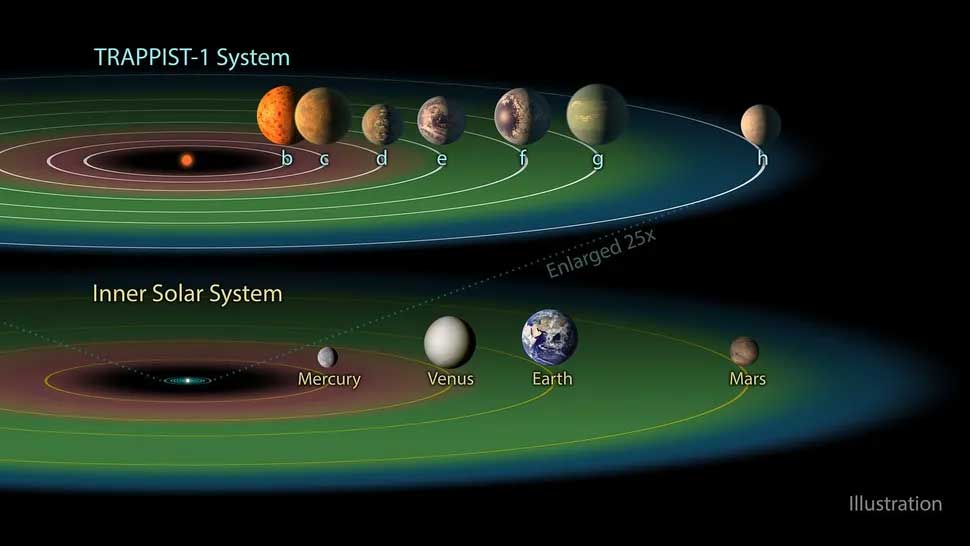
Comparison of the Trappist-1 system of planets orbiting a red dwarf and similar to Gliese 12 b. NASA/JPL-Caltech
Gliese 12 b orbits its star, Gliese 12, so closely that its year lasts only 12.8 Earth days. However, because Gliese 12 is only about a quarter the size of the Sun, it is also much cooler than our star. This means that, although Gliese 12 b is located at a distance from its red dwarf parent equivalent to only 7% of the distance between the Sun and Earth, it still lies within the habitable zone of its planetary system. Also known as the “Goldilocks zone,” the habitable zone is the region around a star that is neither too hot nor too cold for planets to harbor liquid water, a vital component for life as we know it. Importantly, the two teams behind Gliese 12 b’s discovery cannot yet say for sure whether it has an atmosphere. Therefore, it remains unclear whether the world could be habitable, but the researchers are cautiously optimistic.
Scientists spotted Gliese 12 b as it crossed (or “transited”) the disk of its red dwarf. These transits cause small dips in brightness, which TESS captures beautifully. Pailthorpe added that when they began this project, the team didn’t know for sure what the planet’s orbital period or size would be.
Gliese 12 b receives about 85% of the radiation that Venus receives from the Sun, but its surface temperature is thought to be much cooler—107 degrees Fahrenheit (42 degrees Celsius)—compared to Venus’s surface temperature of 867 degrees Fahrenheit (464 degrees Celsius).
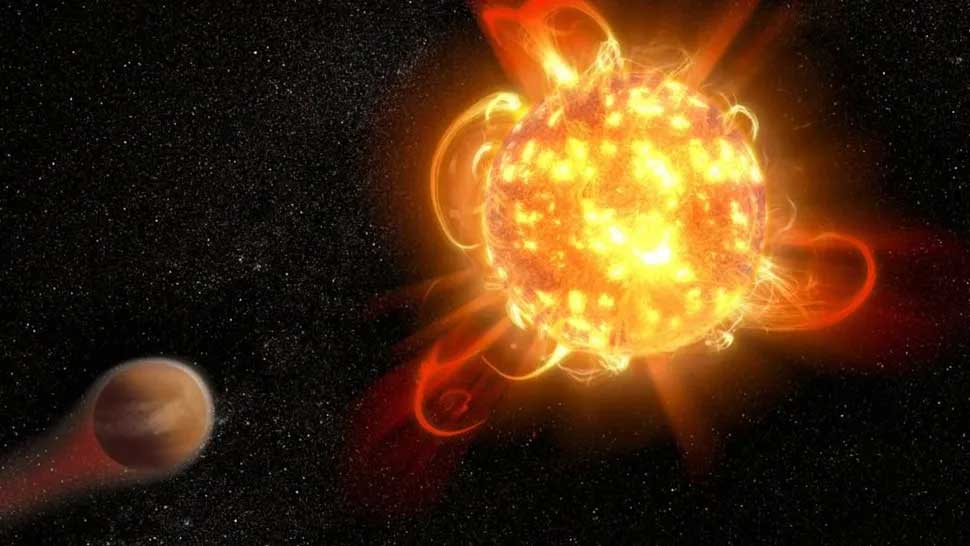
A young red dwarf star is erupting violently, blasting powerful radiation at an exoplanet orbiting it. NASA, ESA, and D.Player
Although Earth and Venus are in the Sun’s habitable zone, one is capable of supporting life and has a favorable atmosphere, while the other is an inhospitable hell with temperatures hot enough to melt lead. Studying Gliese 12 b may help us understand why.
The team will investigate whether Gliese has an atmosphere, but preliminary data suggests that if it does, it’s relatively thin. However, surprisingly, the lack of a dense atmosphere is good news for the planet’s habitability.
It may either have no atmosphere, which is not ideal for life, or it may have a tenuous atmosphere, similar to Earth’s. However, even if Gliese 12 b lacks an atmosphere, it could still be an important target for further searches for life elsewhere in the Milky Way. This is because, as a red dwarf, the star it orbits is the most common form of star in our galaxy, yet we know relatively little about the planetary systems of red dwarfs.
In the Milky Way, red dwarfs form the largest family of stars, where the fusion of hydrogen from helium continues in their cores. This process determines the so-called “main sequence” of a star’s life. An estimated 60% to 70% of the stars in our galaxy are red dwarfs like Gliese 12, and of the 30 stars closest to Earth, at least 20 are red dwarfs.
Red dwarfs, officially known as K- or M-type stars, have masses ranging from 7.5% to 50% that of the Sun. This low mass compared to the Sun means these stars burn at lower temperatures, reaching only 6,380 degrees Fahrenheit (3,500 degrees Celsius) compared to our star’s 9,900 degrees Fahrenheit (5,500 degrees Celsius). For example, the surface temperature of Gliese 12 is about 60% that of the Sun.
This lower temperature means that dim red dwarfs can exist as main-sequence stars much longer than moderately massive stars like the Sun. While the Sun is expected to live for about 10 billion years, the lifespan of red dwarfs is predicted to be tens, even hundreds, of times longer, sometimes reaching trillions of years. This means life would have more time to develop on planets orbiting red dwarfs than on planets orbiting larger main-sequence stars.
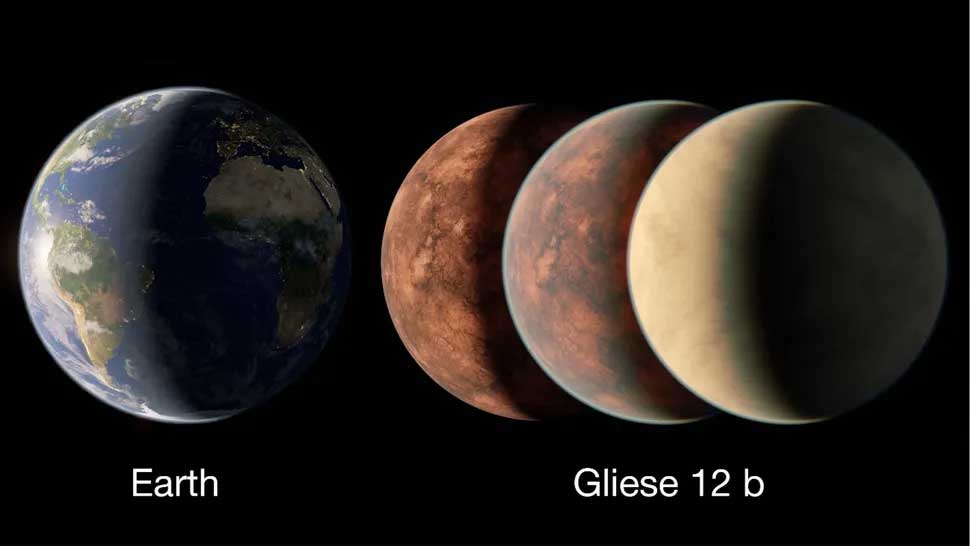
Possible sizes of the newly discovered exoplanet Gilese 12 b. NASA/JPL-Caltech/R.Hurt (Caltech-IPAC)
However, not everything is so rosy in terms of the prospects for life on exoplanets orbiting red dwarfs.
Although red dwarfs are cooler than the Sun in their stellar maturity, they are believed to be much more violent than our star. This class of stars is believed to exhibit high magnetic activity, emitting frequent and powerful flares of high-energy light in the form of X-rays. These X-rays can violently disrupt the atmosphere of a planet orbiting a red dwarf.
Furthermore, recent studies have shown that even red dwarfs that remain quiescent for years can suddenly explode in superflares with a power 100 to 1,000 times greater than solar flares. Such eruptions are more common in the young ages of this class of stars and are also capable of destroying atmospheres and evaporating liquid water, even in habitable zones.
However, for now, both teams involved in the discovery of Gliese 12 b believe that the red dwarf’s orbit is relatively quiet, which could be good news for the exoplanet’s chances of having an atmosphere.
The fact that red dwarfs are cooler than stars like the Sun, and therefore their habitable zones are closer to their stars, actually makes it a bit easier for TESS and its transit planet-hunting method to detect exoplanets around them.
To further study this planet, the team will need to use instruments other than TESS. They will also switch to a different exoplanet detection method to better characterize Gliese 12 b. One of these is called the “radial velocity method,” and it uses the tiny oscillations that planets cause in the motion of their stars as they gravitationally tug on them.
Pailthorpe and Van Uylen also hope to collaborate with the James Webb Space Telescope (JWST) to further study the planet’s atmosphere. This is possible because as Gliese 12 b passes across its star’s disk, the light passing through its atmosphere will carry the characteristic signatures of the chemical elements present in the atmosphere.

This process is called “transmission spectroscopy,” and Gliese 12 b is just one of a few temperate Earth-like worlds close enough to be studied in this way.
JWST is currently conducting a similar study of seven Earth-sized planets in the TRAPPIST-1 system, located approximately 40 light-years away. These planets resemble Gliese 12 b not only in that many of them are in the habitable zone of their star, but also in that the star is also a small, cool red dwarf.
When it comes to the possibility of life on Gliese 12 b, both scientists are extremely cautious. After all, it’s still too early to talk about our understanding of this world, nor about the methods that would allow us to detect signs of life in the atmosphere of an exoplanet, even one as relatively close as Gliese 12 b.
A fifth planet was discovered in the habitable zone of a neighboring star in 2025, with conditions possibly conducive to the existence of liquid water and potential life.
L 98-59, located approximately 35 light-years from Earth, is a cool, dim red dwarf star already known to host a compact system of small rocky planets. The latest discovery, by researchers from the Trottier Institute for Exoplanet Research at the University of Montreal, confirms the existence of L 98-59 f, a super-Earth with a minimum mass 2.8 times that of Earth. The study was published on July 12, 2025, in the journal Earth and Planetary Astrophysics.
The newly discovered exoplanet orbits its star in a nearly perfect circular orbit with an orbital period of 23 Earth days. According to the university, the planet receives approximately the same amount of stellar energy as Earth, placing it within the star’s habitable zone—the range of distances where liquid water could exist under suitable atmospheric conditions.
“The discovery of a temperate planet in such a compact system makes this discovery particularly exciting,” said Charles Cadieux, a research fellow at the university and lead author of the study. “It highlights the remarkable diversity of exoplanet systems and strengthens the case for studying potentially habitable worlds around low-mass stars.”
L 98-59 f was discovered through a reanalysis of data from the European Southern Observatory’s (ESO) High-Accuracy Radial Velocity Planet Search (HARPS) and ESPRESSO spectrographs. Because the exoplanet does not transit its star or pass in front of it, astronomers detected it by tracking subtle changes in the star’s motion caused by the planet’s gravitational pull.
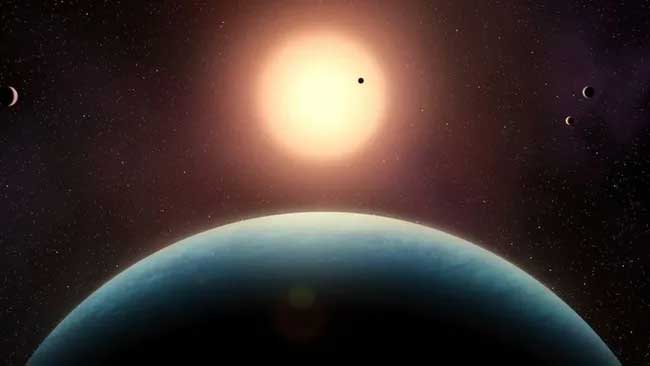
Five small exoplanets orbit closely around the red dwarf star L 98-59, located 35 light-years away. In the foreground of this illustration is the super-Earth L 98-59 f, which is thought to be in its star’s habitable zone. Benoit Goujon, University of Montreal
By combining spectrograph data with observations from NASA’s Transiting Exoplanet Survey Satellite (TESS) and James Webb Space Telescope (JWST), and using advanced stellar noise filtering techniques, the researchers were able to determine the size, mass, and basic properties of all five planets.
The study shows that L 98-59 b, the innermost planet, is only 84% the size of Earth and half its mass, making it one of the smallest exoplanets studied. Tidal forces may be responsible for volcanic activity on the two innermost planets in the system, and the unusually low density of the third suggests it may be a water-rich world unlike any other in our solar system. According to the study’s participants, this diversity offers a rare opportunity to study the formation and evolution of planetary systems beyond our own.
“These new results paint the most complete picture we’ve ever had of the remarkable L 98-59 system,” said Cadieux. “They’re a compelling demonstration of what we can achieve by combining data from space telescopes and high-precision instruments on Earth, and they open up key targets for future atmospheric research with the James Webb Space Telescope.”
Because L 98-59 is small and close, its planets are particularly well-suited for subsequent atmospheric studies. If L 98-59 f has an atmosphere, telescopes like the JWST could detect water vapor, carbon dioxide, and even biosignatures.
The rocky planet, dubbed LHS 1140 b, is located 48 light-years from Earth, and according to new research, its atmosphere contains helium. It is also the first rocky planet whose atmosphere has been directly detected. It is the first rocky planet with an atmosphere discovered that is also located in the habitable zone—the appropriate distance from its star for the potential existence of liquid water.
As we continue our search for planets that can be considered “habitable,” this planet meets more requirements than almost anything we’ve ever seen.
This exoplanet, or planet outside our solar system, was first discovered in 2017 by a team of astronomers led by Jason Dittman, who is now a co-author of this new discovery. This work is described in a study published in the journal Science in 2026.
Since it’s a rocky planet, “it definitely has a surface… it’s made of rocks,” Dittman said. What does the planet’s surface look like? We can’t say yet, but the researchers who discovered the planet’s atmosphere believe there’s a good chance it contains water.
Although the planet orbits a red dwarf star that is smaller and cooler than the Sun, it is closer to our star than we are, maintaining a temperature that keeps the planet in the “Goldilocks zone” where liquid water could exist on its surface.
“There’s probably a lot of water there, too,” Cherubim said. “If there’s any atmosphere there that could create a greenhouse effect, and we know there is… then it’s likely to have conditions that we consider habitable on Earth, and conditions that would likely allow liquid water to exist.”
While it’s certainly not an exact replica of Earth, this planet can be considered Earth-like in two key ways, Cherubim explained. First, its general composition. The planet is rocky, likely with an iron core, and has an atmosphere. Second, the planet’s temperature is ideal for liquid water, which is essential for life, at least as we understand it, on our planet.
The discovery of the first exoplanet was confirmed just over 30 years ago. Since then, scientists have discovered over 6,000 exoplanets, and that number continues to grow. Although several rocky planets have been discovered in the habitable zones of their stars, only now has the presence of an atmosphere around a rocky planet in the habitable zone been confirmed.
One of the reasons scientists have had difficulty finding planets with atmospheres is their stars. LHS 1140 b orbits the most common type of star—red dwarfs, which are about a third the size of our Sun. Stars of this type remain active much longer than stars like our Sun. This activity means they emit outbursts of extreme radiation, such as solar flares and coronal mass ejections. And the extreme radiation around these stars typically completely strips the atmospheres of planets orbiting them, so astronomers wondered whether planets orbiting these stars could have atmospheres at all.
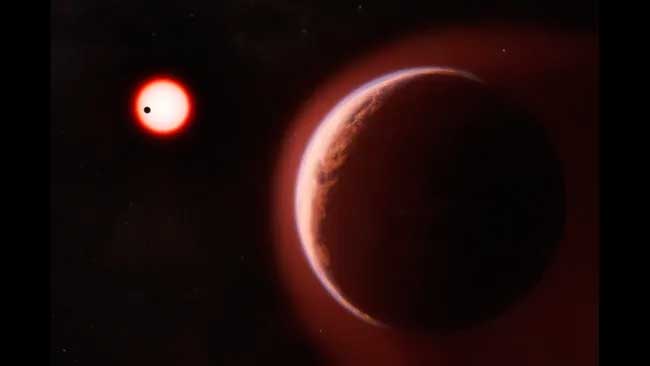
An artist’s impression of the exoplanet LHS 1140 b in the foreground, surrounded by a helium atmosphere. Its red dwarf star, orbited by another planet, is in the background. Melissa Weiss/Center for Astrophysics | Harvard and Smithsonian
“This discovery is hugely significant because it shows that at least this rocky planet has retained an atmosphere for billions of years,” Cherubim said. It’s “a credible and compelling way to say that, yes, atmospheres can exist on rocky exoplanets.”
It’s quite possible that the planet’s atmosphere contains other gases besides helium, and it’s possible that some of its atmosphere was previously stripped away by the star’s radiation. However, the red dwarf star around which this planet orbits is approximately 6 billion years old, which is several billion years older than the age at which its extreme radiation activity begins to subside. Therefore, although some helium is still slowly escaping the planet’s atmosphere over time, the team expects the planet to retain its atmosphere, Dittman shared. After all, even Earth’s helium slowly escapes our own atmosphere.
To prove the planet’s atmosphere, the team began with a hypothesis Cherubim had made during his graduate studies. It all began with a theoretical model and a vague suspicion that rocky exoplanets with atmospheres different from Earth’s might exist.
See also... New method for observing individual atoms confirms century-old quantum mechanical theory |
“It was the result of a very specific prediction based on a planetary evolution model that I developed from scratch, from first principles, for my PhD as a theorist, and I made a very specific prediction about this planet,” Cherubim said. “And then I did something quite unexpected, quite strange, using a method typically used to observe giant planets, and I applied it to a rocky planet, which no one had done before.”
“And then, to my surprise, I made a measurement that completely matched my prediction. And it was very satisfying to close the circle of the scientific method.”
The team took a theoretical model developed by Cherubim in graduate school and tested it using the WINERED (Warm Infrared Echelle) spectrograph at the Magellan Observatory in Chile. These observations allowed them to see LHS 1140 b and another planet transit the star on the same night. Using these spectrographic data, they were able to identify molecular signatures in the atmospheres of these planets as they passed in front of the star. While one planet yielded no results, it did show a direct, undeniable helium signature.
When it comes to a rocky planet with an atmosphere and a habitable zone (meaning it could harbor liquid water), the question of whether life exists quickly arises. Since this is the first planet of its kind discovered, further research will help us put all the pieces of the puzzle together.
The planet, designated GJ 3378b, orbits a dim red dwarf star in the constellation Cameloparalis (The Camelopardalis). A potentially habitable rocky planet has been discovered in the habitable zone of the red dwarf, located just 25 light-years away.
However, faced with a hostile beam of radiation from its star, it remains unclear whether this new exoplanet has an atmosphere or whether life is likely to exist. Nevertheless, astronomers are celebrating the discovery.
“This is an exciting discovery,” said Paul Robertson of the University of California, Irvine. “It’s one of our nearest cosmic neighbors. Twenty-five light-years seems like a long distance, but the Milky Way is about 100,000 light-years across, so in that respect, it’s our closest neighbor.” The results of the study were published on June 30, 2026, in The Astrophysical Journal.
The planet, designated GJ 3378b, orbits a dim red dwarf star in the constellation Cameloparalis (The Camelopardalis). It was discovered in 2024 by French astronomers using the Canada-France-Hawaii Telescope on Mauna Kea, but American astronomers have revised these initial data, showing that the planet may be more Earth-like than previously thought.
All we know for sure is GJ 3378b’s mass and orbit. We don’t yet know whether it’s Earth-like—it could have land, sea, clouds, and life, or it could be airless and cratered.
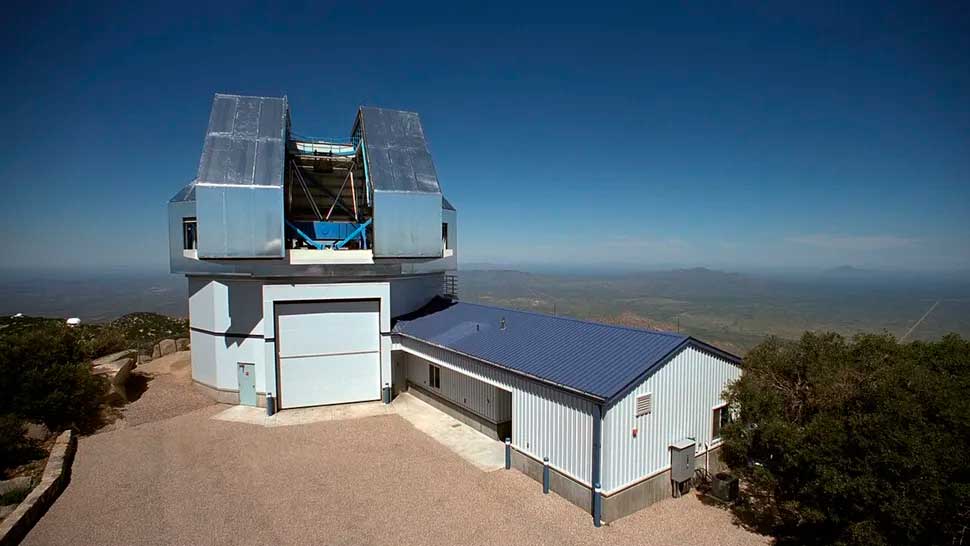
The 3.5-meter WIYN telescope at Kitt Peak National Observatory near Tucson, Arizona, is one of two telescopes used to discover the exoplanet GJ 3378b. NOIRLAB/NSF/AURA
The planet isn’t observed transiting or passing in front of its star, blocking its light from our perspective. Instead, GJ 3378b was discovered through the gravitational pull of its parent star. This causes the star to wobble around the center of mass it shares with the planet, a wobble that manifests itself as a Doppler shift in the star’s light, measured by its spectrum—the wavelength of its light.
When the planet was discovered in 2024, its mass was measured at 5.26 Earth masses, placing it in the mini-Neptune category—a larger, mostly gas planet. However, after studying the planet with two different telescopes, Robertson’s team was able to show that its true mass is 2.3 Earth masses. This means it is closer to a rocky super-Earth.
Furthermore, the same observations revealed that GJ 3378b’s orbital period is 21 days, not 25 days as initially estimated. This means the planet is closer to its star than previously thought and comfortably located in the habitable zone, where temperatures would be suitable for liquid water to exist on the surface of a planet with an atmosphere. Therefore, from this perspective, the likelihood that GJ 3378b is habitable, if not inhabited, seems quite high.
“This super-Earth receives about 90% of the radiation from its star that Earth receives from its sun, so it’s in a prime position,” Robertson said.
One significant problem, however, is that red dwarfs emit harmful streams of radiation in the form of powerful gusts of stellar wind, which can destroy a planet’s atmosphere.
The James Webb Space Telescope (JWST) is studying the atmospheres of other rocky worlds orbiting red dwarfs, such as the planets in the TRAPPIST-1 system. It does this using transit spectroscopy, in which the atmosphere surrounding the planet absorbs some of the star’s light passing through it, leaving dark absorption lines in the star’s spectrum.
Unfortunately, GJ 3378b does not transit its star. This means astronomers will have to wait until the 2040s, when NASA’s Habitable Worlds Observatory is expected to launch, to determine whether GJ 3378b actually has an atmosphere.
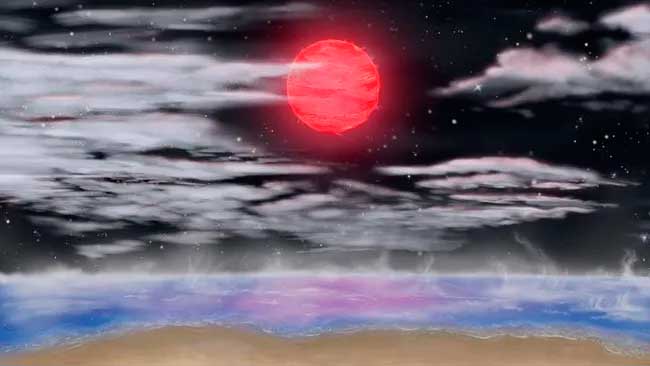
An artist’s impression of the surface of the habitable-zone super-Earth exoplanet GJ 3378b. Nikolai Berman/University of California, Irvine
Nevertheless, astronomers are hopeful. GJ 3378b lies right on the edge of the zone where planets are expected to be severely irradiated, meaning it may have escaped the worst. If so, perhaps the Habitable World Observatory will be able to detect more than just an atmosphere.
“The ultimate goal is to detect biosignatures,” said Michael Endl, an astronomer at the University of Texas at Austin, in a separate statement. “We really want to know: Are we alone in the universe? We’re still in the exploration phase of the outer solar system, trying to find planets around nearby stars, because they’ll be the easiest places to detect biosignatures.”
“This planet brings us one step closer to understanding all of our neighbors and, ultimately, which of them might be habitable.”
Planet candidate HD 137010 b, which may be remarkably similar to Earth, has one potentially important difference: it may be colder than perpetually frozen Mars.
Scientists continue to analyze data collected by NASA’s Kepler space telescope, which was decommissioned in 2018, and continue to make unexpected discoveries. The paper reports the latest: a possible rocky planet, slightly larger than Earth, orbiting a Sun-like star approximately 146 light-years away, according to NASA’s press service.
An international scientific team published a paper on the discovery, titled “A Steep Earth-Size Planet Candidate Transiting a Tenth-Magnitude K-Type Dwarf Star from the K2 Region,” in The Astrophysical Journal Letters on January 27, 2026. The team was led by graduate student astrophysicist Alexander Wenner of the University of Southern Queensland, Toowoomba, Australia, now a postdoctoral fellow at the Max Planck Institute for Astronomy, Heidelberg, Germany. Other authors include several volunteers from the NASA citizen science project Planet Hunters—Hans Martin Schwengeler, Martti H. Christiansen, Mark Omohundro, and Ivan A. Terentev. Wenner also participated in Planet Hunters before defending his doctoral dissertation.
The planet’s orbital period—listed as a “candidate” pending further confirmation—is likely similar to Earth’s, about one year. HD 137010 b may also lie just outside its star’s “habitable zone,” an orbital distance that would allow liquid water to form on the planet’s surface if a suitable atmosphere were present.
An artist’s animated sketch of exoplanet candidate HD 137010 b shows a view as if you were flying over this possible rocky planet, slightly larger than Earth, which is thought to orbit a sun-like star about 146 light-years away. This view also creates a transit-like effect, as the planet’s star disappears and then reappears from behind HD 137010 b. NASA/JPL-Caltech/Keith Miller (Caltech/IPAC)
Planets orbiting other stars are known as “exoplanets.” And this planet may be the first exoplanet with Earth-like properties to cross the disk of a Sun-like star, close enough and bright enough for meaningful follow-up observations.
The amount of heat and light such a planet would receive from its star is less than a third of what Earth receives from the Sun. Although HD 137010 is a star similar to our Sun, it is cooler and dimmer. This could mean the planet’s surface temperature would not rise above minus 90 degrees Fahrenheit (minus 68 degrees Celsius). For comparison, the average surface temperature of Mars is about minus 85 degrees Fahrenheit (minus 65 degrees Celsius).
Further observations will be needed for HD 137010 b to be considered a candidate planet. Exoplanet scientists use a variety of methods to identify planets, and this discovery was the result of a single “transit”—a single instance of a planet crossing the star’s surface in a sort of miniature eclipse—detected during the second Kepler mission, known as K2. Even with just one transit, the study’s authors were able to estimate the candidate planet’s orbital period. They tracked the time it took the planet’s shadow to pass across the star’s surface—in this case, 10 hours, compared to about 13 for Earth—and then compared it to orbital models of the system itself. However, while the precision of this single detection is far higher than that of most transits observed by space telescopes, astronomers need to regularly observe repeats of these transits to confirm that they are caused by a real planet.
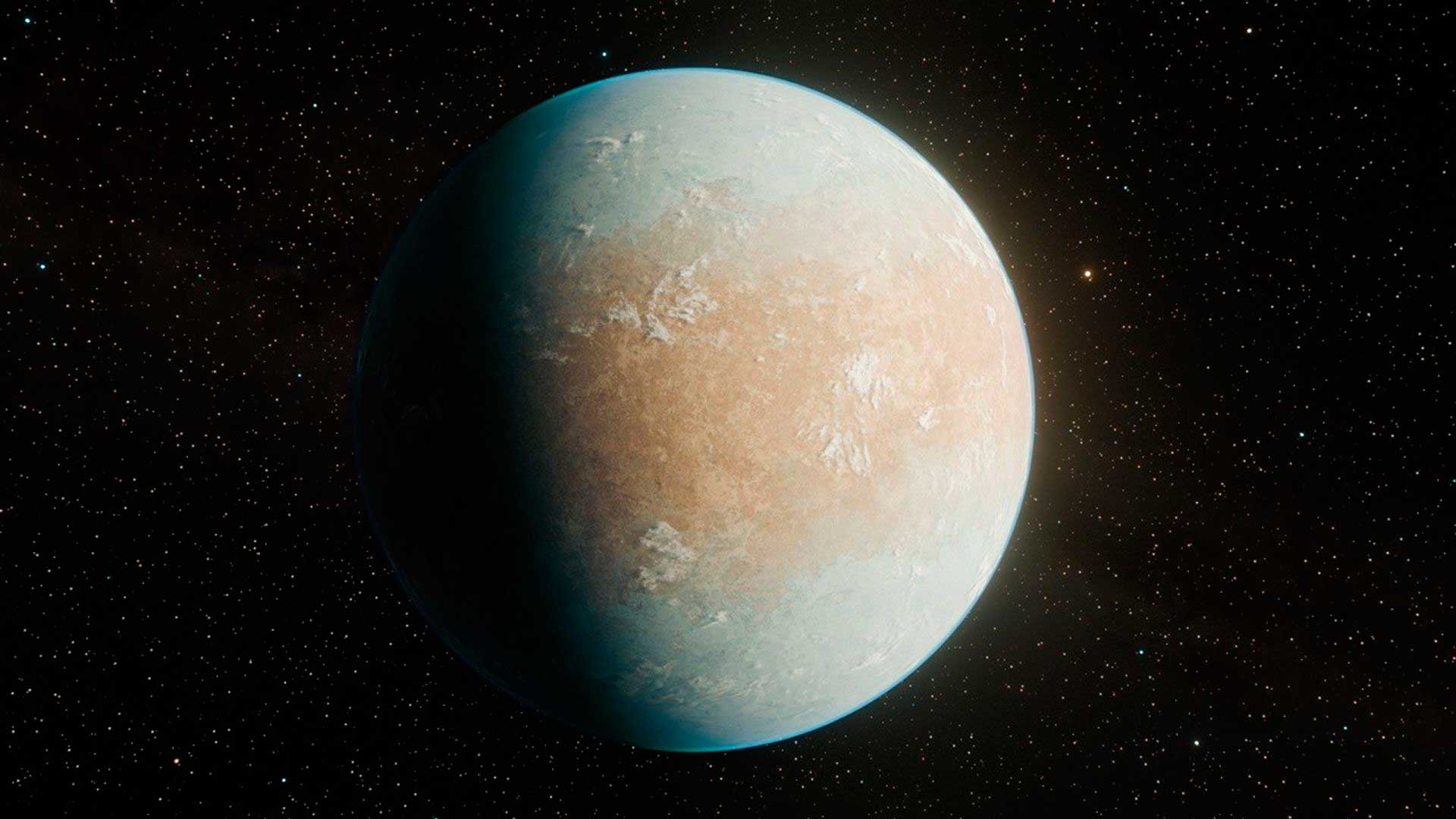
An artist’s impression of the exoplanet candidate HD 137010 b, nicknamed “cold Earth” because it is a possible rocky planet slightly larger than Earth orbiting a Sun-like star about 146 light-years away. NASA/JPL-Caltech/Keith Miller (Caltech/IPAC)
Obtaining more transits will be a challenging task. The planet’s orbital distance, so close to Earth’s, means such transits are much less frequent than those of planets in closer orbits around their stars (this is one of the main reasons why exoplanets with Earth-like orbits are so difficult to detect). With luck, confirmation could come from further observations with Kepler/K2’s successor, NASA’s Transiting Exoplanet Survey Satellite (TESS), the still-operating primary planet-detection instrument, or the European Space Agency’s CHEOPS (CHaracterizing ExOPlanets Satellite). Otherwise, collecting additional data on HD 137010 b may have to wait until the next generation of space telescopes becomes available.
Despite the possibility of a cold climate, HD 137010 b could also be a temperate or even aquatic planet, according to the authors of the paper about this exoplanet. For this, it simply requires an atmosphere richer in carbon dioxide than our own. Based on modeling of possible planetary atmospheres, the scientific team estimates the probability of falling within the “conservative” habitable zone around the star at 40%, and within the broader “optimistic” one at 51%. On the other hand, the authors of the study claim that the planet has approximately a 50% chance of falling entirely outside the habitable zone.
There are several places in our solar system where researchers are also looking for signs of life, and where there are some hints that life may be lurking in unexpected places.
Although Mars doesn’t appear to harbor any “little green men,” microbial life may have existed there in the past. Mars is currently a cold desert, but rovers studying the planet’s rocks indicate that it once held liquid water—an essential prerequisite for life.
In addition to studying the Martian environment, the Perseverance rover collects promising rock samples to return to Earth for in-depth analysis. NASA and ESA are currently developing the Mars Sample Return mission, which envisions a mission to Mars, collecting samples, and returning them to Earth.
Venus, commonly referred to as Earth’s “twin,” is likely not the first place in the solar system to look for life. Its surface temperature is hot enough to melt lead, and the average surface pressure is more than 90 times that of Earth. Venus is shrouded in thick, dense clouds composed primarily of sulfuric acid—an extremely corrosive substance that, when mixed with water, forms acid rain on Earth, harming flora, fauna, and soil.
Despite such harsh conditions, extremophile microbes may be able to survive high in the atmosphere of Venus, where temperatures and pressures are less extreme; perhaps life will find ways to protect itself from the destructive effects of sulfuric acid. To find out, MIT is organizing Morning Star Missions, which will travel to the atmosphere of Venus with the ultimate goal of collecting a sample of the planet’s clouds and returning it to Earth for more in-depth analysis.
When searching for life, scientists often focus on finding liquid water, as it’s essential for life on Earth. Discovering life on Venus would break this limitation, meaning extraterrestrial life could be much stranger than we thought, and there could be many more places to look for it.
In 2020, the possible detection of phosphine in the clouds of Venus sparked debate about signs of life on the planet. Phosphine was a surprising finding, as most known chemical processes that produce it occur in living organisms or under extreme pressure on gas giants. However, the signal was weak, and critics argued that it could be noise in the data. The Morning Star missions to Venus will provide much more information about the planet’s chemistry and may even confirm the presence of phosphine in the clouds.
There are several moons of Saturn and Jupiter orbiting far from the solar system that could potentially support life, including Enceladus and Europa.
Saturn’s moon Enceladus harbors a global subsurface ocean hidden beneath a thick icy crust. The moon continually spews gigantic jets of saltwater into space, giving scientists a rare opportunity to directly probe the interior of a celestial body other than Earth. The Cassini mission made several flybys of Enceladus from 2005 to 2017, collecting images and even direct samples from these jets, the analysis of which is ongoing. A paper published in Nature in 2023 reported the discovery of phosphates on Enceladus, meaning scientists have now discovered all the essential chemical components necessary for life in the moon’s ocean.
ESA and NASA teams are developing several astrobiology missions to Enceladus with the aim of collecting more samples from the plumes, although they are still a long way from the launch pad.
Like Enceladus, Jupiter’s moon Europa is an icy world with a global subsurface ocean and jets of water erupting from its surface. Jupiter’s powerful gravitational pull on the moon provides the energy and propulsion that fuels intense geological activity and is thought to be the primary reason the ocean is warm enough to be liquid. The interaction between the salty ocean and the rocky interior could potentially support life, similar to that found around hydrothermal vents on Earth.
The European Space Agency’s (ESA) Jupiter Icy Moons Explorer (Juice) spacecraft was launched on April 14, 2023, and is expected to arrive at Jupiter in July 2031. There, it will study Jupiter and its three moons: Europa, Callisto, and Ganymede. NASA’s Europa Clipper mission was launched on October 14, 2024. The mission is scheduled to reach Jupiter in 2030 and conduct a flyby of Europa to study the potential for life there.
Titan, another moon of Saturn, is a unique place in the solar system. It has a methane cycle similar to Earth’s water cycle and a dense nitrogen-methane atmosphere. The Cassini mission made more than 50 flybys of Titan from 2004 to 2017 and launched the Huygens probe, which landed on the moon’s surface in 2005. These two missions collected data indicating that Titan’s atmosphere is likely capable of producing complex molecules, the building blocks of life. NASA is developing a car-sized octocopter to fly to Titan and collect samples at various landing sites.
There are many other places in the solar system where life could be found, including dwarf planets like Ceres. Ceres is thought to harbor abundant liquid water beneath its icy and rocky crust, based on images taken by NASA’s Dawn mission, which visited the planet in 2015.
Comment on Facebook* The owner of the Meta company is recognized as extremist in Russia and is banned.See also... Complete list of HTML/Javascript event handlers with examples List of required documents for a website in the Russian Federation |