


The findings suggest that water may not be a rare cosmic coincidence, but rather an inevitable consequence of planet formation, making it far more common in the galaxy than scientists previously thought. Water is life, at least as we know it. All life on Earth uses liquid water, and researchers studying the origins of life believe that the complex chemistry of life likely originated either in a warm pool on the Earth’s surface or near a deep-ocean hydrothermal vent. Therefore, planetary scientists are particularly interested in extraterrestrial locations where liquid water exists. Based on existing exoplanet data, super-Earths and sub-Neptunes are considered the most common classes of planets in our galaxy, and some of them are likely water worlds. However, these planets are large, and the interactions between the water in their oceans and the rocks in their interiors will determine how habitable they might be.
Up to 95% of the exoplanet’s water could be permanently locked deep within its iron core, changing our understanding of water worlds and potentially making them even more habitable than we thought.
“There’s much more water on planets than previously thought,” said Caroline Dorn, a professor of exoplanet science at the Swiss Federal Institute of Technology (ETH Zurich), in a statement. The study’s findings were published on August 20, 2024, in the journal Nature Astronomy.
When planets form through the accretion of debris and collisions with other protoplanets, they heat up so much that their entire surface becomes covered in an ocean of molten rock. This magma cools over time, forming a silicate-rich mantle and a solid crust covering a deep core of molten iron, which forms over time as heavier materials sink toward the planet’s center.
Water is among the materials that make up planets, and in the early stages of a planet’s development, water is present and dissolved in a magma ocean. Previous studies have shown that young planets similar in size and mass to Earth—and therefore with relatively moderate internal pressure and temperature—are capable of attracting water dissolved in magma to their cores. Indeed, one study found that Earth contains at least tens of times more water in its interior than on its surface in the form of our familiar oceans.
A significant portion of the iron is initially contained in the hot magma soup in the form of droplets. Water in the magma can combine with these iron droplets as they descend toward the core. The iron droplets act as a raft, carried downward by the water.
This is good for Earth-sized planets, but many of the rocky exoplanets discovered by astronomers are much larger than Earth. These so-called super-Earths can have masses up to 10 times greater than our planet, but it remains unclear whether such worlds, with their more extreme interior conditions, can extract water from a magma ocean, as happened on Earth.

Rocky planets that once harbored, or perhaps still harbor, magma oceans on their surfaces are capable of drawing large amounts of water into their cores. ESO/L. Calçada
Using computer simulations to understand how water interacts with the molten magma surface of a young, hot, rocky planet, Dorn, along with researchers Haiyang Luo and Jie Deng of Princeton University, answered that question, finding that even on super-Earths, most of the water could end up in its interior.
The larger the planet and the greater its mass, the more water tends to be entrained by iron droplets and integrated into the core. Under certain conditions, iron can absorb up to 70 times more water than silicates. However, due to the enormous pressure in the core, water no longer takes the form of H2O molecules, but rather exists as hydrogen and oxygen.
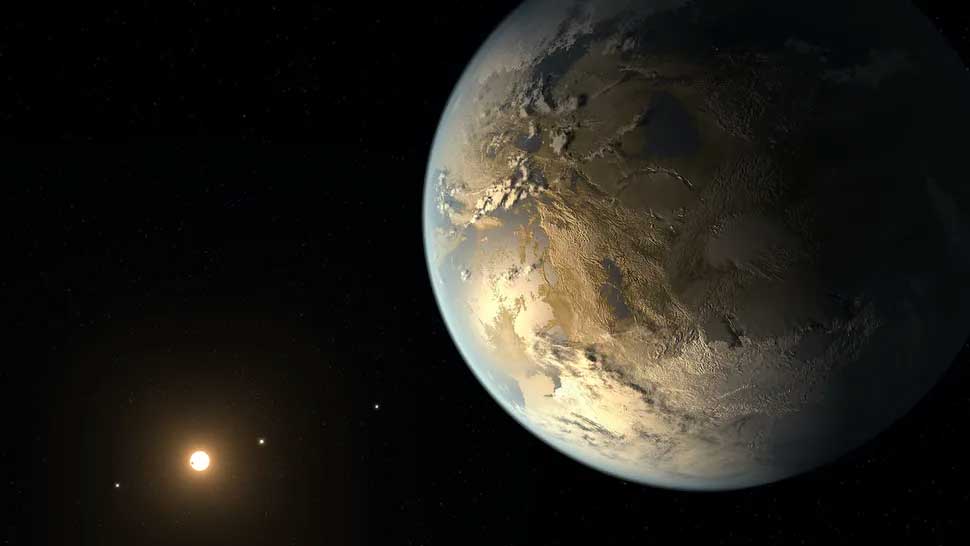
This water is so deep that it’s permanently locked in the planet’s core and impossible to reach, making it useless for life on or near the surface. However, it could contribute to habitability in other ways.
By measuring the mass and radius of exoplanets—using Doppler radial velocity measurements and transits, respectively—we can calculate the density of these worlds (by dividing the planet’s mass by its volume, which is calculated from its radius). The density of some exoplanets suggests that a significant fraction, perhaps up to a quarter of their mass, consists of water.
It was previously assumed that this water existed on the surface as an ocean tens of kilometers deep, but if the new research is correct, most of the water is actually located within the planet. Although water is essential for life, a planet with only water on its surface (and no land) may be uninhabitable. For example, nutrients essential for life are washed off the land into the sea, and this same runoff process is a vital part of the carbon cycle, which maintains the planet’s climate over long periods of time.
Dorn believes that the putative “Gytzean” worlds—named for the combination of the words “hydrogen” and “ocean”—deserve further study to test the theory that water enters the planet’s interior. Gytzean planets have hydrogen-rich atmospheres, but were previously thought to also harbor deep oceans at habitable temperatures.
When a planet’s mantle cools, before oceans form, some of the water dissolved in its rocks can degas and rise to the surface, where it can be released into the atmosphere. Therefore, if we detect water in the planet’s atmosphere, it’s likely that much more of it exists deep within.
In particular, the exoplanet TOI-270d, which orbits a red dwarf star 73 light-years from Earth and has a mass 4.78 times greater than our planet, is of interest to Dorne, who was part of a team that studied its atmosphere with the James Webb Space Telescope and found methane, carbon dioxide and water vapor.
“There was evidence collected there of the actual existence of such interactions of water between the magma ocean in its depths and the atmosphere,” Dorn said.
The ability of water to percolate deep into a planet, rather than pooling on its surface at great depths, means that there is even greater potential for more habitable planets with shallower oceans in the galaxy.
According to a 2025 study, water is delivered to planets not only by comets and asteroids, but can also be formed during the formation of worlds.
For decades, scientists have debated the origin of water on Earth. One long-standing theory suggests that it was delivered by icy bodies from the outer solar system after Earth’s formation, while another posits that the raw materials that make up our planet already contained the necessary components for the formation of water within it. However, until now, this second hypothesis has never been tested in a real laboratory setting.
In a series of high-pressure, high-temperature experiments designed to simulate the fiery beginnings of a young planet, scientists recreated the extreme conditions under which molten rock and hydrogen gas interact on such worlds. These studies demonstrated that liquid water can indeed form naturally during the early stages of planet formation.
The new findings, published October 30, 2025, in the journal Nature, offer fresh insight into one of planetary science’s oldest questions and expand our understanding of where life-sustaining water might exist in space.
“This work demonstrates that large volumes of water form as a natural consequence of planet formation,” said Anat Shahar, a scientist at the Carnegie Institution for Science in Washington and co-leader of the study, in a statement. “This represents an important step forward in our understanding of the search for distant worlds capable of supporting life.”

Artist’s impression of a protoplanetary disk around a newborn star. University of Copenhagen/Lars Buchhave
Of the more than 6,000 exoplanets discovered so far in our Milky Way galaxy, the most common are worlds larger than Earth but smaller than Neptune, known as sub-Neptunes. Although such planets do not exist in our Solar System, scientists hypothesize that these worlds have rocky interiors surrounded by dense, hydrogen-rich atmospheres. As the study notes, this combination makes them ideal for studying how water may have formed during the earliest stages of planetary evolution.
To study this process, Shahar and her team built a miniature version of a sub-Neptune in the lab. Using a device called a diamond anvil, they compressed samples of molten, iron-rich rock between the tips of two diamonds to a pressure nearly 600,000 times greater than Earth’s atmospheric pressure, heating them to over 7,200 degrees Fahrenheit (4,000 degrees Celsius)—temperatures comparable to those observed deep within the molten planet, according to the statement.
See also... New method for observing individual atoms confirms century-old quantum mechanical theory |
Scientists argue that this model simulated a crucial stage in planet formation, when newly formed worlds orbiting young stars are enveloped in a dense layer of hydrogen gas. This hydrogen acts as a “thermal blanket,” trapping heat and maintaining magma oceans in a molten state for millions—or even billions—of years, during which the gas and molten rock can interact.
Under these hellish conditions, researchers discovered that hydrogen readily dissolves in molten rock, where it reacts with iron oxides to form significant amounts of water. These results suggest that water can form as a natural byproduct of chemical reactions between rocks and gases, without requiring delivery from comets, asteroids, or other external sources.
The findings suggest that water may not be a rare cosmic coincidence, but rather an inevitable consequence of planet formation, making it much more common in the galaxy than scientists previously thought.
Although there are liquid oceans on Earth’s surface, water makes up only 0.2% of the planet’s mass. Meanwhile, some planets and moons can be up to 50% water, meaning their oceans can reach hundreds or even thousands of kilometers in depth.
Scientists first learned that Jupiter’s moon Europa likely harbored a liquid ocean beneath its icy shell during NASA’s Galileo mission, launched in 1989. For nearly eight years, the Galileo spacecraft orbited Jupiter, where it observed interactions between Europa and Jupiter’s magnetic field that indicated the presence of water within the moon.
The Europa Clipper mission has set off for Europa to determine whether it is habitable. This marks the first time a spacecraft has visited a watery world. Researchers are particularly interested in the mixing of water and rock deep within Europa, where nutrients and chemical compounds could support microbial life, similar to the hydrothermal vents that support life on Earth.

Jupiter’s moon Europa, as imaged by the JunoCam instrument on NASA’s Juno spacecraft during a close flyby of the mission on September 29, 2022. NASA/JPL-Caltech/SwRI/MSSS. Björn Jönsson (CC BY 3.0)

Europa is an intriguing water world, likely harboring a liquid ocean beneath its surface. Tobias Rötzsch/Future
Callisto, Jupiter’s second-largest moon, may also harbor a subsurface liquid ocean. Callisto has the most heavily cratered surface in the solar system, suggesting the moon lacks any geological processes or weathering. However, approximately 250 kilometers below the surface, a salty ocean may interact with a layer of rock, potentially creating habitable conditions deep within the moon. Oxygen has also been detected in Callisto’s exosphere, the uppermost region of the moon’s thin atmosphere.

Callisto as seen by NASA’s Galileo spacecraft. NASA/JPL/DLR
In 2015, scientists using the Hubble Space Telescope discovered that Jupiter’s largest moon, Ganymede, likely also harbors an internal ocean of liquid water. Ganymede has its own magnetic field, which generates auroras at its magnetic poles. Observations of Ganymede’s auroras revealed that the internal ocean of liquid water likely dampens the fluctuations of Ganymede’s magnetic field as it interacts with Jupiter’s magnetic field.
Ganymede’s ocean is thought to be 60 miles (100 km) thick, nearly 10 times the thickness of Earth’s ocean. Ganymede and the other Galilean moons likely formed from materials similar to those that surrounded Jupiter during the early stages of the solar system’s formation, explaining why each of these moons likely contains relatively large amounts of water.

This image was taken by NASA’s Juno spacecraft during its flyby of Ganymede on June 7, 2021. NASA/JPL-Caltech/SwRI/MSSS
Enceladus, a small icy moon of Saturn, is one of the most interesting places in the Solar System where planetary scientists have discovered water. This is because icy geysers on Enceladus’s surface spew water and ice into space, allowing researchers to directly sample materials from the moon’s interior.
This water and ice are ejected from the internal ocean, and in 2005, the Cassini spacecraft detected these materials being ejected from the moon’s surface at speeds of approximately 800 miles per hour (1,300 km/h). Warm hydrothermal vents are also believed to provide the lunar ocean with minerals and nutrients crucial for life.

Global infrared map of Enceladus. NASA/JPL-Caltech/University of Arizona/LPG/CNRS/University of Nantes/Institute of Space Studies
Saturn’s largest moon, Titan, is unlike anything else in the solar system. Its surface is covered with lakes, rivers, seas, clouds, and rain composed of the hydrocarbons methane and ethane. Beneath Titan’s icy crust, an internal ocean of liquid water is thought to harbor life. Its surface may also harbor life forms completely different from anything found on Earth, as they may use different chemical pathways to generate energy.
Although Titan’s chemical composition is very different from Earth’s, this large moon has characteristics conducive to habitability, such as a thick atmosphere and dynamic geological and weathering processes.

Titan as seen by the Cassini spacecraft. NASA/JPL-Caltech/University of Nantes/University of Arizona
In 2022, using data from NASA’s Transiting Exoplanet Survey Satellite, an international team of researchers discovered the exoplanet TOI-1452 b. The planet is approximately 1.6 times larger than Earth and is classified as a super-Earth. It is five times more massive than Earth, and its density may indicate that a significant portion of the planet—potentially 30%—is composed of water.
TOI-1452 b, located approximately 100 light-years from Earth, is a prime candidate for further observations with the James Webb Space Telescope (JWST).

An artist’s impression of the star TOI-1452b orbiting one of the red dwarf stars in a binary system. Benoit Goujon, Université de Montréal
In July 2024, researchers using the JWST telescope observed the atmosphere of the exoplanet LHS-1140 b, which may support a liquid ocean on its surface. The planet orbits a red dwarf star five times smaller than the Sun and is located 48 light-years from Earth.
Additional data from the JWST telescope indicate that the planet may be 10-20% liquid water. LHS-1140 b orbits the star with the same side always facing the star. Furthermore, current models suggest that the planet may be a giant snowball, implying the presence of a “centered” ocean on the side that always faces the star.

An artist’s impression of the super-Earth LHS-1140 b. ESO/spaceengine.org
Two possible water-bearing worlds, Kepler-138 c and Kepler-138 d, orbit a red dwarf star 218 light-years from our Solar System. In 2022, researchers discovered that the apparent densities of these planets indicate that they may be composed of a large percentage of water.
Researchers believe that up to half of the materials composing these planets must be lighter than rock but heavier than hydrogen or helium. The most common component in the universe that meets these criteria is water.

An artist’s impression of the Kepler-138 planetary system. In this image, the super-Earth Kepler-138d is in the foreground. Kepler-138c is on the left, and Kepler-138b is seen in silhouette in the background, passing in front of its central star. NASA, ESA, Leah Hustak (STScI)
In 2014, astronomers discovered water vapor on a Neptune-sized planet located 124 light-years from Earth. The exoplanet, designated HAT-P-11 b, orbits close to its star and completes an orbit in just five days. It is a scorching planet with surface temperatures reaching over 1,000 degrees Fahrenheit (530 degrees Celsius) and is believed to have a rocky core and a gaseous atmosphere of water vapor, rich in hydrogen.
Researchers detected water in the atmosphere of HAT-P-11 b using a technique called transmission spectroscopy. When an exoplanet passes by its star (from our perspective), the star’s light passes through the exoplanet’s atmosphere. Various atmospheric particles absorb some of the starlight at specific wavelengths. By analyzing which wavelengths are absorbed, scientists can determine the chemical composition of the atmosphere.

Artist’s impression of HAT-P-11 b passing in front of its host star. NASA, ESA, and R. Hurt (JPL-Caltech)
In 2019, water vapor was detected in the atmosphere of K2-18 b, a super-Earth located 110 light-years from the Solar System. This exoplanet orbits a red dwarf star and is thought to be at the ideal distance for liquid water to exist on its surface. However, planetary scientists are still unsure whether this planet is a rocky world or a giant ball of liquid and gas.

K2-18 b has been shown to contain water and may have temperate conditions capable of supporting life. ESA/Hubble, M. Kornmesser
See also... Complete list of HTML/Javascript event handlers with examples List of required documents for a website in the Russian Federation |

