The Milky Way’s halo contains a large group of stars with unusual orbits, many of which are believed to have been engulfed by our galaxy during an event astronomers call the “last major merger.” As the name suggests, this was the last time our galaxy experienced a significant collision with another galaxy—presumably a massive dwarf galaxy that flooded the Milky Way with stars passing very close to our galaxy’s center.
Our galaxy has collided with many others throughout its history. The European Space Agency’s (ESA) Gaia space telescope now shows that the most recent of these collisions occurred billions of years later than previously thought.
The Milky Way expanded over time as other galaxies approached our galaxy, collided with it, were torn apart, and were absorbed into it. Each collision caused changes that are still felt in various families of stars, influencing their motion and behavior in space.
One of Gaia’s goals is to unravel the history of our galaxy by studying these “warps” – and it does this by precisely determining the positions and motions of more than 100,000 stars near our own, which is only a tiny fraction of the roughly two billion sources it observes, the European Space Agency’s press service announced on June 6, 2024.
“We get more wrinkles as we age, but our work shows that the Milky Way is the opposite. It’s a kind of cosmic Benjamin Button, becoming less wrinkled over time,” says Thomas Donlon of Rensselaer Polytechnic Institute and the University of Alabama in Huntsville, USA, lead author of the new Gaia study. “By studying how these wrinkles fade over time, we can trace back to when the Milky Way experienced its last major collapse—and it turns out it happened billions of years later than we thought.”
These galactic folds were discovered by the Gaia telescope only in 2018. This study, for the first time, accurately determined the timing of the collision that formed these folds by comparing observations with cosmological models. Details of this study can be found in the paper by Donlon et al. (2023), “Debris from the ‘Last Major Merger’ Is Dynamically Young,” in the journal Monthly Notices of the Royal Astronomical Society.
The Milky Way’s halo contains a large group of stars with unusual orbits, many of which are believed to have been engulfed by our galaxy during an event astronomers call the “last major merger.” As the name suggests, this was the last time our galaxy experienced a significant collision with another galaxy—presumably a massive dwarf galaxy that flooded the Milky Way with stars passing very close to our galaxy’s center.
Scientists dated this merger to between eight and eleven billion years ago, when the Milky Way was in its infancy, and it is known as the Gaia-Sausage-Enceladus (GSE) merger. But Gaia data, published as part of the telescope’s third data release in 2022, now suggest that a different merger may have been responsible for these unusually moving stars.
“For stellar folds to be so clearly visible in the Gaia data, they must have appeared on Earth less than three billion years ago—at least five billion years later than previously thought,” adds co-author Heidi Jo Newberg of Rensselaer Polytechnic Institute. “New stellar folds form every time stars move back and forth across the center of the Milky Way. If they had appeared on Earth eight billion years ago, there would be so many of them next to each other that we would no longer see them as separate objects.”
The Milky Way has expanded over time as other galaxies collided with and were absorbed by our galaxy. Each collision caused folds that are still felt today in different families of stars, influencing their motion and behavior in space. The European Space Agency’s (ESA) Gaia space telescope aims to unravel the history of our galaxy by studying these folds, and new research from this mission suggests that the last of these galactic collisions occurred billions of years later than previously thought. This animation shows the merger, which began about 9.7 billion years ago and continues almost to the present day. The spiral Milky Way is shown in the center of the frame, and two prominent satellite galaxies (the Large and Small Magellanic Clouds) are visible at the lower right. The image shows a red cloud of stars moving across the frame—this is a dwarf galaxy that collided with the Milky Way. The collision tears the galaxy apart. About 7 billion years ago, the animation upscaling shows a “cloud” of new stars being drawn into the Milky Way from the colliding dwarf galaxy. These stars create a “halo” around our galaxy—a large stellar component extending in all directions (this halo is visually enhanced in this simulation, but in reality it is very faint compared to the galactic disk). Shortly after the collision, the galaxy’s interior appears scruffy and wrinkled, but over time it becomes smooth. Gaia observes these wrinkles to trace and rewrite the history of the Milky Way. The space telescope is uniquely positioned to study the countless stars in our sky and has collected an unrivaled dataset on the positions, distances, and motions of approximately 1.5 billion stars. A new Gaia discovery shows that the folds we see in the Milky Way likely resulted from a collision between a dwarf galaxy and the Milky Way around 2.7 billion years ago – in other words, most of the Milky Way only merged with us within the last few billion years, ESA
The findings suggest that these stars were formed not by an ancient GSE merger, but by a more recent event called the Virgo Radial Merger, which occurred less than three billion years ago.
There is evidence that a GSE merger occurred in the Milky Way’s distant past. However, recent studies have questioned whether a large, ancient merger is necessary to explain the properties of the Milky Way as we see it today, and whether all the stars originally associated with the GSE actually originated from the same merger event.

In 2020, Thomas led a study that identified stellar folds in the Milky Way and compared them with simulations of various possible mergers. “We can see how the shape and number of folds change over time using these simulated mergers. This allows us to pinpoint the time when the simulation best matches what we see in real Gaia data of the Milky Way today—a method we also used in this new study,” says Thomas. “Thus, we found that the folds were likely caused by a collision between a dwarf galaxy and the Milky Way about 2.7 billion years ago. We called this event the Virgo radial merger.”
Since then, Thomas and his colleagues have continued to study this merger, gradually refining the idea that many of the strangely moving stars and debris in the Milky Way’s inner halo were delivered to our galaxy by a much more recent galaxy collision than the GSE merger. They also clarified that the stars initially associated with the GSE merger may have arisen from multiple mergers, some of which occurred in ancient times.
“The history of the Milky Way is currently being constantly rewritten, thanks in large part to new data obtained by the Gaia satellite,” Thomas adds. “Our understanding of the Milky Way’s past has changed dramatically compared to even ten years ago, and I think our understanding of these mergers will continue to evolve rapidly.”
“This result—that a significant portion of the Milky Way merged with us only in the last few billion years—is significantly different from what astronomers had previously assumed. Many popular models and ideas about how the Milky Way grows assumed that a recent head-on collision with a dwarf galaxy of such mass would be an extremely rare event.”
It’s likely that the Virgo radial merger brought with it a family of other small dwarf galaxies and star clusters that joined the Milky Way around the same time. Further research will reveal which of these smaller objects, previously thought to be associated with the ancient radial merger, are actually associated with the more recent Virgo radial merger.
This discovery adds to the growing body of data obtained by the Gaia telescope, which is rewriting the history of our cosmic home. The space telescope has unique capabilities for studying the countless stars in our sky and has, to date, collected an unrivaled data set on the positions, distances, and motions of approximately 1.5 billion stars.
“Gaia is an incredibly productive mission that is changing our understanding of space,” says Timo Prusti, ESA’s Gaia Project Scientist. “These results are made possible by the incredible teamwork and collaboration of countless scientists and engineers across Europe and beyond.”
“This discovery expands our knowledge of the many complex processes that shaped the Milky Way and helps us better understand how galaxies form and change, particularly our own.”
The European Space Agency’s (ESA) Gaia space telescope was launched on December 19, 2013, and has been observing the sky since 2014. During this time, the mission has turned our understanding of the Milky Way upside down, revealing its shape and structure and showing how mergers have affected the stars that populate our galaxy. You can read more about some of the telescope’s key achievements here.
A story of survival is unfolding on the outskirts of our galaxy, and NASA’s Hubble Space Telescope is also witnessing this saga.
The Large Magellanic Cloud, also known as the LMC, is one of the Milky Way’s closest neighbors. This dwarf galaxy occupies a prominent position in the southern night sky, with an apparent diameter 20 times larger than the full Moon.
Many researchers speculate that the Large Magellanic Cloud (LMC) is not orbiting our galaxy, but merely passing by. These scientists believe the LMC has just completed its closest approach to the much more massive Milky Way. As a result of this encounter, much of the spherical gas halo surrounding the LMC was swept away, NASA’s press service reported.
Astronomers have now measured the size of the halo of the Large Magellanic Cloud (LMC) for the first time—something they had previously only been able to do with the Hubble Space Telescope. In a 2025 study published in The Astrophysical Journal Letters, the researchers were surprised to discover that it is incredibly small—about 50,000 light-years across. This is approximately 10 times smaller than the halos of other galaxies with masses similar to the LMC. Its compactness tells the story of its collision with the Milky Way.
“The Large Magellanic Cloud is a marvel,” said Andrew Fox of the European Space Agency’s AURA/STScI in Baltimore, who was the principal investigator for these observations. “Even though it has lost most of its gas, it still has enough left to continue forming new stars. Therefore, new star-forming regions could still be created. A smaller galaxy wouldn’t have survived for long—there would be no gas left, just a cluster of aging red stars.”
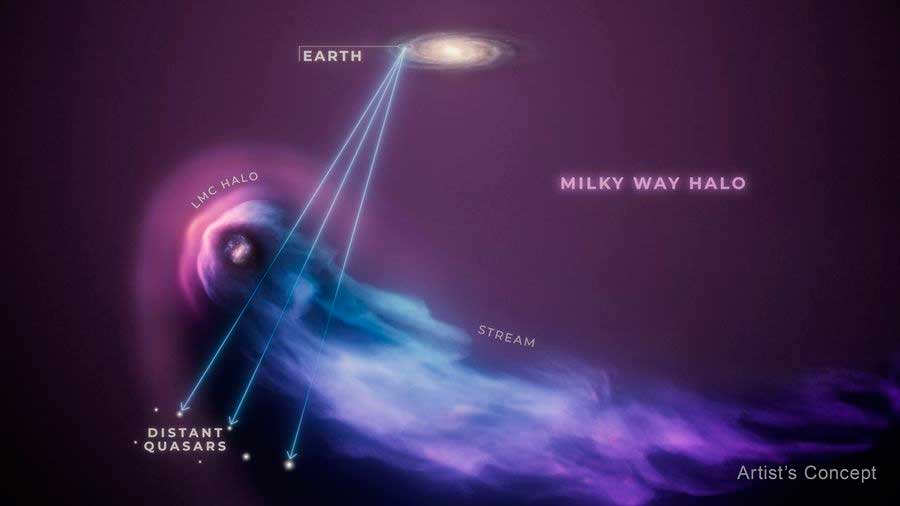
In this artist’s impression, the Large Magellanic Cloud (LMC) is shown in the foreground, passing through the gas halo of the much more massive Milky Way galaxy. The collision swept away much of the spherical gas halo surrounding the LMC, as evidenced by a gas plume resembling a comet’s tail. However, a compact halo remains, and scientists don’t expect this remnant halo to be lost. The team studied the halo using the background light of 28 quasars—an exceptionally bright type of active galactic nucleus that shines throughout the universe like a beacon. Their light allows scientists to “see” the intervening halo gas indirectly, through the absorption of background light. The lines represent the Hubble Space Telescope’s view from its orbit around Earth of distant quasars through the LMC gas. NASA, ESA, Ralph Crawford (STScI)
Despite significant damage, the Large Magellanic Cloud (LMC) still retains a compact, short halo of gas—something it wouldn’t be able to hold gravitationally if it were less massive. The LMC’s mass is 10 percent that of the Milky Way, making it heavier than most dwarf galaxies.
“Because of the Milky Way’s gigantic halo, the gas in the Large Magellanic Cloud (LMC) is truncated, or ‘quenched,'” explained Sapna Mishra of STScI, lead author of the paper describing the discovery. “But even with this catastrophic interaction with the Milky Way, the LMC manages to retain 10 percent of its halo thanks to its large mass.”
Much of the Large Magellanic Cloud’s halo was swept away by a phenomenon called dynamic pressure compression. The dense Milky Way resists the approaching Large Magellanic Cloud, creating a gas trail that trails behind the dwarf galaxy, like a comet’s tail.
“I like to think of the Milky Way as a giant hair dryer, blowing gas off the Large Magellanic Cloud as it approaches us,” Fox said. “The Milky Way is pushed away with such force that the dynamic pressure tears away most of the original mass of the Large Magellanic Cloud’s halo. Only a small piece remains, and that’s the small, compact remnant we see today.”
As dynamic pressure pushes away most of the Large Magellanic Cloud’s halo, the gas will slow down and eventually fall into the Milky Way. But since the Large Magellanic Cloud has just passed its closest approach to the Milky Way and is once again moving into deep space, scientists don’t expect the entire halo to be lost.
To conduct this study, a team of scientists analyzed ultraviolet observation data from the Mikulsky Space Telescope Archive at the S.T.S. Most ultraviolet radiation is blocked by the Earth’s atmosphere, making it impossible to observe with ground-based telescopes. Hubble is the only modern space telescope configured to detect these wavelengths of light, making this study possible thanks to Hubble.
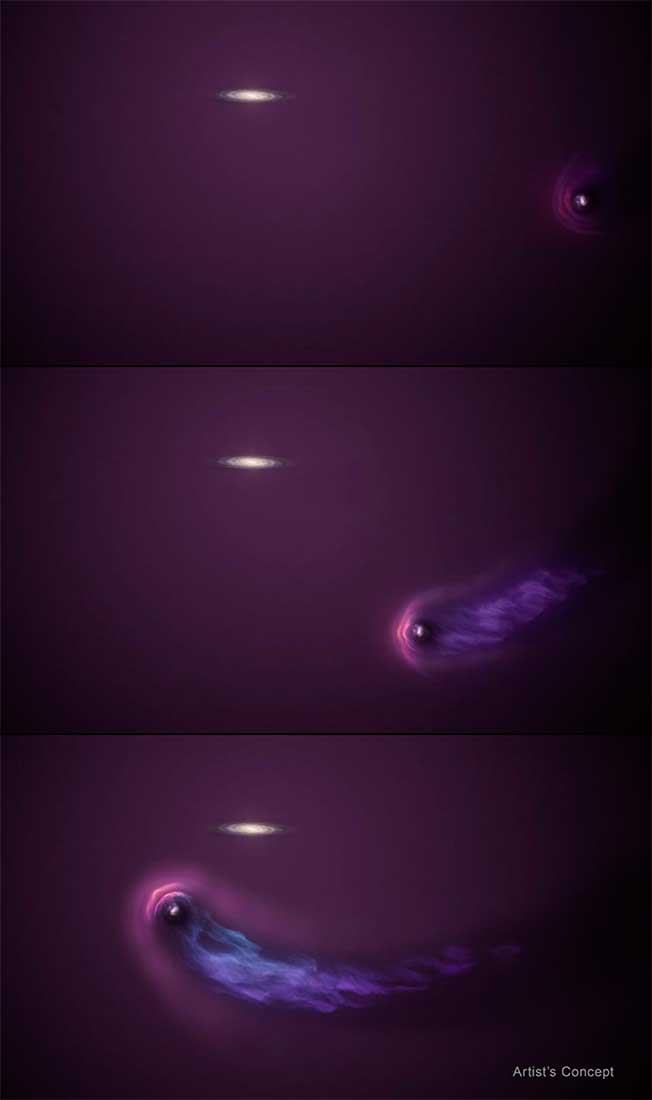
This artist’s concept depicts the collision of the Large Magellanic Cloud (LMC) with the gaseous halo of the Milky Way galaxy. In the top figure, in the middle right, the LMC begins to plow through our galaxy’s much more massive halo. The bright purple shock front represents the leading edge of the LMC halo, which is compressed as the Milky Way halo is repelled by the approaching LMC. In the middle figure, a portion of the halo is torn off and ejected back into the gas stream that will eventually crash into the Milky Way. The bottom figure shows the progression of this interaction, as the LMC’s comet-like tail becomes more pronounced. What remains is the compact halo of the LMC. Because the LMC has just passed its closest approach to the Milky Way and is moving again into deep space, scientists do not expect the remnant halo to be lost. NASA, ESA, Ralph Crawford (STScI)
The research team studied the halo using the background light of 28 bright quasars. Quasars, the brightest type of active galactic nuclei, are thought to be powered by supermassive black holes. Shining like beacons, they allow scientists to “see” the halo gas indirectly by absorbing the background light. Quasars are found throughout the universe at extreme distances from our galaxy.
Scientists used data from the Hubble Space Telescope’s Cosmic Origins Spectrograph (COS) to detect the presence of gas in the halo by observing how it absorbs certain colors of light from background quasars. The spectrograph breaks down light into its component wavelengths to reveal signatures of an object’s state, including its temperature, velocity, abundance, distance, and composition. Using COS, they measured the velocity of the gas around the Large Magellanic Cloud, allowing them to determine the size of the halo.
Due to its mass and proximity to the Milky Way, the Large Magellanic Cloud is a unique astrophysical laboratory. Observing the interactions of the Large Magellanic Cloud with our galaxy helps scientists understand what happened in the early universe when galaxies were closer to each other. It also reveals the complexity and intricacy of galaxy interactions.
See also... New method for observing individual atoms confirms century-old quantum mechanical theory |
The Hubble Space Telescope has been operating for more than three decades and continues to make groundbreaking discoveries that shape our fundamental understanding of the universe. Hubble is a project of international collaboration between NASA and ESA (the European Space Agency). NASA’s Goddard Space Flight Center in Greenbelt, Maryland, manages the telescope and mission operations. Lockheed Martin Space, based in Denver, Colorado, also supports mission operations at Goddard. The Space Telescope Science Institute in Baltimore, Maryland, which is run by the Association of Universities for Research in Astronomy, conducts Hubble science operations for NASA.
Observations of the collision of two spiral galaxies suggest what might happen to the Milky Way and the Andromeda Galaxy if and when they collide.
The results of the study, described in the July 2025 issue of the journal Monthly Notices of the Royal Astronomical Society, may also help solve a mystery that has plagued the standard model of cosmology.
The two colliding galaxies, NGC 5713 and NGC 5179, are located 88 million light-years from Earth. Currently, the distance between them is approximately 300,000 light-years, although this distance is steadily decreasing as they move closer to each other.
They are surrounded by numerous satellite galaxies. In the standard cosmological model, these satellite galaxies are the remaining building blocks that were assembled by a massive dark matter halo to form larger galaxies long ago. According to the theory, each dwarf galaxy should orbit its parent galaxy through the dark matter halo in a random trajectory, and together they should create a cloud of satellites around the main galaxy, like a swarm.
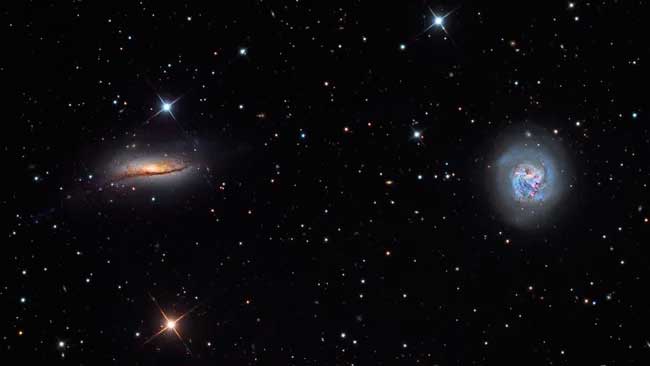
Dwarf galaxies NGC 5719 and NGC 5713, as seen from the Mount Lemmon SkyCenter at the University of Arizona. Adam Block/Mount Lemmon SkyCenter/University of Arizona/CC BY-SA 3.0 US
However, observations show that many galaxies do not behave this way. For example, many dwarf galaxies in the Milky Way orbit it in a single direction along a narrow plane. Observations with the Hubble Space Telescope have shown that the dwarf galaxies of Andromeda—the closest large galaxy to the Milky Way—also rotate within their own plane. Dwarf galaxies in other galaxies, such as Centaurus A—formed by a major merger of two larger galaxies—also orbit within a single plane.
New observations of NGC 5713 and NGC 5719 have shown for the first time that the cloud of dwarf satellites is transitioning into a thinner orbital plane.
Fourteen dwarf galaxies have been confirmed in the NGC 5713/5719 system after velocity measurements showed they orbit their host galaxies. Another 18 candidates await confirmation, and there are likely many more galaxies too dim to be detected. Observations show that the 14 confirmed dwarf galaxies are divided into two subgroups associated with the two larger galaxies, but they appear to orbit them in the same direction and plane.
Sweet leads a research program called Delegate, in which researchers from Australian institutions are studying how representative the galaxies of our Local Group, particularly the Milky Way and Andromeda, are of galaxies elsewhere in the Universe.
Our galaxy and Andromeda are moving toward each other. They are still 2.5 million light-years apart, but in about 4 billion years they will come very close. A recent analysis showed that while Andromeda has only a 50% chance of colliding with the Milky Way during their first encounter within the next 10 billion years, gravity will eventually cause them to collide again and merge.
Astronomers are trying to determine whether this merger will be similar to other mergers we’ve observed in the universe, or whether the Milky Way and Andromeda are different from other galaxies. Because NGC 5713 and NGC 5719 are in the later stages of their collision, they offer an excellent example for study.
Astronomers led by Helmut Jerjen of the Australian National University considered several explanations for why the orbits of dwarf galaxies around NGC 5713 and NGC 5719 are transformed into a flattened, aligned plane. The best explanation is that the two satellite systems, following their host galaxies, collided with each other along the Bootes band—a vast filament of dark matter in the cosmic web. When the two galaxies began interacting, the gravitational dynamics of the Bootes band and the two galaxies led to the formation of the satellite plane.
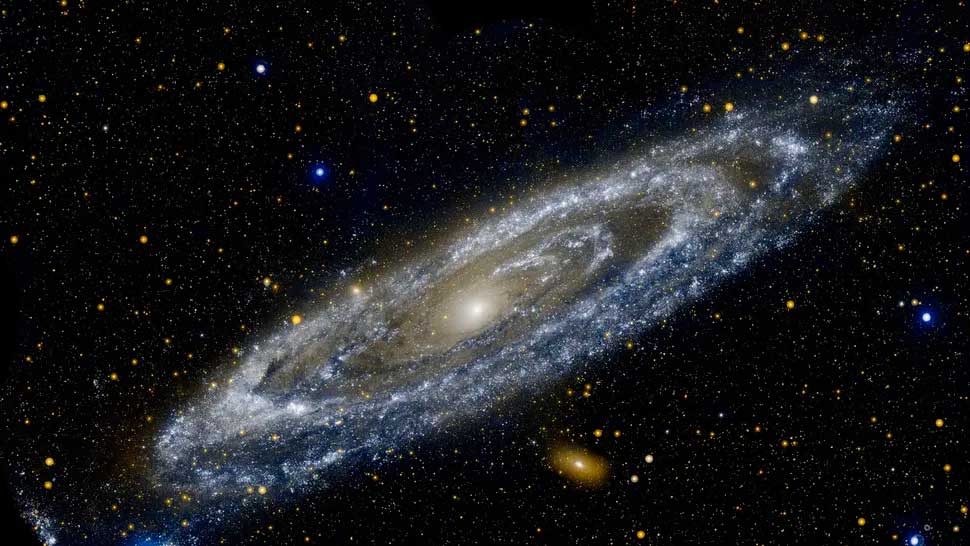
Andromeda Galaxy. NASA/JPL-Caltech
Cosmological models based on the standard model, in which dark matter is a crucial component, struggle to simulate galaxies with satellite planes around them. This leaves two options: either the models need updating, or the standard cosmological model is incorrect. While some researchers propose an alternative theory of gravity, called modified Newtonian dynamics, to replace dark matter, others believe the models are insufficiently accurate and require adjustment. Data from NGC 5713/5719 suggest this may be the case.
However, the existence of satellite planes around the Milky Way and Andromeda remains a mystery, as the galaxies are still too far apart for a process similar to that in NGC 5713/5719 to have occurred. Other mergers may have occurred in the past; the Hubble Space Telescope has observed signs that Andromeda experienced a significant collision and merger with another galaxy within the last few billion years. The Milky Way is a major enigma; its last major merger occurred between 8 and 11 billion years ago.
“Large mergers like this are one possible way to form satellite planes like those we see around the Milky Way and Andromeda, but it’s still a mystery because we don’t often see this kind of structure in the best cosmological models,” Sweet said. “Other explanations might be that dwarf stars form in situ, or fall along filaments, or a combination of both.”
Careful observations with the Hubble Space Telescope are gradually allowing us to reconstruct the motion of dwarf galaxies around Andromeda, and it is estimated that another five years of research will allow astronomers to trace the orbits of these dwarf galaxies and understand how they arrived at their current plane. And by continuing to observe other galaxies, we will be able to learn more about how our own galaxy functions.
Comment on Facebook* The owner of the Meta company is recognized as extremist in Russia and is banned.See also... Complete list of HTML/Javascript event handlers with examples List of required documents for a website in the Russian Federation |