


The three-body problem is a notoriously difficult puzzle in physics and mathematics, and an example of how complex the natural world is. Two objects orbiting each other, like a lonely planet around a star, can be described with just a line or two of mathematical equations. However, add a third body, and the math gets much more complicated. Since each object influences the others with its gravity, calculating a stable orbit in which all three objects coexist is a difficult task.
An international team of mathematicians claims to have found 12,000 new solutions to this infamous problem — a significant addition to the hundreds of previously known scenarios. Their work has been published as a preprint on the arXiv database.
More than 300 years ago, Isaac Newton wrote down his fundamental laws of motion, and mathematicians have been working on solutions to the three-body problem almost ever since. There is no single correct answer; instead, there are many orbits that can work within the laws of physics for three rotating objects.

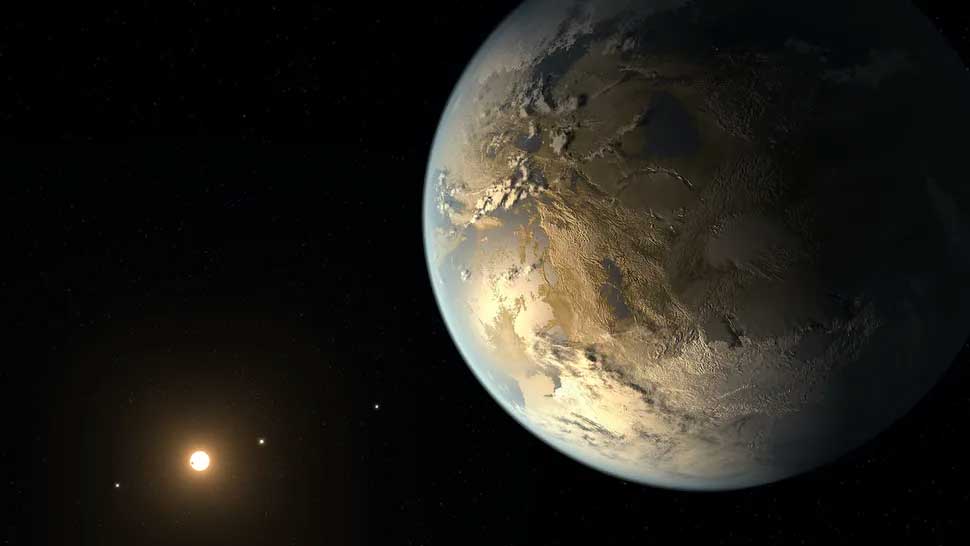
One planet orbiting a star, no problem. Two or more planets orbiting a star? That’s one of the biggest problems in astrophysics. NASA
Unlike our planet’s simple loop around the sun, the orbits for the three-body problem can look twisted and tangled, like pretzels and scribbles. The 12,000 recently discovered ones are no exception — the three hypothetical objects start from a standstill and, when released, are pulled into different spirals toward each other by gravity. They then zip past each other, moving further and further away, until gravity takes over and they come back together, repeating the pattern over and over.
The orbits “have a very beautiful spatial and temporal structure,” lead author Ivan Hristov, a mathematician at Sofia University in Bulgaria, told New Scientist. Hristov and his colleagues found the orbits using a supercomputer, and he believes that with even better technology he could find “five times more.”
See also... New method for observing individual atoms confirms century-old quantum mechanical theory |
Three-body systems are quite common in the universe; there are many star systems with multiple planets or even multiple stars orbiting each other. In theory, these new solutions could prove extremely valuable to astronomers trying to explain the cosmos. But they are only useful if they are stable , meaning the orbital patterns can repeat over time without breaking up and throwing one of the component worlds into space . Just because they are theoretically stable does not mean they will withstand the many other forces present in a real star system.
“Their physical and astronomical significance will become more clear after studying their stability – this is very important,” said Khristov.
Johan Frank, an astronomer at Louisiana State University who was not involved in the work, is sceptical that these orbits will be stable. “They will probably never be realized in nature,” he told New Scientist. “After a complex yet predictable orbital interaction, such three-body systems typically break up into a binary system and a runaway third body, usually the least massive of the three.”
But be that as it may, these solutions are a mathematical miracle. According to Khristov, “whether stable or unstable, they are of great theoretical interest.”
See also... Complete list of HTML/Javascript event handlers with examples List of required documents for a website in the Russian Federation |
No related posts found...

