


In 2024, archaeologists discovered a huge observatory in Egypt, which they say is the largest ever found and dates back to the sixth century BC. Several stones with sundials and inscriptions related to astronomy were found at the site.
During excavations of a temple in the ancient capital of Lower Egypt, what appears to be a record-breaking ancient astronomical “observatory” equipped with a sundial was discovered.
The mud-brick temple building was found within a larger complex now known as the Buto Temple but named after Wadjet in the sixth century BC, from which it dates.
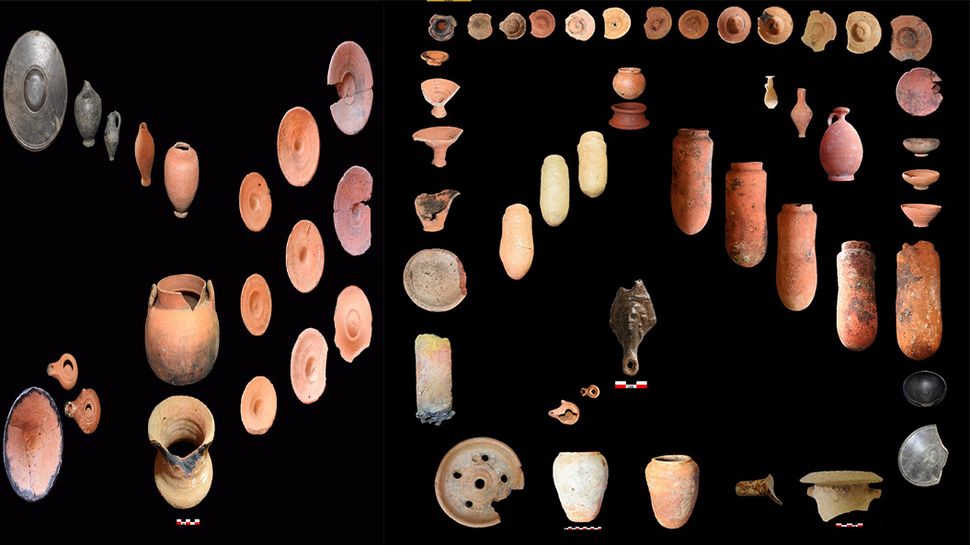
Various artifacts have been found at a 6th-century BCE temple in Buto, Egypt, which may be linked to an astronomical observatory. Egyptian Ministry of Tourism and Antiquities
The building covers more than a quarter of an acre (850 square meters), making it the first and largest observatory building from the sixth century B.C., according to the study. It was used to “observe and record astronomical observations and the movements of the sun and stars,” Egypt’s Ministry of Tourism and Antiquities said.

Temple astronomers of that era carried out their work during an unstable time, during the transition to the late phase of Egyptian pharaonic power, in which many foreign rulers occupied the throne. The newly discovered observatory is part of a larger excavation at modern Tell el-Fara’in, about 50 miles (80 kilometers) east of Alexandria.
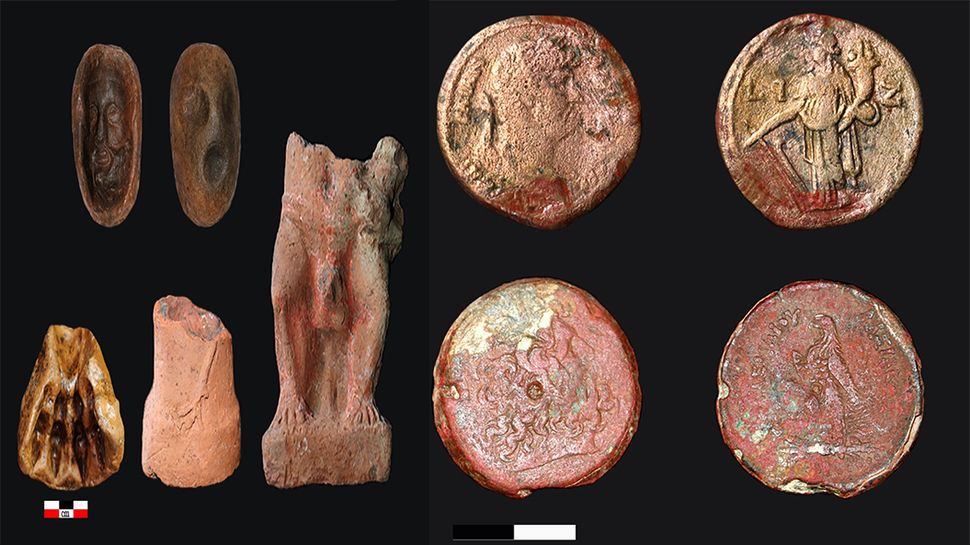
Various artifacts found in what was believed to be an astronomical observatory at a 6th-century BCE temple in Buto, Egypt. Egyptian Ministry of Tourism and Antiquities
As the archaeological work progresses, the researchers say they hope to learn how the ancient Egyptians performed astronomy using instruments they are gradually analyzing as they discover them.
A significant new tool was a “tilted stone sundial,” which measured time based on the movement of the sun. The temple building itself faced east, the direction from which the sun rises. Inside the building, the team found design features that also suggested alignment with the sun. For example, three stone blocks on the ground were used to “measure the position of the sun.”
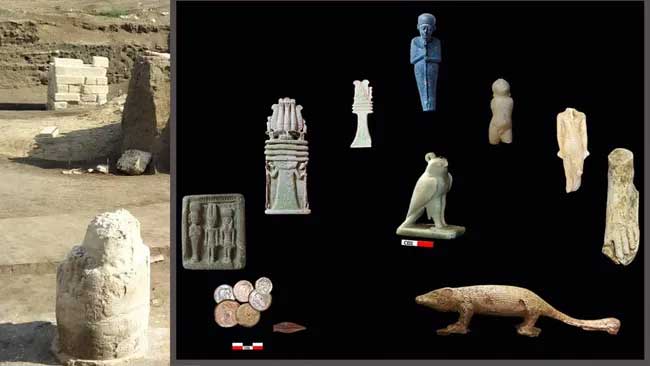
Finds from a supposed ancient astronomical observatory (right) from the 6th century BCE, located near the Buto Temple in Egypt (left), where the artifacts were found. Egyptian Ministry of Tourism and Antiquities
Another set of five flat limestone blocks set on long (16 feet, or 4.8 m) slabs had slanted lines “used to measure the tilt of the sun and shadow, as well as to observe the movement of the sun during the day,” the ministry said.
See also... New method for observing individual atoms confirms century-old quantum mechanical theory |
The statement said a supposed observatory tower built of stone, a stone platform in a large hall with inscriptions about sunrises and sunsets, and various inscriptions with measurements “indicating time and astronomy” were also found.
The hall was also decorated with images of deities associated with the sky. For example, Horus (in the form of a falcon) usually has his right eye symbolizing either the sun or the “morning star” Venus, while his left eye symbolizes the moon or the “evening star” (also Venus, in her setting phase).

Artifacts. Egyptian Ministry of Tourism and Antiquities
Horus is the son of Wadjet, the patron goddess of Lower Egypt, after whom the temple is named. Wadjet and the deity Nekhbet, representing Upper Egypt, are sometimes represented together on the pharaoh’s crown jewel or diadem, symbolizing how the pharaoh united Upper and Lower Egypt.
Smaller finds at the temple site include a beaded necklace known as a Menat, offering tablets, amphora lids, and pottery believed to have been used for both temple rituals and everyday life. The ministry’s current excavation phase in and around the Butoh complex dates back to at least 2018, according to news reports.
See also... Complete list of HTML/Javascript event handlers with examples List of required documents for a website in the Russian Federation |
Related Posts
A little bit about cats: the history of domestication and interesting facts about the behavior of pets

Cats have lived among humans for thousands of years. They…
New facts in the history of Ancient Egypt have been discovered

It would seem that Egypt has been dug up and…
Astrophysicist Claims 5,000-Year-Old Egyptian Coffins Depict Milky Way Galaxy

A new study suggests that ancient depictions of the Egyptian…

