


Previously, researchers believed that the main burials represented young royals with sacrificed attendants. But this interpretation was based on the idea that early Bronze Age societies had developed into large states with a king at the top of the social hierarchy.
Five thousand years ago, Bronze Age people in Mesopotamia built elaborate stone tombs filled with impressive burial goods and human sacrifices. Researchers aren’t sure what this ritual meant, but a new study of skeletons points to a clue: the age at which people were sacrificed and their biological sex.
The find could also upend assumptions about the type of government the culture practiced. Previously thought to be a hierarchical society led by a king, the burials hint at a more egalitarian organization.
Vengrov and his colleagues studied a series of skeletons found at the archaeological site of Basur Höyük, in the upper Tigris River region of southeastern Turkey. Basur Höyük, once part of ancient Mesopotamia, dates to between 3100 and 2800 BCE. Several stone tombs were discovered there a decade ago, containing hundreds of copper artifacts, textiles, and beads.

Eight human sacrifices were found at the entrance to this tomb, which contained the remains of two 12-year-old children from ancient Mesopotamia. Cambridge Archaeological Journal 2025
In a previous study, the researchers found the burial of two 12-year-old children alongside eight brutally murdered people, and suggested that the burial ritual pointed to the emergence of an early state that included “royal” tombs with “servant sacrifices.”

However, in a new study published March 17, 2025 in the Cambridge Archaeological Journal, scientists have conducted ancient DNA analysis on a separate set of skeletons and provided a more detailed look at the cemetery, focusing on the idea of adolescence as an important stage of life in this society.
An analysis of ancient DNA from nine skeletons at Bashur Hüyük showed that the individuals were not biologically related to each other. The DNA also showed that most of the individuals the researchers examined were female. So these were teenagers who had been brought together or volunteered from biologically unrelated groups to perform a very extreme form of ritual, but the meaning of the ritual is still unclear.
Previously, researchers believed that the main burials represented young royals with sacrificed attendants. But this interpretation was based on the idea that early Bronze Age societies had developed into large states with a king at the top of the social hierarchy.
There is now more archaeological evidence that Bronze Age political systems were more flexible. Societies in Mesopotamia could regularly switch between hierarchical rule based on a king and a more egalitarian social organization where people made decisions collectively.
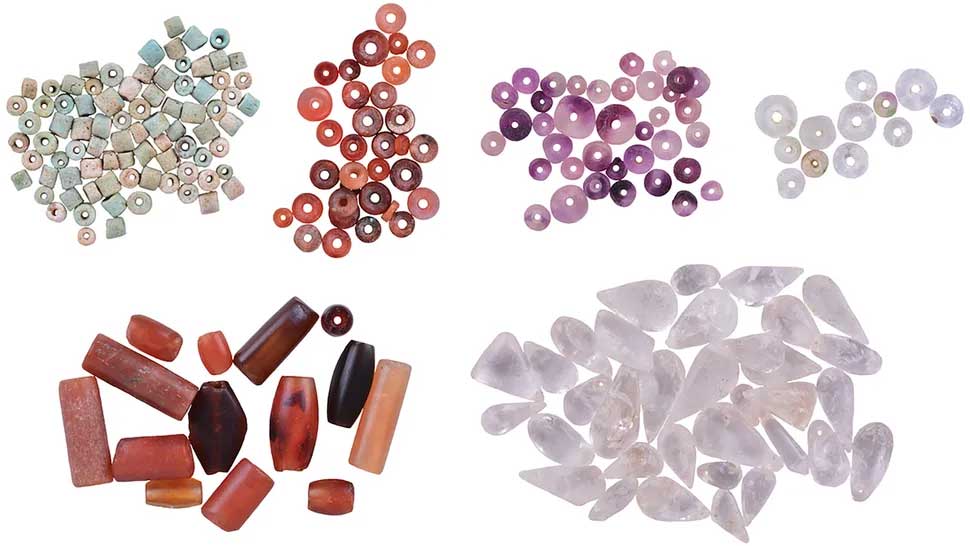
Beads found in one of the graves at Bashur Hüyük. Cambridge Archaeological Journal 2025
See also... New method for observing individual atoms confirms century-old quantum mechanical theory |
The idea that humans evolved to live in just one form of society most of the time is almost certainly wrong. If Bashur Huyuk was one of these more fluid societies, the “royal” burials might be better explained as a complex and potentially age-related burial tradition.
It is far more likely that what the scientists found in the ancient cemetery is a subset of a larger group, other members of which survived the ritual process and reached full maturity. This larger group can be called an “age set,” according to the study.
In general, in egalitarian societies, leadership is earned rather than inherited, but “age group” and gender can also play a role. For example, elders may be valued for their wisdom and experience, while adolescents may be valued for their hunting skills. In the case of Bronze Age burials in Turkey, this “age group” of adolescents may have represented initiates of an ancient cult or victims of intergroup rivalry or violence, the researchers note in their study.
The researchers noted in their study that few studies have focused on adolescence in ancient societies, so the Bashur Huyuk burials highlight the importance of examining age groups in Early Bronze Age states rather than assuming that societies were led by kings and other royal figures at the top of the political hierarchy.
Further studies of the skeletons using stable isotope analysis are also needed to determine the origins of the people buried at Bashur Hüyük. At this point, all that can be said is that many of the teenagers buried in the graves were not locals to the cemetery area.
See also... Complete list of HTML/Javascript event handlers with examples List of required documents for a website in the Russian Federation |
Related Posts
The oldest calendar and the oldest analog computer were discovered in the summer of 2024

Yet these historical monuments were practically before the eyes of…
DNA analysis reveals features of people’s lives in other eras
DNA has revealed incest, smallpox and violent deaths among Christians…
Natural selection in human populations continues today, and scientists are studying the prospects for its influence on human genes

Scientists have discovered that natural selection is happening right now…

