


Scientists have discovered two 444-million-year-old fossil specimens with their soft tissues well preserved, according to a new study. Unlike most fossils, the creature’s muscles and guts, but not its tougher shell, were preserved in ancient sediments that turned to stone.
The fossil, found 250 miles (402 kilometers) north of Cape Town, South Africa, is a new species of multi-segmented arthropod that may have lived in low-oxygen waters, according to a study published March 26, 2025, in the journal Papers in Palaeontology.
The researchers named the new species Keurbos susanae and nicknamed the fossil “Sue” after the mother of its discoverer.
“Sue is an inside-out, legless, headless marvel,” lead study author Sarah Gabbott, a paleontologist at the University of Leicester in the U.K., said in a statement. “Remarkably, her insides are a mineralized time capsule: muscles, tendons, sinews, and even intestines, all preserved in incredible detail. And yet her hard shell, legs, and head are missing — lost to decay more than 440 million years ago.”

A 444-million-year-old fossil of Keurbos susanae from South Africa. Sarah Gabbott, LiveScience
The researchers found the fossils in the Soom Shale, a site known for producing fossils with well-preserved soft tissue, more than 20 years ago. They had hoped to find more specimens, but fossils of the species were rare. The silt, clay, and mud that preserved Sue were deposited on an ancient seafloor, beneath an ocean with low oxygen but high levels of dissolved acidic hydrogen sulfide — suggesting that K. susanae may have adapted to low-oxygen environments.

Sue dates back to the Late Ordovician mass extinction (443 million years ago), when freezing temperatures and advancing glaciers wiped out nearly 85% of marine species.
Researchers are still working to understand how the soft tissue in fossils like K. susanae is preserved in the Soom Shale. Clay minerals may have played a role, as may calcium phosphate, a compound commonly found in fossilized muscle. On the other hand, the shells and exoskeletons of species preserved in the Soom Shale likely dissolved in the acidic ocean.
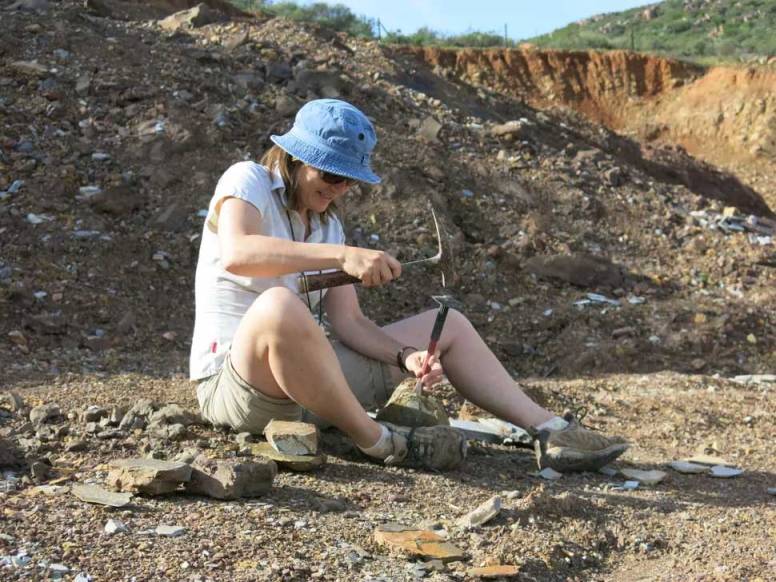
Paleontologist Sarah Gabbott hammers at a specimen in the field. Claire Browning, LiveScience
Because the K. susanae specimen was fossilized inside out, scientists are still unsure of the species’ evolutionary history or how it relates to other fossils from the same time period.
See also... New method for observing individual atoms confirms century-old quantum mechanical theory |
“We are now confident that she was a primitive marine arthropod, but her precise evolutionary relationships remain frustratingly elusive,” Gabbott said in a statement. The fossil’s segmented trunk suggests she had limbs of some kind — but comparing Sue to known fossil species would require a specimen with part of its exoskeleton preserved.
Recent mining operations have buried the site where Gabbott and her colleagues found Sue, the team says, making it unlikely they will find other specimens of the same species with intact legs or head.
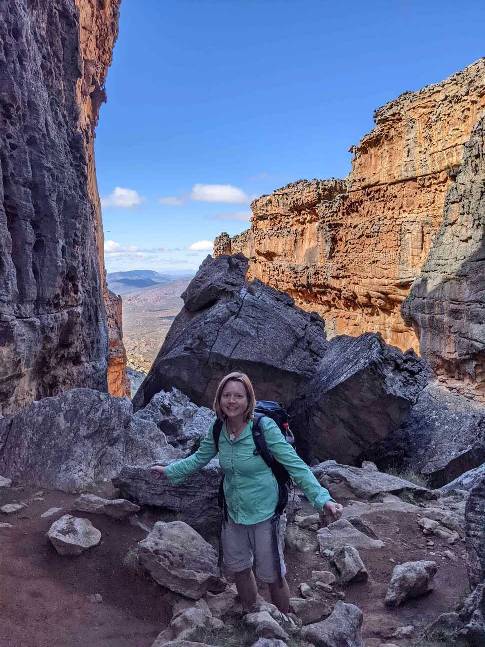
Sarah Gabbott in the Cederberg Mountains of South Africa, where the fossil was found. Simon Andrews, LiveScience
“I’ve always hoped to find more specimens, but it seems that after 25 years of searching, this fossil has become vanishingly rare — so I can’t wait any longer,” Gabbott said. “Especially since my mom recently said to me, ‘Sarah, if you’re going to name this fossil after me, you’d better hurry and do it before I end up in the ground and fossilized.’”
Gabbott joked that she named the fossil after her mother because it was a “well-preserved specimen.” But the real reason, she said, was that “my mom always told me I should pursue a career that made me happy — whatever that was. For me, that’s digging rocks, finding fossils, and then trying to figure out how they lived, what they tell us about ancient life and evolution on Earth.”
See also... Complete list of HTML/Javascript event handlers with examples List of required documents for a website in the Russian Federation |
No related posts found...

