The spherical shell known as the Oort Cloud is virtually invisible. Its particles are spread so thinly and so far from the light of any star, including the Sun, that astronomers simply cannot see the cloud, even though it envelops us like a blanket. It may be hard for the human mind to comprehend: a cosmic cloud so colossal that it encircles the Sun and eight planets, stretching trillions of miles into deep space.
Astronomers assume that the Oort Cloud exists because it is the only logical explanation for the arrival of a certain class of comets that occasionally visit our solar system. The cloud, it turns out, is essentially a giant reservoir that could contain billions of icy celestial bodies.
Tsuchinshan-ATLAS, also known as Comet C/2023 A3, was brightest and likely visible to the naked eye for a week or two after October 12, when it would be closest to Earth. A second comet, C/2024 S1 (ATLAS), discovered on September 27, was visible in late October. The comet passed closest to Earth on October 24.
The inhabitants of the Cloud may be the reason life began on Earth; having fallen to our planet many centuries ago, these icy bodies may have supplied at least some of the water that all life requires. At the same time, these same objects pose a constant threat to the continued existence of Earth and the survival of life.
Some of these bodies, known as long-period comets, have orbits of hundreds, thousands or even millions of years, like Tsuchinshan-ATLAS. This is different from so-called short-period comets, which do not visit the Oort Cloud and have comparatively fast orbits. Halley’s Comet, which cuts a path through the solar system and orbits the sun every 76 years or so, is one of these.
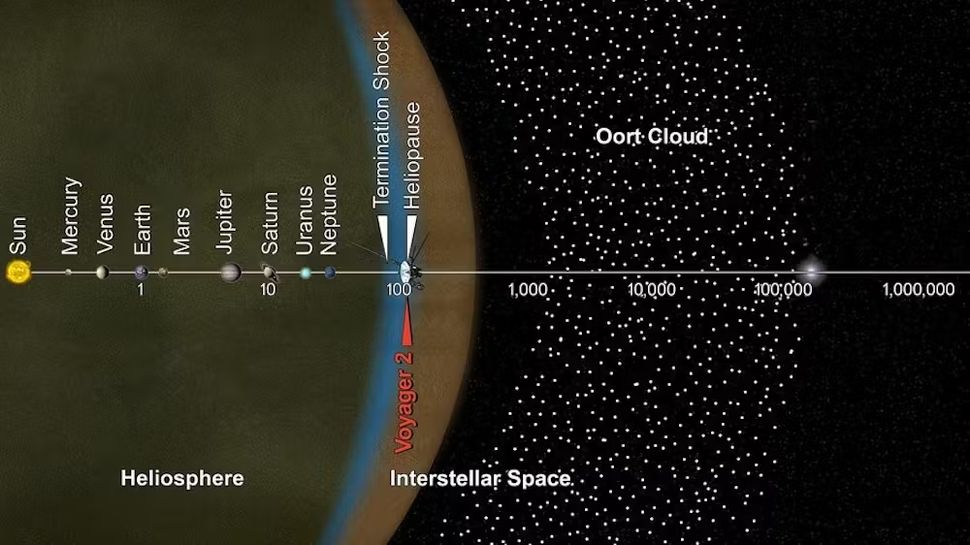
An illustration of the solar system and the Oort Cloud. The numbers on the graph represent AU, or astronomical units. Note the location of Voyager 2, which will take another 30,000 years to escape the Cloud. NASA
The 20th-century Dutch astronomer Jan Oort, intrigued by long-period comets, wrote a paper about them in 1950. He noted that about 20 comets had an average distance from the Sun that was more than 10,000 astronomical units. This was astounding; just one AU is the distance from the Earth to the Sun, which is about 93 million miles. Multiply 93 million by 10,000, and you find that these comets came from more than a trillion miles away. What’s more, Oort suggested, they weren’t necessarily the outermost objects in the cloud.
Nearly 75 years after Oort’s paper, astronomers still can’t directly image this part of the cosmos. But they estimate that the Oort Cloud extends up to 10 trillion miles from the Sun, nearly halfway to Proxima Centauri, the next closest star.
Long-period comets spend most of their time at these vast distances, making only brief, quick visits to the Sun as they approach from all directions. Oort suggested that the cloud contains 100 billion of these icy objects. That could be as many as there are stars in our galaxy.
How did they get there? Oort suggested, and modern simulations have confirmed, that these icy bodies may have originally formed near Jupiter, the solar system’s largest planet. Perhaps the objects’ orbits around the sun were disrupted by Jupiter, much as NASA spacecraft bound for destinations from Saturn to Pluto routinely flew past the giant planet to speed up their outward journeys.
Some of these objects would leave the solar system forever, becoming interstellar objects. But others would end up with orbits similar to those of long-period comets.
Long-period comets pose a particular potential hazard to Earth. Because they are so far from our sun, their orbits are easily altered by the gravity of other stars. This means that scientists have no idea when or where one will appear until it suddenly does. By then, it is usually closer than Jupiter and moving fast, at tens of thousands of miles per hour. Indeed, the fictional comet that doomed Earth in the film Don’t Look Up came from the Oort Cloud.
New Oort Cloud comets are being discovered all the time, about a dozen a year in recent years. The odds of any of them hitting Earth are extremely low. But it’s possible. The recent success of NASA’s DART mission, which altered the orbit of a small steroid, demonstrates one possible approach to deflecting these small bodies. But that mission was designed after years of studying its target. An Oort Cloud comet might not offer that much time — perhaps just a few months, weeks, or even days.
Or it might not offer any time at all. Oumuamua, a strange little object that visited our solar system in 2017, was discovered not before, but after, its closest approach to Earth. Although Oumuamua is an interstellar object, not from the Oort Cloud, the assumption still applies; one of these objects could sneak up on us, leaving Earth defenseless.
One way to prepare for these objects is to better understand their basic properties, including their size and composition. Researchers are working to characterize new long-period comets. The largest known comet, Comet Bernardinelli-Bernstein, discovered just three years ago, is about 75 miles (120 kilometers) across. Most known comets are much smaller, ranging from one to several miles, and some are too faint for us to see. But new telescopes are helping. In particular, the Rubin Observatory’s Legacy Survey of Space and Time, which begins in 2025, could double the list of known Oort cloud comets, which currently stands at about 4,500.
The unpredictability of these objects makes them difficult targets for spacecraft, but the European Space Agency is preparing a mission that will do just that: Comet Interceptor. Set to launch in 2029, the probe will remain in space until a suitable target emerges from the Oort Cloud. Studying one of these ancient and pristine objects could give scientists clues about the origins of the solar system.
The closest comet to us, Tsuchinshan-ATLAS, is about 44 million miles (70 million kilometers) away; C/2024 S1 (ATLAS) is about 80 million miles (130 million kilometers) away. That sounds like a long way, but in space, it’s a near miss.