Jupiter, the largest planet in our solar system, boasts 95 moons, making it the second most populated planet by moon count (Saturn has the most). A huge gas giant, Jupiter is orbited by numerous moons; the four largest of these are known as the Galilean moons, discovered by Galileo Galilei using a telescope in 1610. The four moons – Io, Europa, Ganymede, and Callisto – are arranged in order of their distance from Jupiter. These moons proved that not all celestial bodies orbit the Earth, an important discovery because astronomers had previously believed that the Earth was the center of the universe.
Io
Diameter: 2,260 miles (3,640 km). The most volcanically active place in the solar system, Io is a fascinating world caught in a tug-of-war between Jupiter’s gravity and the gravitational pull of its neighboring Galilean moons Europa and Ganymede. The turbid environment is constantly being refreshed, smoothing out craters with vast lakes of lava erupting from one of the hundreds of volcanoes that cover the landscape. Of the four Galilean moons, Io orbits Jupiter closest to Earth. Io has been explored by spacecraft ranging from Pioneer 10 and 11 in 1973 and 1974 to New Horizons in 2007, as well as by ground-based and space-based telescopes. In fact, Io is the most geologically active object in the solar system. Io’s core is made of iron or iron sulfide, and its outer layer is made of brown silicate, resulting in multicolored orange, yellow, black, red, and white patches on the surface. Io also has sulfurous snowfields that cover much of its surface.

NASA/JPL/University of Arizona
Europe
Diameter: 1,940 miles (3,100 km). Europa is thought to have an iron core, a rocky mantle, and a surface covered in frozen water ice sitting above a vast salty ocean. According to NASA, the icy moon Europa is considered the most promising place to find an environment capable of supporting life beyond Earth. Theoretically, the subsurface salty ocean could contain twice as much water as all of Earth’s oceans combined and could exist long enough for life to form and even evolve. Slightly smaller than Earth’s Moon, Europa is one of the largest bodies in the solar system, though smaller than Jupiter’s other Galilean moons. Cracks and streaks cover its icy surface, which is sparsely cratered because the moon’s shiny, smooth shell is only 20 to 180 million years old, a relatively young age.

NASA/JPL/University of Arizona
Ganymede
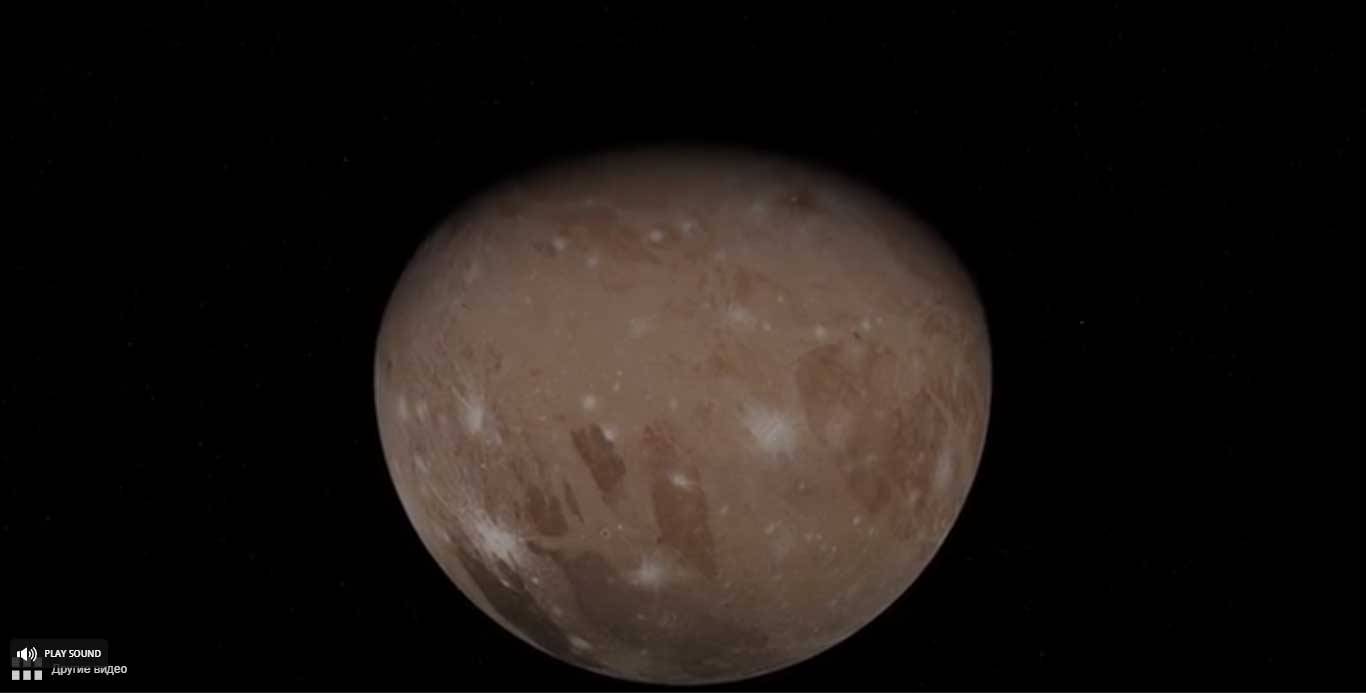
Diameter: 3,270 miles (5,260 kilometers). Jupiter’s moon Ganymede is the largest moon in the solar system, larger than Mercury. It is also the only moon known to have its own magnetic field, which causes spectacular auroras. What’s more, the giant moon may have a salty ocean beneath its surface, thought to contain more water than all the water on Earth combined, according to NASA Science. Ganymede, the third Galilean moon, is the largest by far. It is about the size of Mercury but has about half the planet’s mass. The moon’s iron core is covered in a thick crust made mostly of ice. Dark, cratered areas cover 40 percent of Ganymede’s surface, while the remaining 60 percent is covered in light, striated terrain, creating intricate patterns on the moon.

NASA
Callisto
Diameter: 2,995 miles (4,820 km). The second-largest moon of Jupiter, Callisto is the third-largest moon in the Solar System. The moon’s surface is thought to be about 4 billion years old, making it the oldest icy surface in the Solar System. After 4 billion years of meteorite impacts, it is not surprising that Callisto is also the most heavily cratered body in the Solar System. Callisto, the fourth Galilean moon, is the farthest from Jupiter. The moon’s terrain has remained virtually unchanged since its formation, making it a subject of great interest to researchers. Callisto is roughly the same size as Mercury, but less dense. It is also the least affected by Jupiter’s magnetic field, as it orbits farther from the planet, outside its primordial radiation belt.

NASA
Most of Jupiter’s moons are small: about 60 of them are less than 10 kilometers in diameter. Unusually, the outer moons orbit in the opposite direction to Jupiter’s rotation, suggesting that they were captured by Jupiter’s gravitational field after the original system formed.
Below is a list of Jupiter’s 57 officially named moons, along with details of their discovery, according to NASA.

Adrastea: Discovered in July 1979 by the Voyager science team.
Eithne: Discovered on December 9, 2001 by Scott S. Sheppard, David C. Jewitt, and Ian T. Kleina while observing at the Mauna Kea Observatory, Hawaii.
Amalthea: discovered on September 9, 1892 by American astronomer Edward Emerson Barnard.
Ananke: Discovered on September 28, 1951, by American astronomer Seth Barnes Nicholson from a photograph taken with the 100-inch (2.5-meter) Hooker telescope at Mount Wilson Observatory in California.
Aoede: Discovered on February 8, 2003, by Scott S. Sheppard, David C. Jewitt, Ian T. Kleina, Yanga R. Fernandez, and Henry H. Xie while observing at the Mauna Kea Observatory in Hawaii.
Arche: Discovered on October 31, 2002 by Scott S. Sheppard at the Mauna Kea Observatory in Hawaii.
Autonomous: Discovered on December 10, 2001 by Scott S. Sheppard, David C. Jewitt, and Ian T. Kleina at the Mauna Kea Observatory in Hawaii.
Calliroie: Discovered on October 19, 1999, by Jim W. Scotti, Timothy B. Spahr, Robert S. McMillan, Jeffrey A. Larsen, Joe Montagne, Arianna E. Gleason, and Tom Gehrels using the Kitt Peak 36-inch telescope. The discovery was made as part of the University of Arizona’s Spacewatch program.
Callisto: discovered on January 7, 1610 by the Italian scientist Galileo Galilei.

This image of Callisto was taken by NASA’s Galileo spacecraft. NASA/JPL/DLR
Carme: Discovered on July 30, 1938, by Seth Barnes Nicholson while observing with the 100-inch (2.5-meter) Hooker Telescope at Mount Wilson Observatory in California.
Carpo: Discovered on February 26, 2003, by a team of astronomers from the University of Hawaii’s Institute for Astronomy led by Scott S. Sheppard. The discovery was made using the 3.6-meter Canada-France-Hawaii Telescope at the Mauna Kea Observatory in Hawaii.
Halden: Discovered November 23, 2000 by Scott S. Sheppard, David C. Jewitt, Yang R. Fernandez, and Eugene Magnier at the Mauna Kea Observatory in Hawaii.
Zillen: Discovered on February 9, 2003 by Scott S. Sheppard and his team at the University of Hawaii at Mauna Kea Observatory, Hawaii.
Dia: Discovered on December 5, 2000 by Scott S. Sheppard, David Jewitt, J. R. Fernandez, and J. Magnier using the 2.2-meter reflector on Mauna Kea, Hawaii.
Eirene: Discovered on February 6, 2003 by Scott S. Sheppard, David C. Jewitt, and Ian T. Kleina at the Mauna Kea Observatory in Hawaii.
Elara: Discovered on January 5, 1905, by American astronomer Charles Dillon Perrine, who was viewing photographs taken with the 36-inch (0.9 meter) Crossley reflector at the Lick Observatory on Mount Hamilton at the University of California, San Jose.
Erinome: Discovered on November 23, 2000, by Scott S. Sheppard, David C. Jewitt, Yanga R. Fernandez, and Eugene Magnier at the Mauna Kea Observatory in Hawaii.
Ersa: The moon was first spotted in 2017, and its discovery by Scott S. Sheppard and his team was announced in July 2018.
Euante: Discovered on December 11, 2001 by Scott S. Sheppard, David C. Jewitt, and Ian T. Kleina at the Mauna Kea Observatory in Hawaii.
Yukelada: Discovered on February 6, 2003 by Scott S. Sheppard at the Mauna Kea Observatory in Hawaii.
Eupheme: Discovered on March 4, 2003 by Scott S. Sheppard at the Mauna Kea Observatory in Hawaii.
Eupori: Discovered on December 11, 2001 by Scott S. Sheppard, David C. Jewitt, and Ian T. Kleina at the Mauna Kea Observatory in Hawaii.
Europe: discovered on January 8, 1610 by the Italian scientist Galileo Galilei.
Eurydome: Discovered on December 9, 2001 by Scott S. Sheppard, David C. Jewitt, and Ian T. Kleina at Mauna Kea Observatory, Hawaii.
Ganymede: discovered on January 7, 1610 by the Italian scientist Galileo Galilei.
Harpalyx: Discovered November 23, 2000 by Scott S. Sheppard, David C. Jewitt, Yanga R. Fernandez, and Eugene Magnier at the Mauna Kea Observatory in Hawaii.
Hegemona: Discovered on February 8, 2003 by Scott S. Sheppard, David C. Jewitt, Ian T. Kleina, Yanga R. Fernandez, and Henry H. Hsieh at Mauna Kea Observatory, Hawaii.
Helica: Discovered on February 6, 2003 by Scott S. Sheppard at Mauna Kea Observatory, Hawaii.
Hermippe: Discovered on December 9, 2001 by Scott S. Sheppard, David C. Jewitt, and Ian T. Kleina at Mauna Kea Observatory, Hawaii.
Hers: Opened February 27, 2003 by Brett J. Gladman, John J. Kavelaars, Jean-Marc Petit and Lynn Allen.
Himalia: Discovered on December 3, 1904, by American astronomer Charles Dillon Perrine, who was viewing photographs taken with the 36-inch (0.9 m) Crossley reflector at the Lick Observatory on Mount Hamilton at the University of California, San Jose.
Io: discovered on January 8, 1610 by the Italian scientist Galileo Galilei.
Jocasta: Discovered November 23, 2000 by Scott S. Sheppard, David C. Jewitt, Yanga R. Fernandez, and Eugene Magnier at the Mauna Kea Observatory in Hawaii.
Isonoe: Discovered on November 23, 2000, by Scott S. Sheppard, David C. Jewitt, Yanga R. Fernandez, and Eugene Magnier at the Mauna Kea Observatory in Hawaii.
Kale: Discovered December 9, 2001 by Scott S. Sheppard, David C. Jewitt, and Ian T. Kleina at Mauna Kea Observatory, Hawaii.
Callicora: Discovered on February 6, 2003 by Scott S. Sheppard at Mauna Kea Observatory, Hawaii.
Kalyke: Discovered November 23, 2000 by Scott S. Sheppard, David C. Jewitt, Yanga R. Fernandez, and Eugene Magnier at Mauna Kea Observatory, Hawaii.
Cora: Discovered on February 8, 2003 by Scott S. Sheppard, David C. Jewitt, and Ian T. Kleina at Mauna Kea Observatory, Hawaii.
Leda: discovered on September 14, 1974 by American astronomer Charles Thomas Kowal during observations of plates obtained from September 11 to 13, 1974, at Palomar Observatory, California.
See also... New method for observing individual atoms confirms century-old quantum mechanical theory |
Lysithea: Discovered on July 6, 1938, by American astronomer Seth Barnes Nicholson using the 100-inch (2.5-meter) Hooker telescope at Mount Wilson Observatory, California.
Megaclitus: Discovered November 25, 2000 by Scott S. Sheppard, David C. Jewitt, Yanga R. Fernandez, and Eugene A. Magnier at the Mauna Kea Observatory in Hawaii.

Jupiter’s four largest moons are known as the Galilean moons. This composite image shows, from left to right, Io, Europa, Ganymede and Callisto. NASA/JPL/DLR
Metis: Discovered in March 1979 by the Voyager science team.
Mneme: Discovered on February 9, 2003 by Scott S. Sheppard and Brett Joseph Gladman at Mauna Kea Observatory, Hawaii.
Orthosia: Discovered on December 11, 2001, by Scott S. Sheppard, Yanga R. Fernandez, and David C. Jewitt at Mauna Kea Observatory, Hawaii.
Pandya: The moon was first spotted in 2017, and its discovery by Scott S. Sheppard and his team was announced in July 2018.
Pasiphae: Discovered on January 27, 1908 by British astronomer Philibert Jacques Melotte using the 30-inch Cassegrain telescope at Greenwich Observatory.
Pasithee: Discovered December 11, 2001 by Scott S. Sheppard, David C. Jewitt, and Ian T. Kleina at Mauna Kea Observatory, Hawaii.
Philophrosyne: Discovered in April 2003 by Scott S. Sheppard at the Mauna Kea Observatory in Hawaii.
Praxidike: Discovered on November 23, 2000 by Scott S. Sheppard, David C. Jewitt, Yanga R. Fernandez, and Eugene Magnier at the Mauna Kea Observatory in Hawaii.
Sinope: Discovered on July 21, 1914, by American astronomer Seth Barnes Nicholson while observing photographic plates obtained with the 36-inch (0.9-meter) telescope at Lick Observatory in California.
Sponde: Discovered on December 9, 2001 by Scott S. Sheppard, David C. Jewitt, and Ian T. Kleina at Mauna Kea Observatory, Hawaii.
Taygete: Discovered November 25, 2000 by Scott S. Sheppard, David C. Jewitt, Yanga R. Fernandez, and Eugene Magnier at the Mauna Kea Observatory in Hawaii.
Thebe: Discovered in 1980 by the Voyager science team studying images taken by Voyager 1.
Thelxinoe: Discovered on February 9, 2003 by Scott S. Sheppard and Brett J. Gladman at Mauna Kea Observatory, Hawaii.
Themisto: First discovered on September 30, 1975, by American astronomers Charles Thomas Kowal and Elizabeth Roemer. This small moon was then lost until 2000, when it was rediscovered by Scott S. Sheppard, David C. Jewitt, Yang Roland Fernandez, and Eugene A. Magnier while searching for small irregular moons of Jupiter using the 8.3-meter Subaru Telescope and the 3.6-meter Canada-France-Hawaii Telescope at Mauna Kea Observatory in Hawaii.
Tayon: Discovered on December 11, 2001 by Scott S. Sheppard, David C. Jewitt, and Ian T. Kleina at Mauna Kea Observatory, Hawaii.
Valetudo: First discovered in 2017, the moon was discovered by Scott S. Sheppard and his team in June 2018.
The Story of a Tiny Moon: How NASA’s Juno Mission Discovered Jupiter’s Tiny Moon Amalthea
Amalthea has a radius of only 84 kilometers, making it look like a potato because it lacks the mass to form a sphere. In 2000, NASA’s Galileo spacecraft discovered some of its surface features, including impact craters, hills, and valleys. Amalthea orbits Jupiter along Io, the innermost of the planet’s four largest moons, completing one revolution every 0.498 Earth days.


These images of Jupiter were taken by NASA’s Juno spacecraft during its 59th flyby of the giant planet on March 7, 2024. The images clearly show Jupiter’s colorful belts and swirling storms, including the Great Red Spot. A closer look reveals something more: two fragments of the tiny moon Amalthea
Amalthea is the reddest object in the solar system, and observations show that it radiates more heat than it receives from the Sun. This may be because, as it rotates in Jupiter’s powerful magnetic field, it induces electric currents in the satellite’s core. Tidal stresses caused by Jupiter’s gravity may also be a source of heat.
At the time the first of these two images was taken, the Juno spacecraft was about 165,000 miles (265,000 kilometers) above Jupiter’s cloud tops, at a latitude of about 5 degrees north of the equator.
Citizen scientist Gerald Eichstedt took these images using raw data from the JunoCam instrument, applying processing techniques to sharpen the images.
Mysterious Callisto
Scientists are less certain about the existence of a subsurface ocean on Callisto, but JUICE may be able to answer that question. Callisto, the farthest of Jupiter’s four major moons, is an unusual world that astronomers believe may have the oldest surface in the solar system. The moon is thought to be completely inactive and has a vast number of craters that record its entire history. JUICE’s high-resolution cameras and sensitive instruments will help scientists study the history of not just Callisto, but the entire solar system.

Of the three Jupiter moons that JUICE will study, the least studied is the cratered Callisto. ESA/ATG MediaLab
“Callisto formed 4 billion years ago, at the same time as Jupiter. And the image of Callisto that we see is from the moment of its birth. Europa, on the other hand, is a very active surface that is only 50 million years old and is constantly being renewed.”
In the case of Ganymede, JUICE’s primary target, scientists hope the mission will help them better understand why the moon has its own magnetic field, which has not been observed on any other moon in the solar system.
See also... Complete list of HTML/Javascript event handlers with examples List of required documents for a website in the Russian Federation |