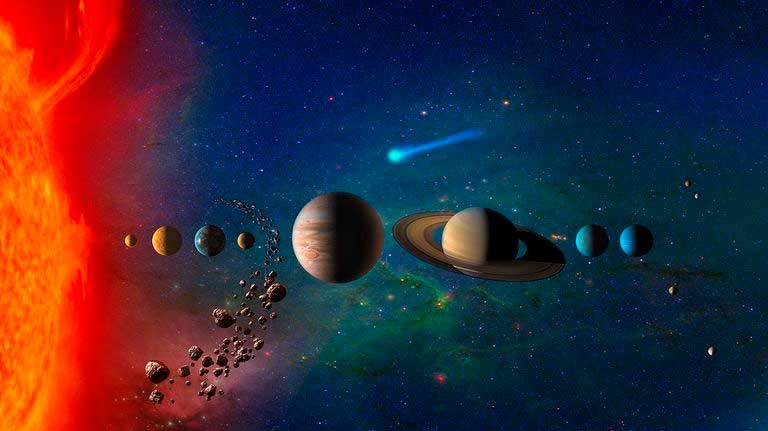
When the New Horizons mission flew past Pluto in 2015, it discovered a geologically rich world, not the cold, dark landscape many expected. Almost immediately, researchers discovered two features, named Mount Wright and Mount Piccard, which were suspected to be ice volcanoes, and further study confirmed their identity.
When NASA’s New Horizons mission flew past Pluto in 2015, humanity saw for the first time a colossal depression on this isolated planet. It’s called Sputnik Planitia. Comparable in size to Mexico and occupying most of one of Pluto’s hemispheres, Sputnik Planitia was likely formed by an impact, but few impact craters have Sputnik Planitia’s unique pear-shaped form.
How Sputnik Planitia formed remains unknown, but researchers have already sketched a possible picture of its origin. They argue that perhaps a Switzerland-sized body slammed into Pluto at a slight angle long ago. If true, this image could also provide clues about what Pluto’s interior looks like beneath its cryogenic surface.
The shape and colossal size of Sputnik Planitia—approximately 2,000 kilometers (1,243 miles) long and 1,600 kilometers (994 miles) wide—are not the only reasons planetary scientists study it with curiosity. Whatever created this formation managed to leave a dent about 4 kilometers (2.5 miles) deep; at the bottom of the dent is likely a frozen layer of nitrogen ice. Gravity should have slowly rotated Pluto so that the dent and its missing mass would end up at one of Pluto’s poles, but, strangely, Sputnik Planitia remains near the equator.
One popular theory suggested that Sputnik Planitia was actually a hint of a global ocean hidden beneath Pluto’s surface. After a powerful impact, liquid water from the ocean could have risen to fill the resulting void, which was then covered by ice and a nitrogen layer, explaining why Sputnik Planitia remained at the equator. However, some scientists remained unconvinced.
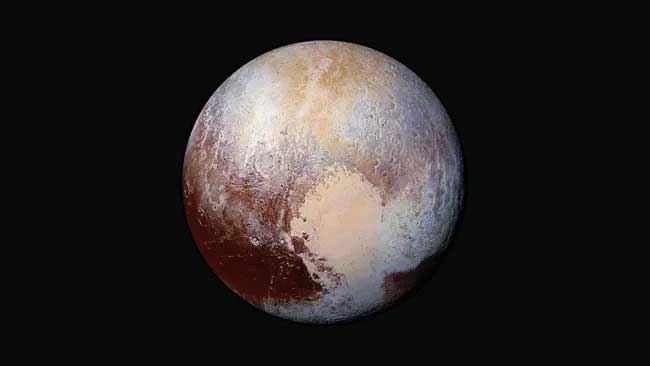
A composite image of Pluto provided by the New Horizons mission. NASA/Johns Hopkins University Applied Physics Laboratory/Southwest Research Institute
Asphaug, Ballantyne, and their colleagues began conducting 3D modeling to explore the circumstances that could have led to the formation of Sputnik Planitia. The dent’s odd shape suggested that the impactor struck Pluto obliquely, rather than head-on. This led them to model a 700-kilometer-wide (435-mile-wide) object—a ball of ice and rock—falling toward a Pluto-like planet. This object was designed to have a rocky core within a water-ice shell, and the impact occurred at a shallow angle of 30 degrees. Indeed, this scenario not only resulted in the formation of the pear-shaped crater, but the team’s modeling also showed that the impactor’s core remained buried beneath Sputnik Planitia, giving it the extra mass needed to remain at the equator. The researchers published their work in the journal Nature Astronomy on April 15, 2024.
The authors argue that further research is still needed to expand on these concepts to understand how Sputnik Planitia evolved over billions of years and how collisions occur in this distant corner of the solar system.
Probing Pluto’s interior could help understand these dynamics, but more definitive answers may have to wait for another mission. While New Horizons’ visit to Pluto was a remarkable achievement, the probe merely flew past, meaning the mission literally only scratched the surface of the former planet. A future mission might be able to orbit Pluto and probe its interior, for example by measuring the planet’s gravitational field.
Some scientists believe that Pluto contains cryovolcanoes that spew water vapor or even solid water ice. This water must come from somewhere—and the layer of liquid water beneath Pluto’s crust fits this description quite well.
Researchers from Washington University in St. Louis and the Lunar and Planetary Institute in Houston began creating a model to demonstrate what this liquid layer might look like. Specifically, they wanted to create a model similar to Sputnik Planitia, a heart-shaped depression on Pluto’s surface thought to have formed as a result of an impact. Therefore, the researchers tested various ocean thickness and water density configurations that would result in Sputnik Planitia being riddled with the cracks observed by New Horizons. Nguyen and co-author Patrick McGovern published their work in the journal Icarus on February 15, 2025.
“We’ve estimated a sort of Goldilocks zone where the shell density and thickness are just right,” Alex Nguyen, a graduate student at Washington University in St. Louis and one of the authors, said in a statement.
Their calculations showed that Pluto’s ocean would likely be between 40 and 80 kilometers (25 and 50 miles) thick and approximately 8 percent denser than Earth’s seawater. This is roughly the same density as the Great Salt Lake.
However, the existence of a Plutonian ocean remains controversial. Scientists don’t know enough about Pluto to determine whether the evidence truly points to liquid water or is merely circumstantial. A recent study modeling the origin of Sputnik Planitia found that the heart-shaped basin would likely have formed if Pluto had a solid interior.
So until New Horizons’ successor allows us to revisit Pluto, what lies beneath the planet’s surface will remain hidden in the shadows.
Another study suggests that a feature on Pluto previously labeled as an impact crater may actually be the caldera of a supervolcano that erupted in the last few million years.
When NASA’s New Horizons mission flew past Pluto in 2015, it revealed a geologically rich world, not the cold, dark landscape many expected. Almost immediately, researchers discovered two features, named Mount Wright and Mount Piccard, which were suspected to be ice volcanoes, and further study confirmed their identity.
But not all cryovolcanoes were easy to spot. The suspected Kiladze supervolcano was initially classified as an impact crater. However, scientists now suspect it is something else.
“We assessed the likelihood that this depression is a cryovolcanic caldera rather than an impact crater,” said Al Emran, a planetary scientist at the Jet Propulsion Laboratory in California. In July 2025, Emran presented his team’s findings at the conference “Progress in Understanding the Pluto System: 10 Years After Flyby” in Laurel, Maryland.
“We think it’s more like the Yellowstone caldera in Wyoming,” Emran said. At least two Yellowstone eruptions millions of years ago reached supervolcano status.
Kiladze is still listed as a crater. But the abundant water ice deposits surrounding the bowl-shaped formation piqued Emran’s curiosity, and he wondered if it was a cryovolcano.
At first glance, the elongated oval looks very much like an impact crater. It is large, with an average diameter of 4 kilometers. Its walls are irregularly shaped, and the complex structures it would have contained could have been easily destroyed by active processes on Pluto’s surface.
The landscape itself is marked by depressions and other geological features, many of which have collapsed. If a falling object had penetrated the surface and exposed veins of solidified lava beneath, it could have caused the explosive distribution of water ice observed on the surface.
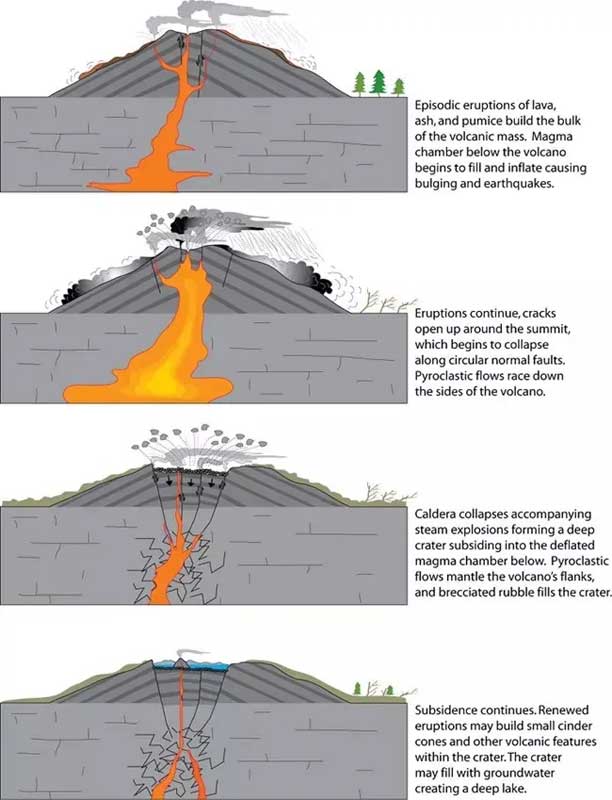
Infographic showing the caldera formation process. Trista L. Thornberry-Ehrlich, Colorado State University.
But when Emran studied the topographic maps of Pluto created by the New Horizons team, he realized there was a problem: the crater was too deep. Throughout the solar system, crater depth varies predictably with its diameter, and the same law appears to apply to other craters on Pluto, but not to Kiladze.
An impact crater of this size is estimated to be 2.74 kilometers wide at best. However, given the activity passing through Pluto, over time, material would likely have filled the crater, making it even smaller. Fog particles would accumulate, and melting or collapsing ice would collapse inward.
However, the Kiladze basin is not shallower than expected, but deeper. Some sections of the basin reach depths of 2.5 meters, and the average depth of the entire reservoir is almost 3 kilometers.

For these reasons, Emran and his colleagues suggest that Kiladze is a caldera, a huge depression formed by the eruption and subsequent collapse of a volcano. Magma (or cryomagma) rapidly erupting from the surface over a short period of time can weaken the underlying rock, causing it to collapse inward.
Despite the destruction of the supervolcano, the Kiladze eruption would have been impressive. Emran and his colleagues calculated that the explosion could have ejected up to 1,000 cubic kilometers of icy cryomagma into the surrounding area, which meets the definition of a supervolcano. Although Yellowstone has erupted more than 80 times in its more than 2 million-year history, only two eruptions have been classified as supervolcanic.
Kiladze could have ejected its cryomagma in a single explosive event, or the eruptions could have been spread out over time. In any case, the most recent eruption ejected water ice at least 100 km away. Emran, however, suggests that this estimate is an underestimate, as the lower resolution of New Horizons likely reveals more water ice.
“One or more catastrophic explosive eruptions, such as those that formed and collapsed what we see as the Kiladze caldera, are expected to have dispersed the ice-water cryomagma widely over a thousand kilometers or more, resulting in outcrops too small to be detected in the existing data,” the authors write in a paper published in The Planetary Science Journal.
Kiladze is located north of Sputnik, the icy heart of Pluto. Although most of the dwarf planet’s surface is covered in various ices, only a small portion can compare to what you’d find in a home freezer. Temperatures on Pluto are so low that water ice forms the dwarf planet’s core, with other ices layered on top.
But in the vicinity of Kiladze, water ice extends across the entire surface. It contains traces of an unidentified ammonia compound. “The exact composition is difficult to determine,” Emran said. Moreover, this specific signature of ammonia is not observed anywhere else on Pluto.
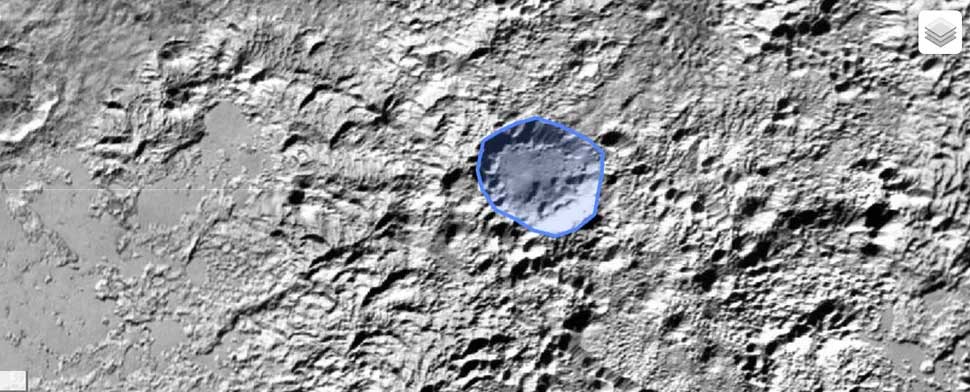
Image by Kiladze. U.S. Geological Survey Astrogeology Research Center.
Ammonia may be what keeps the glacial ice fluid. Its addition lowers the freezing point of water, allowing it to remain liquid longer. Below the surface, deposits of water and ammonia could have avoided freezing during the solidification of Pluto’s bedrock. Ultimately, tectonic pressure could have forced the icy magma to the surface, erupting onto the landscape around Kiladze, Emran explained.
Mysterious traces of ammonia may also help date the cryovolcano. Pure ammonia is quickly destroyed by solar wind, ultraviolet particles, and cosmic rays. Its weak presence indicates that the last eruption in Pluto’s history occurred relatively recently.
Pluto’s haze could help reveal geological activity. A shroud of light covers the dwarf planet, formed by the transition of methane and other gases from solid to gaseous state. As the particles grow, they eventually fall to the surface and spread throughout the dwarf planet. Emran explained that the haze particles that land on the ground cover the water ice like a blanket, obscuring the signs of cryolava. If such a layer had formed, New Horizons would have seen nitrogen-rich ice instead of signs of water-rich volcanism.
To bury the water ice, at least 10 millimeters of haze particles would need to fall on Pluto. This process takes at least 3 million years, Emran said. This could mean Pluto isn’t as frozen as previously thought.
“If Kiladze erupted just 3 million years ago, that really suggests that Pluto’s interior may still retain some residual heat,” Emran said. “This is consistent with the idea that cryovolcanism on Pluto could be either ongoing or episodic.”
An earlier study suggested that the haze shrouding Pluto may be composed of ice crystals containing cyanide nuclei.
Hazes, consisting of tiny particles of dust, smoke, ice, and other substances, are not unique to Earth—scientists have discovered hazes enveloping Mars, Venus, Saturn, and Jupiter.
The haze isn’t limited to the planets. Titan, Saturn’s largest moon and the only known moon with clouds, is shrouded in a thick orange haze, similar in composition to smog on Earth. NASA’s Voyager 2 spacecraft also detected haze in the atmosphere of Triton, Neptune’s largest moon.

NASA’s Cassini spacecraft looks at the night side of Saturn’s largest moon and sees sunlight scattered through the edge of Titan’s atmosphere, creating a ring of color. NASA/JPL-Caltech/Space Science Institute
NASA’s New Horizons mission, which flew past Pluto in 2015, unexpectedly discovered that Pluto also has a haze shrouding the dwarf planet’s frozen surface. Because Pluto, Titan, and Triton are icy worlds with atmospheres rich in nitrogen, methane, and carbon monoxide, researchers suspected they might all possess similar types of haze.
See also... New method for observing individual atoms confirms century-old quantum mechanical theory |
Previous studies have shown that Titan’s haze arose when solar ultraviolet radiation triggered chemical reactions in the icy moon’s upper atmosphere. These reactions produced simple organic compounds, which subsequently fueled the formation of increasingly larger and more complex organic molecules.
However, scientists have discovered that the haze on Pluto and Triton may have a completely different origin than that on Titan. The scientists detailed their findings on December 21, 2021, in the journal Nature Astronomy.
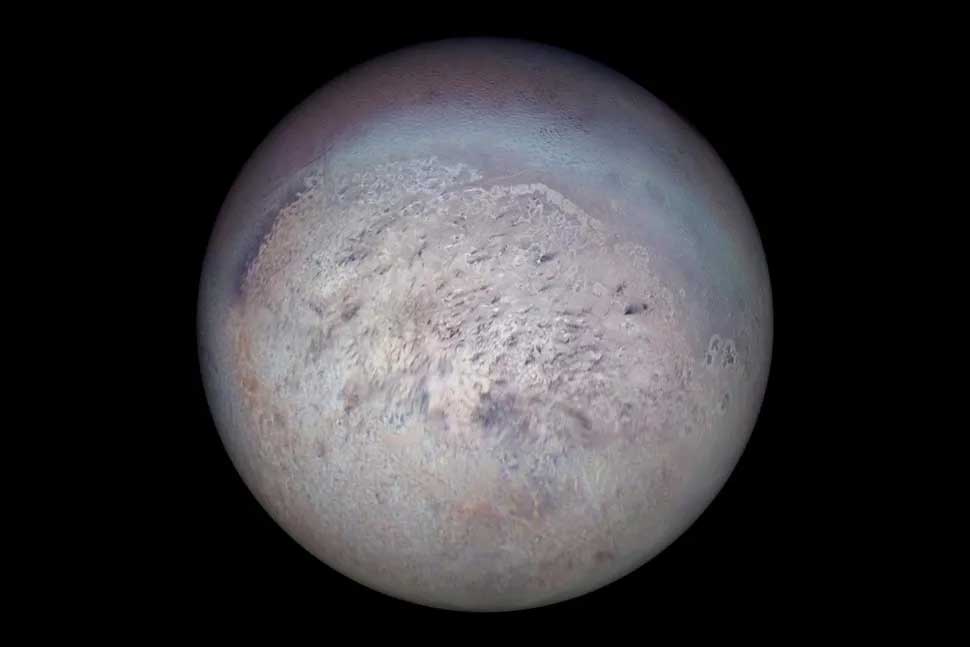
NASA’s Voyager 2 spacecraft captured dark streaks created by geysers visible on the icy surface of Triton’s south polar region. NASA/JPL
When researchers analyzed computer models of haze formation, they found that if the same chemical reactions occurred on Pluto as on Titan, they would only produce about half the amount of haze particles detected in previous studies on the dwarf planet. Because Pluto’s atmosphere is approximately 175 degrees Fahrenheit, or 80 degrees Celsius, cooler than Titan’s, chemical processes in its atmosphere proceed more slowly.
In their study, Lavvas and his colleagues propose that, as on Titan, sunlight triggers chemical reactions in Pluto’s upper atmosphere, forming simple compounds such as hydrogen cyanide—a molecule consisting of one hydrogen atom, one carbon atom, and one nitrogen atom. Their models suggest that hydrogen cyanide can freeze, forming tiny ice particles.
As these microscopic ice particles settle under gravity, other gases condense around them, coating them. Thus, the haze particles on Pluto may consist primarily of various types of ice, rather than more complex organic compounds, as on Titan. Scientists noted that the sizes, abundance, and distribution of these ice grains in the atmosphere, as predicted by computer models, are virtually identical to the sizes of the haze particles detected on Pluto.

NASA’s New Horizons spacecraft captured this image of the blue haze around the dwarf planet Pluto during its historic flyby in 2015. NASA/JHUAPL/SWRI/SPL
Furthermore, the researchers argue that these icy particles on Pluto should interact less with incoming solar energy than the haze particles on Titan. Therefore, according to Lavvas, they should play a smaller role in regulating the temperature of Pluto’s atmosphere than previously thought.
As for Triton, scientists say its atmosphere should be even colder than Pluto’s.
Comment on Facebook* The owner of the Meta company is recognized as extremist in Russia and is banned.See also... Complete list of HTML/Javascript event handlers with examples List of required documents for a website in the Russian Federation |