New models show that stars can exist using only dark matter as fuel, and because there is an extremely large amount of dark matter near the Galactic Center, these stars become immortal.
In 2024, new research revealed that some stars at the center of our galaxy may defy the stellar life-and-death models. These stars may feed on dark matter, the most mysterious substance in the universe, to effectively achieve cosmic immortality, which, in turn, necessitates the creation of a “Hertzsprung-Russell diagram.”
Scientists have developed the Hertzsprung-Russell diagram—a map of stellar life. This diagram traces stars of all masses throughout their evolution, from hydrogen-burning main-sequence stars to dense cosmic remnants.
Stars, like everything else, must die. When their cores run out of the fuel needed for nuclear fusion, stars of all sizes collapse under their own gravity, dying and forming a dense cosmic remnant such as a white dwarf, neutron star, or black hole. Our own star, the Sun, will suffer this fate in about 5 billion years, first swelling to the size of a red giant and destroying the inner planets, including Earth. After about 1 billion years, this phase, too, will end, leaving the Sun’s core as a smoldering white dwarf, surrounded by a cosmic ash cloud of cooling stellar matter.
The stars closest to the Galactic Center, the so-called “S-cluster stars,” exhibit a number of properties found nowhere else: it’s unclear how they ended up so close to the center, where the environment is considered quite hostile for star formation. The S-cluster stars, located approximately three light-years from the very heart of our galaxy, also appear to be much younger than would be expected if the stars migrated to this region from other parts of the Milky Way, reports a research team at the Kavli Institute for Particle Astrophysics and Cosmology.
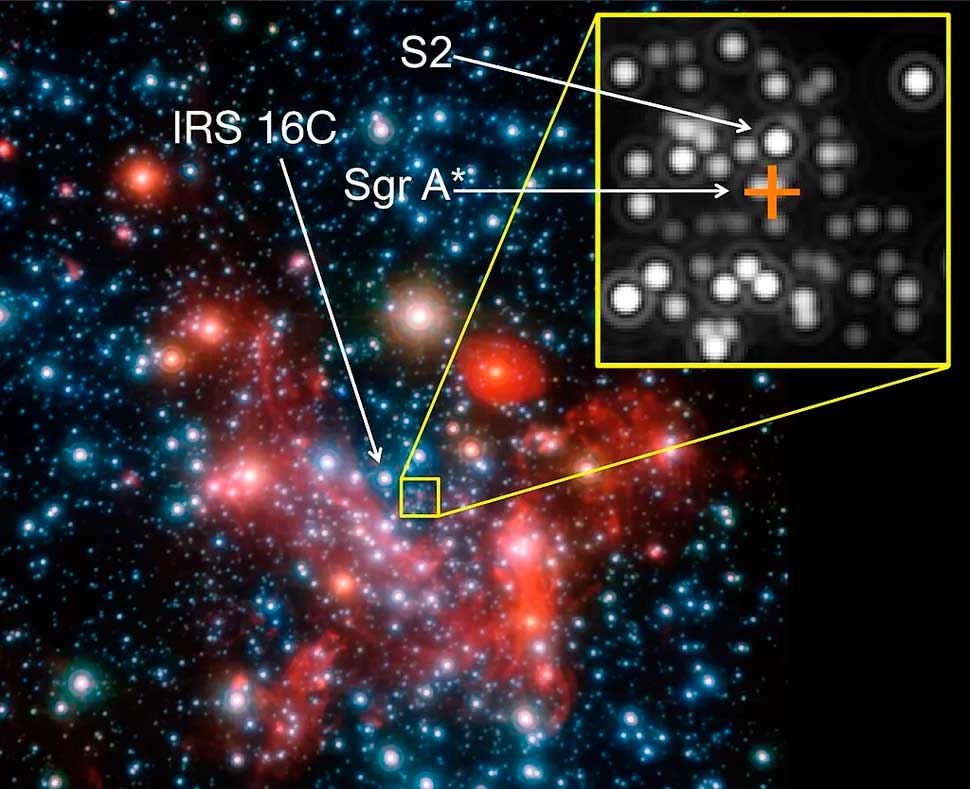
The Milky Way’s galactic center, as seen with the GRAVITY telescope, reveals two S-cluster stars. ESO/MPE/S. Gillessen et al.
These unusual properties may be due to the fact that these stars accumulate large amounts of dark matter, which then annihilates within them. This process could provide them with an entirely new and unexpected form of fuel. Models suggest that stars can exist solely using dark matter as fuel, and because there is an extremely large amount of dark matter near the Galactic Center, these stars become immortal.
The idea of immortal stars could simultaneously explain many of the unusual properties of S-cluster stars. If stars at the galactic center become immortal due to the high density of dark matter, this could explain the unusually large number of seemingly young stars in the galactic center, while also explaining the absence of older stars.
Dark matter poses a challenge for physicists because, while it makes up an estimated 85% of the universe, it is invisible to us because it does not interact with light. Furthermore, dark matter does not appear to interact with “ordinary matter.” This ordinary matter consists of protons, neutrons, and electrons and includes all the stars, planets, moons, asteroids, comets, gas, dust, and living organisms in the universe.
Scientists can only speculate about the existence of dark matter because it interacts with gravity, and this interaction can affect ordinary matter and even light. However, if interactions between dark matter and ordinary matter do occur, they are rare and weak; scientists believe we have never detected such interactions.
It’s less clear whether dark matter interacts with itself. To understand what this means, remember that all ordinary matter particles have an antimatter counterpart. For example, there’s a positively charged antiparticle, called a positron, for the negatively charged electron. And when matter and antimatter meet, they annihilate each other, releasing energy.
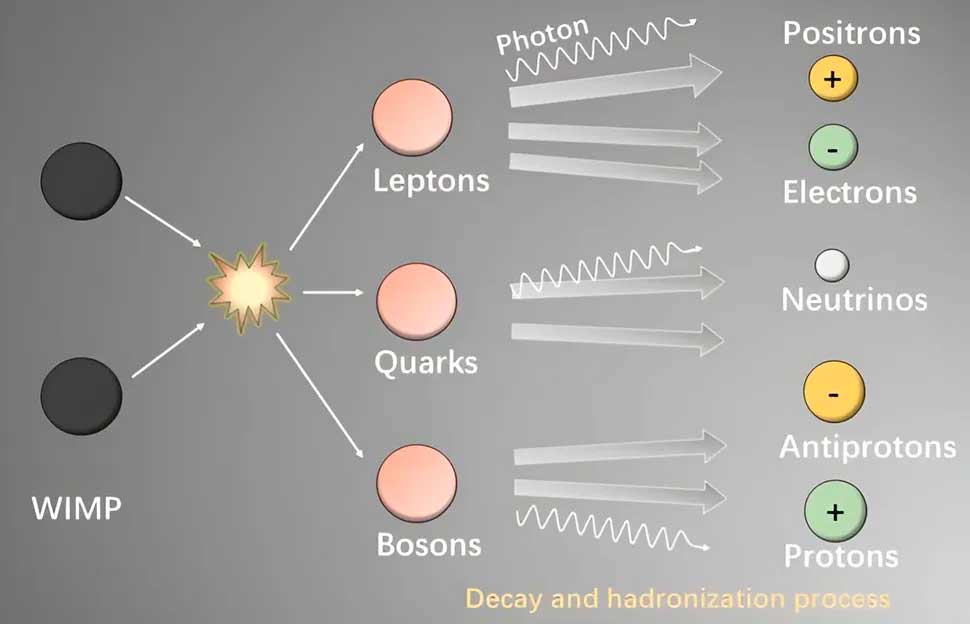
Dark matter particle candidates, called “WIMPs,” collide and annihilate, creating a stream of known particles and energy in the form of photons. Gao Linqing and Lin Sujie
Dark matter annihilation is analogous to matter-antimatter annihilation: when a particle and its antiparticle meet, they annihilate and produce other particles, such as photons. Similarly, dark matter particles can annihilate in a similar way. In many models of dark matter, dark matter particles are considered their own antiparticles, meaning that any two dark matter particles can annihilate each other.
However, we don’t observe dark matter annihilation, so it must be quite rare. This means it’s more likely to occur in environments where large amounts of dark matter are concentrated. Perhaps the superdense region at the center of a star is where the gravity with which dark matter interacts is strongest.
Main-sequence stars burn hydrogen through nuclear fusion throughout their lifetimes. This creates helium, the bulk of the star’s energy, and an outward “radiation pressure” that balances the star’s internal gravitational forces. This cosmic struggle between radiation pressure and gravity lasts for millions, even billions, of years and maintains these stars in a stable equilibrium.
For most of a star’s life, these processes occur primarily in its core, where gravitational pressure is greatest. If stars accumulate large amounts of dark matter, which then annihilates within the star, this can also create outward pressure, making the star stable through dark matter annihilation rather than nuclear fusion. Thus, stars can use dark matter as fuel instead of hydrogen. Stars use up their hydrogen, which ultimately leads to their death. Alternatively, dark matter can accumulate continuously, making these stars immortal.
Our Sun cannot achieve immortality by switching to this alternative fuel source. Situated in the middle of one of the Milky Way’s spiral arms, it is in the wrong place in our galaxy to access this dark fountain of eternal youth.
Stars require a very large amount of dark matter to effectively fuel nuclear fusion. Throughout most of the Milky Way, the dark matter density is not high enough to significantly affect stars. But at the center of the Galaxy, the dark matter density is very high, potentially many billions of times higher than on Earth, providing the amount of dark matter needed to make stars immortal.
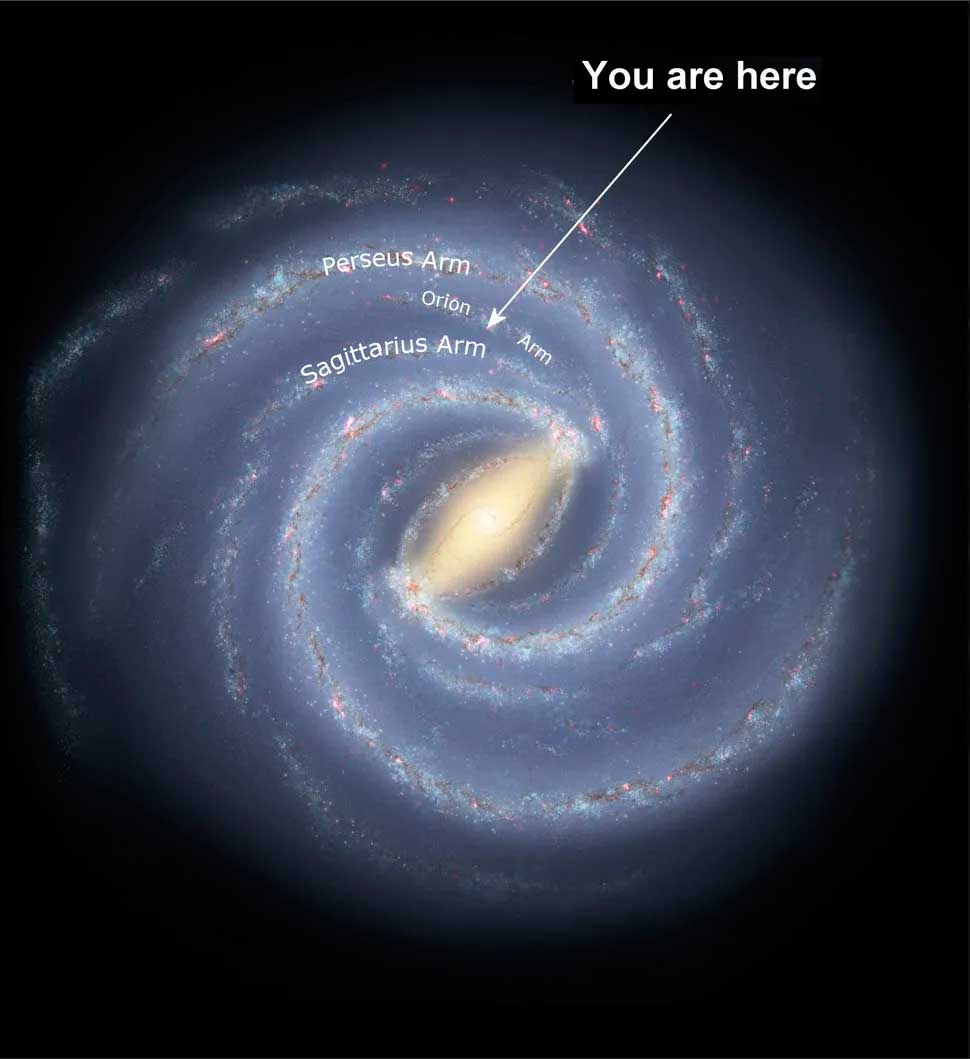
The Solar System’s position midway between the galactic center and its orbit means it won’t become immortal by feeding on dark matter. NASA/PL-Caltech/R.Hurt (SSC-Caltech)
The results of the research by the Kavli Institute for Particle Astrophysics and Cosmology team potentially reveal many secrets about dark matter itself, as well as the immortal stars it may power.
The results show that dark matter can scatter off ordinary particles, which is necessary to slow down and capture dark matter particles within a star, and that dark matter particles can annihilate with each other. By observing the distribution of immortal stars around the Galactic Center, it is possible to obtain some information about the distribution and density of dark matter around the Galactic Center.
To confirm these findings, astronomers need more precise observations of the Milky Way’s innermost stars to determine whether these stars are on the “dark main sequence,” which could indicate their immortality.
Researchers also intend to determine the impact of dark matter annihilation on different stars. Initial models suggest that lighter stars will become “bloated” and shed their outer layers when they switch to this dark fuel. This could explain the nature of the so-called “G-objects” discovered in the center of the Galaxy—stellar bodies that appear to be surrounded by clouds of gas.
According to new research, galaxies may be associated with giant “dark stars”—clusters of invisible matter located at their cores. Although astronomers have ample evidence that most of the mass in any given galaxy is invisible, they still don’t know what this “dark matter” is.
In recent decades, the most promising hypothesis has been that dark matter consists of some kind of heavy particles that rarely, if ever, interact with light or other matter. However, this hypothesis struggles to explain the relatively low density of galactic nuclei, as modeling of dark matter’s behavior predicts that it should easily condense to extremely high densities, which is inconsistent with observations.
One possible answer to this problem is that dark matter particles are incredibly light—billions of times less massive than neutrinos, the lightest particle currently known. These hypothetical particles, dubbed “fuzzy” dark matter, are so light that their quantum wave nature manifests itself on larger, macroscopic—even galactic—scales. This means they could stabilize into gigantic clumps of invisible matter, forming dark stars.
These dark stars can extend across space for thousands of light-years, yet have relatively low masses due to their very light particles. Therefore, they could potentially form galactic nuclei, providing the bulk of their mass without creating ultra-high densities at their centers.
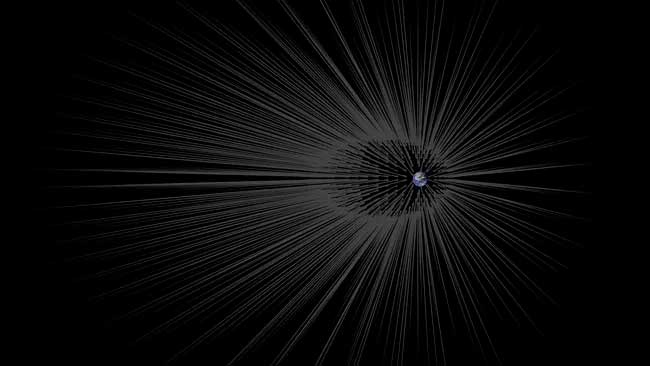
An illustration of “hairy” dark matter around Earth. New research suggests that dark matter clumps may form enormous, invisible stars at the centers of galaxies like our own. NASA/JPL-Caltech
But galaxies aren’t made solely of dark matter—fuzzy or otherwise. They also contain ordinary matter, distributed as diffuse gas clouds and stars, and it’s these elements that astronomers can observe. Therefore, to test this idea, we need to understand the relationship between fuzzy dark matter and ordinary matter within a galaxy.
In a paper published in December 2024 on arXiv, an international team of astrophysicists explored how galaxies might evolve in response to the presence of fuzzy dark matter. In this first step, they did not attempt to recreate an entire complex galaxy. Instead, they constructed a simple model containing just two components: a large fraction of fuzzy dark matter and a smaller fraction of simple, ideal gas.
They then calculated how these two components would evolve under the influence of their mutual gravity. They found that, despite initially behaving randomly, the diffuse dark matter quickly coalesced into a large central clumping point, surrounded by more diffuse clouds of dark matter.
Gas followed, mixing with the fuzzy dark matter at the center, forming what the researchers called a fermionic-boson star, referring to the two types of matter that mixed to form the central object. This star would have been completely unlike our usual conception of a star. It would have been gigantic—up to 10,000 light-years across—and almost completely invisible, save for a faint glow of gas distributed across its surface.
However, the researchers noted that this would serve as an ideal representation of a galactic core containing a higher, but not too high, density of ordinary matter, thereby confirming a key prediction of the fuzzy dark matter model.
In early 2026, new research revealed that the supermassive black hole at the center of the Milky Way is actually an incredibly massive yet compact cluster of dark matter.
Scientists argue that this dark matter cluster would exert the same gravitational influence currently attributed to the Milky Way’s supermassive black hole, Sagittarius A* (Sgr A*). This includes the violent and fast-paced stellar dance occurring at the Galactic Center, in which so-called “S-stars” race around our galaxy’s compact core at speeds of up to 67 million miles per hour (30,000 kilometers per second). For comparison, that’s about 10% of the speed of light. According to the researchers, this dark matter cluster also explains the orbits of dust-shrouded bodies, or “G-sources,” located at the Galactic Center. The team’s findings were published on February 5, 2026, in the journal Monthly Notices of the Royal Astronomical Society (MNRAS).
However, this replacement of dark matter with a black hole only works if the dark matter consists of ultra-light particles belonging to the “fermion” family. This would allow the dense cluster at the center of the galaxy to form a cosmic structure consistent with the observed characteristics of the Galactic Center.
The research team argues that fermionic dark matter is capable of forming a structure consisting of an ultra-dense, compact core with such enormous mass that it mimics a supermassive black hole with a mass equivalent to 4.6 million solar masses. This core would be surrounded by a vast, diffuse halo extending far beyond the visible matter of the Milky Way, yet acting as a single entity. This is a structure that cannot be reproduced using other methods of dark matter synthesis.
“We’re not simply replacing the black hole with a dark object; we’re proposing that the supermassive central object and the galaxy’s dark matter halo are two manifestations of the same continuous matter,” said team member Carlos Argüelles of the Instituto de Astrofísica de La Plata in a statement.
The theory proposed by Argüelles and his colleagues is largely based on observations made by the European Space Agency’s Gaia star-tracking mission, the results of which were published in June 2022 as part of the project’s third data release.
Gaia allowed the team to precisely map the rotation and orbits of stars and gas in the Milky Way’s outer halo, revealing a slowing of our galaxy’s rotation curve: the so-called Keplerian decay. The team believes that Keplerian decay can be explained by their observed diffuse outer halo, which is a factor in their model and is now known to support the fermionic model of dark matter.
In the standard cosmological model, also known as the Lambda Cold Dark Matter (LCDM) model (the best description of the Universe we have), dark matter is “cold,” meaning that its particles move at speeds significantly slower than the speed of light.
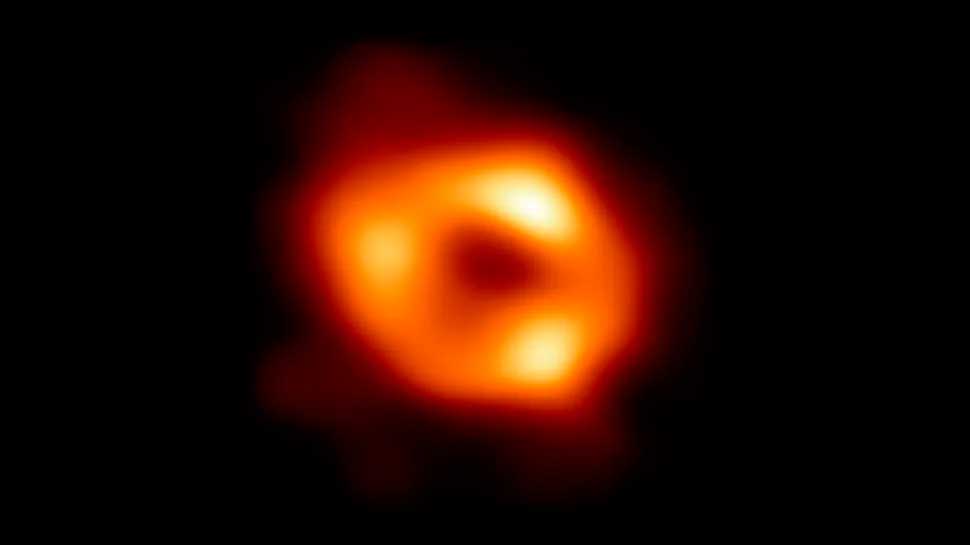
This image of the supermassive black hole at the center of the Milky Way, a giant named Sagittarius A*, was taken by the Event Horizon Telescope on May 12, 2022. Event Horizon Telescope collaboration
Cold dark matter forms an extended halo tail, which struggles to explain the slowdown observed by Gaia. The fermion model, on the other hand, predicts a denser and more compact halo tail, which could lead to a Keplerian decay. It should be noted that in the Sgr A* model, the dark matter at the center of the Milky Way is not bound together by a single structure with the outer halo, so this tail is absent in this model.
“This is the first time that a dark matter model has successfully combined these very different scales and different orbits of objects, including modern data on the rotation curve and central stars,” Argüelles said.
So far, so good. The theory that a dark matter cluster, rather than a black hole, may reside at the center of our galaxy seems quite compelling. However, there’s another important point related to the 4.6-million-solar-mass figure: an image of Sgr A* taken by the Event Horizon Telescope (EHT) and released in May 2022. However, the team claims their fermionic dark matter model can explain it.

Before delving into that explanation, it’s worth considering what we actually see when we look at the EHT image of what we all now think of as Sgr A*.
The glowing golden ring in this image is actually superhot matter orbiting something lurking at the heart of the Milky Way. What we see in this image is not a black hole at all, which makes sense because black holes are surrounded by a light-trapping surface called an event horizon; we can’t directly see Sgr A*. However, we do see the shadow cast by the black hole.
However, in 2024, researchers demonstrated that a dense core of fermionic dark matter could cast a shadow similar to the one seen in the EHT image. The core would be invisible, like a black hole, since dark matter is known not to interact with light.
“This is a turning point,” said team leader Valentina Crespi of the Instituto de Astrofísica de La Plata. “Our model not only explains the orbits of stars and the rotation of the galaxy, but also matches the famous image of a ‘black hole’s shadow.’ A dense dark matter core can mimic a shadow because it bends light so strongly, creating a central darkness surrounded by a bright ring.”
Although the team conducted a statistical comparison of their dark matter model with the generally accepted model of the supermassive black hole at the center of the Milky Way, and the former was able to reproduce the behavior of S-stars, G-sources, the structure of our galaxy, and the black hole’s shadow, the researchers emphasize that this theory is still in its early stages of development.
The team’s research lays the groundwork for future observations using the Very Large Telescope (VLT) to search for photon rings at the center of the Milky Way, which would be present in Sgr A* but absent if our galaxy’s dominant central body is a dense cluster of dark matter.
On the other hand, after 50 years of searching, astronomers have finally discovered evidence of powerful winds emanating from Sagittarius A* (Sgr A*), the supermassive black hole at the center of our galaxy. This discovery deepens our understanding of the physical processes occurring both around supermassive black holes and at the center of the Milky Way.
Scientists have long theorized that black holes generate energy by consuming matter, which pushes matter away from their surroundings—a process known as “black hole winds.” This even applies to Sgr A*, which feeds on gas and dust in such meager quantities that for a human, this is equivalent to consuming one grain of rice every million years.
The problem was that scientists had been unable to gather evidence of black hole winds flowing through the heart of the Milky Way, leaving astronomy baffled for about half a century—until now.
If a black hole doesn’t exist in a perfect vacuum, it must somehow emit a wind. And a perfect vacuum doesn’t exist in the Universe. Thanks to these new observations, this is the first time we have a clear enough image to see the signature of the wind. The team’s results were published on June 4, 2026, in The Astrophysical Journal Letters.
Scientists have long known that feeding black holes emit powerful outflows of matter around themselves, including jets and winds. Winds arise when matter falling toward the black hole accelerates to nearly the speed of light, creating pressure that pushes the infalling matter away. This has been observed in black holes that consume matter very rapidly, but not in the lightly fed Sgr A*. Its sparse consumption of matter and the fact that it is hidden from our view by the plane of the Milky Way make it difficult to track this wind.
Gorski’s colleague from Northwestern University and co-leader of his team, Lena Murcikova, noted that the scientists were the first to detect molecular gas in the immediate vicinity of Sgr A*, which feeds a supermassive black hole. This allows them to confidently conclude that Sgr A* is similar to other supermassive black holes.
“The wind isn’t strong, and its direction likely changes over time. This shows that our black hole isn’t unique, and neither is our place in the Universe,” Murchikova added. “To observe our own black hole, we have to look through the plane of our galaxy. This means we have to peer through gas, dust, and ionized structures, and it’s not easy to see through all of that.”
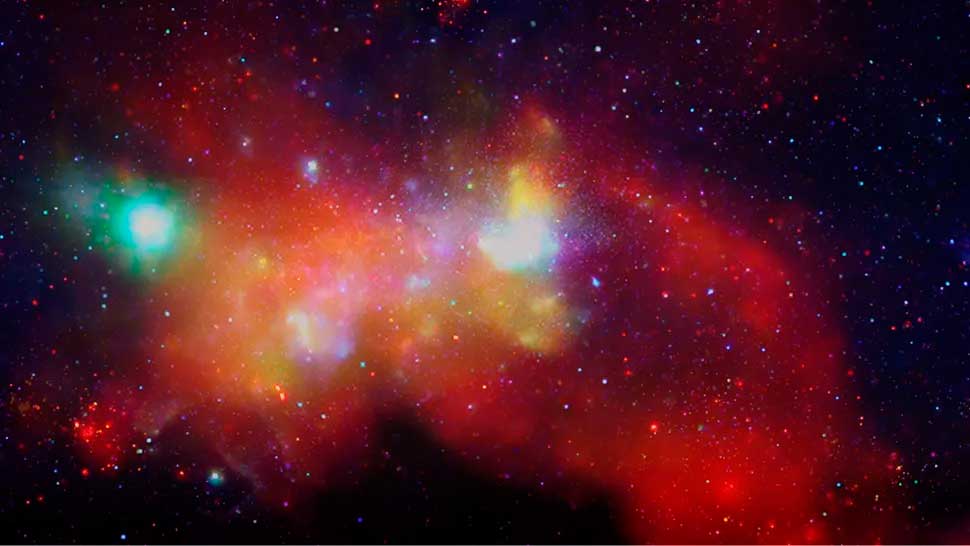
A composite image of the center of the Milky Way, obtained by combining radio data from the ALMA telescope with X-ray data from the Chandra telescope. NASA/CXC/UMass/D. Wang et al.; radio emission: ALMA(ESO/NAOJ/NRAO)/S. Longmore et al. Background image: ESO/D. Minniti et al.
To address these difficulties, the team turned to five years of deep observations of the Milky Way’s center using the Atacama Large Millimeter/submillimeter Array (ALMA), a 66-antenna array located in northern Chile. This yielded the sharpest image to date of cold molecular gas, spanning approximately 3 light-years across, for Sgr A*. One aspect of these observations that struck the scientists was a three-light-year-long cone-shaped cavity within this cloud of cold gas. They hypothesized that this cavity must have been cleared by hotter gas in the black hole’s wind sweeping through the region, either pushing the cold gas ahead or heating it.
“If you blow hot material out of a black hole, it won’t want to coexist with cold material,” Gorski said. “It will either push the cold material out or heat it up. And if it gets too hot, the cold gas won’t be visible anymore.”
The region around Sgr A* is densely populated with stars, and the stars also emit stellar winds, but the team believes these stellar winds are not sufficient to form such a large cavity.
“This is a massive deficit of matter. We calculated how much energy was required to create this cavity. It’s more than the stars in this region could provide,” Gorski explained. “Essentially, a contribution from the supermassive black hole is required. And if you trace the shape of the cone, it points directly toward the black hole.”
To double-check their results, the scientists turned to observations of the same region by NASA’s Chandra X-ray Space Telescope.
“Exceptional claims require exceptional evidence,” Gorski said. “We wanted to make sure this wasn’t just some imaging artifact. And then the Chandra X-ray image matched perfectly. The molecular features matched.”
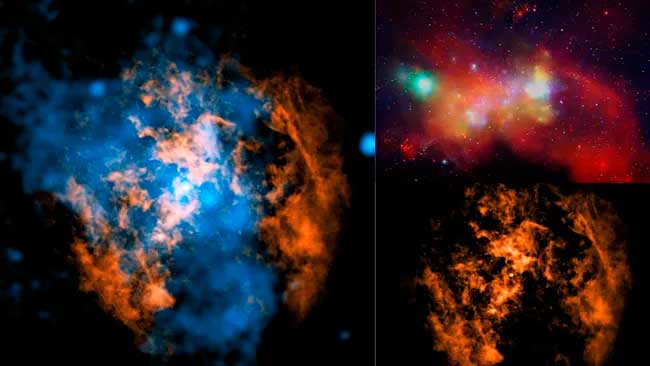
Images of the center of the Milky Way from the Atacama Large Millimeter/submillimeter Array (ALMA) and the Chandra X-ray telescope. X-ray: NASA/CXC/Northwestern University/M. Gorski; Radio: ESO/NAOJ/NRAO/ALMA; Imaging: NASA/CXC/SAO/K. Arcand and P. Edmonds. NASA/Mass./D. Wang et al.
This confirmed the results obtained by ALMA, which revealed X-ray emission coming from a region of the cavity in the cold gas.
While the study’s results confirm that Sgr A* is extremely quiet compared to supermassive black holes located in bright, turbulent regions of other galaxies called active galactic nuclei (AGNs), this black wind is not weak. In fact, scientists believe it has been raging for about 20,000 years.
In 2026, scientists studied high-energy radiation known as the Galactic Center Excess.
One of the most debated mysteries in astronomy looks set to continue, as new research doesn’t rule out the self-annihilation of dark matter as the source of gamma rays emanating from the Milky Way’s core. This high-energy radiation, known as the Galactic Center Excess, is a spherical gamma-ray emission extending thousands of light-years from our galaxy’s core and has baffled researchers for over a decade.
While several possible explanations for the excess of particles at the center of the Galaxy have been proposed, including a population of rapidly rotating neutron stars called pulsars, one of the most common is a specific type of dark matter particle. Dark matter is a mysterious substance that makes up 85% of the matter in the universe. It is virtually invisible because it does not interact with light or with “ordinary” matter, which is composed of atoms. This fact has led to the development of numerous possible dark matter particle candidates, including some that self-annihilate. This is similar to what happens when an electron encounters its antimatter counterpart, a positron. They annihilate each other, releasing energy into space.
In the case of self-annihilation of dark matter, these particles are their own antiparticles, meaning that when they interact, they annihilate and release energy in the form of gamma rays. Since dark matter is five times more massive than ordinary matter, one would expect this annihilation to occur constantly, filling the cosmos with gamma rays. However, in this model, dark matter rarely interacts with itself. Thus, dark matter annihilation is a factor only when this mysterious substance is densely concentrated in a region like the heart of a galaxy. The team’s research results were published on February 5, 2026, in the journal Physical Review Letters.
“Interpreting the signal is particularly challenging because the Galactic center is an exceptionally bright and densely populated gamma-ray region,” said Florian List, a member of the research team and a researcher at the University of Vienna, in a statement.
To determine whether dark matter annihilation could indeed explain the excess gamma rays at the galactic center, List and his colleagues turned to machine learning trained on over a million simulated gamma-ray observations. Previous similar approaches pointed to relatively bright, unresolved light sources as potential sources of the excess gamma rays at the galactic center. However, this new study found that these point sources, including pulsars, would be extremely faint, which is good news for scientists who favor dark matter annihilation as the cause of these gamma rays.
This is because, while previous studies suggested that only a few hundred pulsars were enough to explain the excess of pulsars in the Galactic center, these results indicate that the pulsar population in the center of the Milky Way must be larger than 35,000.
See also... New method for observing individual atoms confirms century-old quantum mechanical theory |
“Our new analysis shows that the sources must be so faint that they are virtually indistinguishable from the radiation expected from annihilating dark matter,” said research team member Nick Rodd, a scientist at Lawrence Berkeley National Laboratory.
While this study may leave dark matter as a possible explanation, it falls far short of confirming the annihilation of this mysterious substance as the source of the excess radiation at the galactic center. “The origin of the excess radiation at the galactic center is one of the longest-running debates in astrophysics,” said List. “Our work does not show that dark matter is responsible for this signal. However, it does suggest that it is too early to rule out this possibility.”
In mid-2025, the Gaia telescope detected a huge wave in our galaxy.
Our Milky Way galaxy never stands still: it rotates and oscillates. And now data obtained by the European Space Agency’s Gaia space telescope shows that a giant wave is also emanating from the center of our galaxy.
We’ve known for about a hundred years that the galaxy’s stars orbit its center, and the Gaia telescope has measured their velocities and motions. Since the 1950s, we’ve known that the Milky Way’s disk is warped. Then, in 2020, Gaia discovered that this disk wobbles over time, like the motion of a spinning top. The paper by E. Poggio and co-authors, “The Big Wave: Evidence for Large-Scale Vertical Corrugations Propagating Outward in the Galactic Disk,” was published in the scientific journal Astronomy and Astrophysics.
It has now become clear that a massive wave is driving stars in our galaxy at distances of tens of thousands of light-years from the Sun. Like a stone thrown into a pond and causing ripples, this galactic wave of stars encompasses a significant portion of the Milky Way’s outer disk.
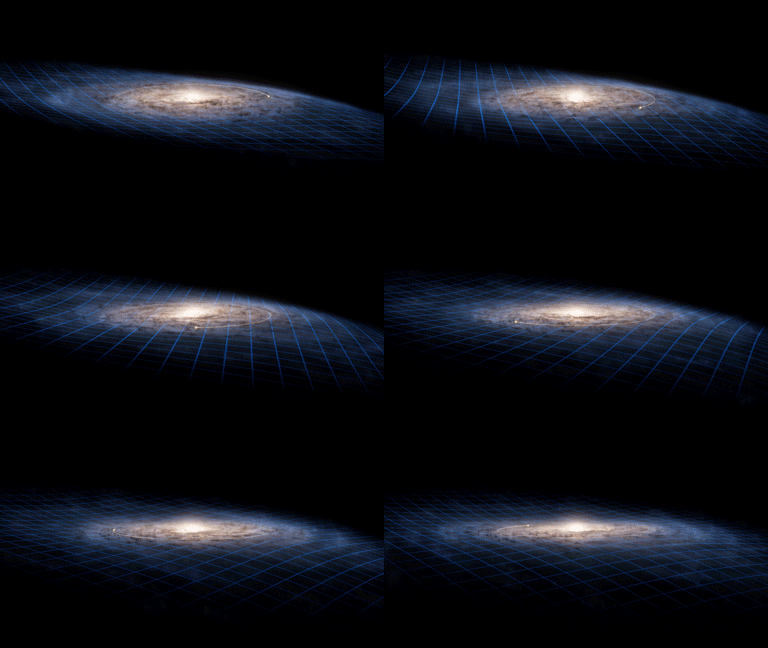
The Milky Way’s warped galactic disk wobbles like a spinning top. ESA
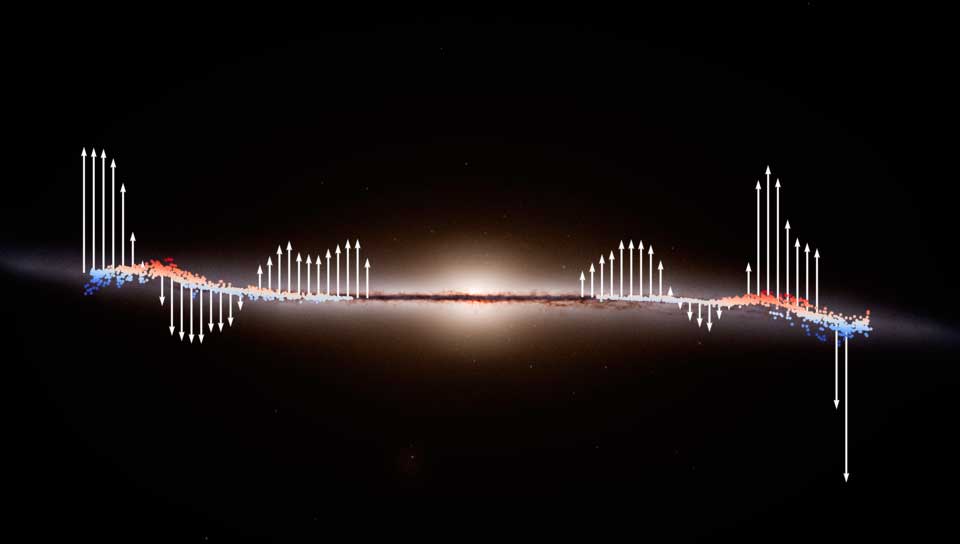
The unexpected galactic ripples are shown in the image. The positions of thousands of bright stars are shown in red and blue, superimposed on maps of the Milky Way provided by Gaia.
In the left image, we look at our galaxy from above. In the right image, we see a vertical slice through the galaxy, viewing the wave from the side. This perspective shows that the “left” side of the galaxy is curved upward, while the “right” side is curved downward (this is due to the disk warp). The newly discovered wave is indicated in red and blue: in the red regions, stars are located above, and in the blue regions, stars are located below, the galaxy’s warped disk.
Even if no spacecraft were ever able to leave our galaxy, the uniquely precise image obtained by the Gaia satellite – in all three spatial directions (3D) plus three speeds (movement toward us, away from us, and horizontally) – allows scientists to create these maps from top to bottom and side to side.
These data show that the wave extends over a huge part of the galactic disk, affecting stars located at a distance of at least 30–65 thousand light years from the center of the galaxy (for comparison, the diameter of the Milky Way is about 100 thousand light years).
The Milky Way’s Great Wave in Motion ESA
“What makes this even more compelling is our ability, thanks to Gaia, to also measure the motion of stars inside the galactic disk,” says Eloisa Poggio, an astronomer at the National Institute for Astrophysics (INAF) in Italy, who led the team that discovered the wave.
“What is interesting is not only the visual manifestation of the wave structure in three-dimensional space, but also its wave-like behavior when analyzing the motion of stars within it.”
The motions of the stars are shown by white arrows in the image of the Milky Way. You can see that the wave-like pattern of the vertical motions (represented by the arrows) is slightly offset horizontally relative to the wave-like pattern formed by the vertical positions of the stars (indicated by the red/blue colors).
“The observed behavior is consistent with what we would expect from a wave,” explains Eloise.
Imagine a “wave” created by a crowd in a stadium. Given that galactic timescales are much longer than ours, imagine this “wave” in the stadium frozen in time, similar to how we observe the Milky Way. Some people will be standing upright, some will have just sat down (as the wave passes), and others will be preparing to stand up (as the wave approaches them).
In this analogy, people standing upright correspond to the areas colored red on our maps, photographed from the front and side. And if we consider movement, the people with the largest positive vertical movements (represented by the largest white arrows pointing upward) are those just beginning to stand up, ahead of the approaching wave.
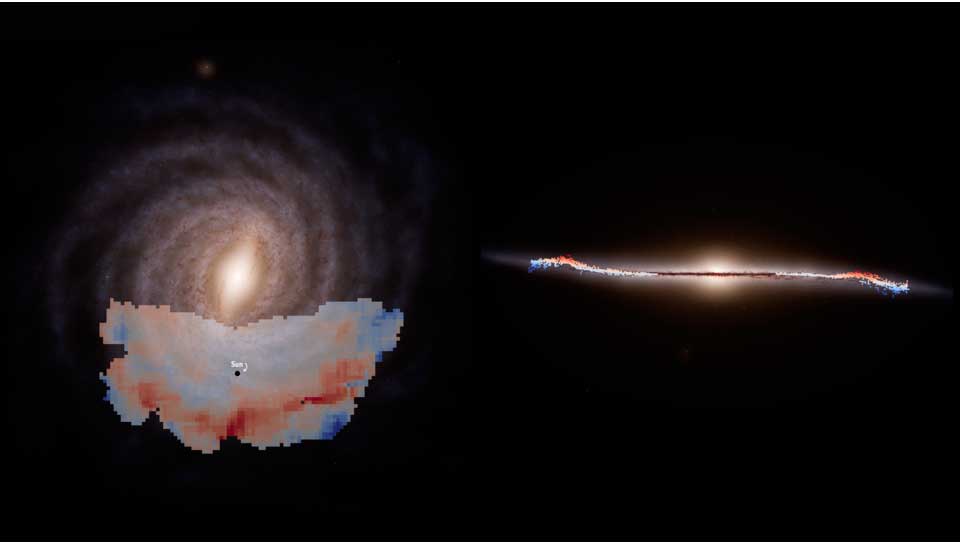
Illustration of a huge wave of the Milky Way. ESA
Eloise and her colleagues were able to track this remarkable movement by studying the detailed positions and motions of young giant stars and Cepheid stars. These are the types of stars whose brightness varies predictably, which can be observed with telescopes like Gaia at large distances.
Since young giant stars and Cepheid stars move with the wave, scientists believe that gas in the disk may also be involved in these large-scale ripples. Perhaps young stars retain a memory of the wave information from the very gas from which they were born.
Scientists don’t know the origin of these galactic vibrations. A possible explanation is a past collision with a dwarf galaxy, but further investigation is needed.
This huge wave may also be related to a smaller wave-like motion observed 500 light-years from the Sun and extending over 9,000 light-years, called the Radcliffe wave.
“However, the Radcliffe wave is a much smaller filament and is located in a different part of the galactic disk than the wave studied in our work (much closer to the Sun than the larger wave). These two waves may or may not be related. That’s why we’d like to conduct further research,” adds Eloise.
“The upcoming fourth Gaia data release will include even more precise coordinates and motions of Milky Way stars, including variable stars such as Cepheids. This will help scientists create even better maps and thereby advance our understanding of these characteristic features of our home galaxy,” says Johannes Zahlmann, Gaia Project Scientist at ESA.
See also... Complete list of HTML/Javascript event handlers with examples List of required documents for a website in the Russian Federation |