Billions of years ago, Venus had as much water as Earth, but at some point in its evolution, clouds of carbon dioxide in the planet’s atmosphere triggered the most intense runaway greenhouse effect in the Solar System. This led to a sharp increase in temperature to the levels observed today. This, in turn, caused the planet’s water to evaporate, disappearing into space. Meanwhile, Venus’s atmosphere at cloud level rotates approximately 60 times faster than the planet itself—a phenomenon known as superrotation.
The influence of the magnetic field on the atmosphere of Venus
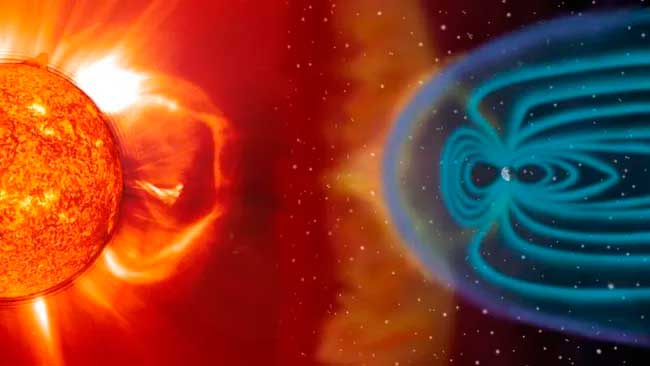
According to data obtained by the European space probe BepiColombo during its flyby of Venus, large quantities of gases, including carbon and oxygen, are being emitted from the planet’s atmosphere.
These data were obtained during the spacecraft’s flyby of Mercury and could shed new light on the permeable atmosphere of our planetary neighbor. These findings could further help scientists catalog the composition of Venus’s fragile magnetic environment.
Unlike Earth, a planet with its own magnetic field that protects its atmosphere from escaping into deep space, Venus lacks its own stable magnetic field. This is because its cooler interior cannot stir the molten material necessary to create and maintain a magnetic field. Instead, sunlight falling on the amber-green sphere charges the atoms of its atmosphere, which then generate electric currents that generate an unstable, sunlight-dependent magnetosphere. The results of the study were published on April 12, 2024, in the journal Nature Astronomy.
In August 2021, the BepiColombo spacecraft flew for 90 minutes through the weak magnetosphere of the comet-shaped planet to slow down and adjust its course toward its final destination, Mercury. However, scientists analyzing the data collected during this fleeting visit discovered valuable information about Venus. Charged particles, or ions, were apparently escaping the planet due to sunlight accelerating molecules in the atmosphere to extremely high speeds. These speeds were so high that the ions even escaped the planet’s gravity and escaped into space.
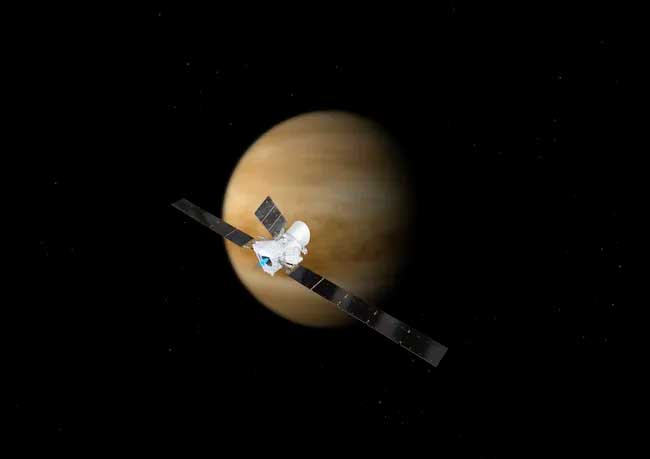
Artist’s impression of the BepiColombo mission flying past Venus. ESA.ATG medialab
“These are heavy ions that typically move slowly, so we’re still trying to understand the mechanisms that are involved,” Lina Hadid, a researcher at the Laboratory of Plasma Physics in France who led the new analysis, said in a statement.
Venus’s dense, hellish atmosphere is composed primarily of carbon dioxide, but also contains smaller amounts of nitrogen and other trace gases. Scientists previously knew of tiny amounts of oxygen on the night side of Venus, but last November, another team of researchers also detected this molecule on the planet’s dayside. This same team concluded that oxygen concentrations on Venus are declining in tandem with decreasing solar radiation.
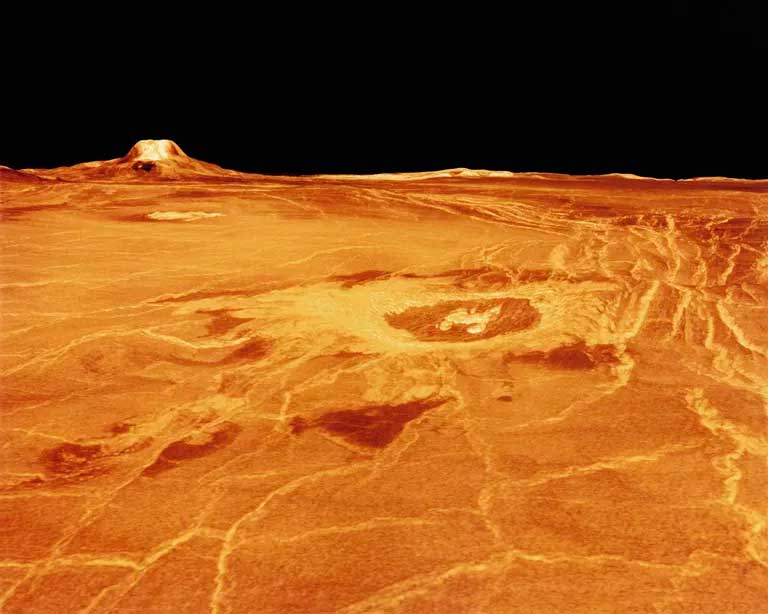
Magellan’s mapping radar captures the Eistla region, Gula Mons volcano, and Kunitz crater on the surface of Venus. Getty Images/Lee Corkran
Studying the loss of these molecules and the mechanisms by which they are released “is crucial for understanding how the planet’s atmosphere evolved and how it lost all its water,” study co-author Dominique Delcourt, also a researcher at the Laboratory of Plasma Physics, said in the same statement.
The BepiColombo spacecraft is nearing the end of its seven-year journey and is expected to reach Mercury in late 2025. Meanwhile, a fleet of robotic probes is planned to visit Venus in the next decade. The European Envision spacecraft is scheduled to launch in 2031, and NASA’s DAVINCI probe, originally scheduled for 2029, has been delayed until 2031.
The relaunched VERITAS mission is now also scheduled to launch no earlier than 2031, although team members still favor an earlier launch, in November 2029.
During its seven-year solar exploration mission, NASA’s Parker Solar Probe may have finally discovered the source of Venus’s mysterious lightning storms. The discovery came in 2021, when Parker made a scheduled flyby of Venus to harness the planet’s gravitational pull and get closer to its host star.
In short, according to a paper based on 2021 Parker Space Telescope data, the flashes of light on Venus that many experts attribute to lightning may not be lightning at all. Rather, they appear to be related to disturbances in the magnetic fields surrounding the planet. Of course, this doesn’t mean there’s no lightning on Venus—perhaps just not as much as we once thought.
“The debate about lightning on Venus has been going on for almost 40 years,” George said. “Hopefully, with this new data, we can help settle the debate.”
In fact, although Venus appears to be riddled with lightning, based on signals collected by scientists over time, some things don’t quite add up. For example, a 2021 study, the statement says, failed to detect radio waves expected from lightning on the planet, and a paper published in August 2023 suggests that some flashes of light commonly attributed to Venusian lightning are actually meteors burning up in the planet’s atmosphere.
Essentially, George and his fellow researchers reached their conclusions about lightning on Venus—or the lack thereof—by tracking a phenomenon known as “whistle waves.” A paper describing these findings was published on September 29, 2023, in the journal Geophysical Research Letters.
Whistle waves are fleeting pulses of energy expressed as electromagnetic waves that can propagate through various media; on Earth, for example, they propagate through part of the atmosphere and typically last about half a second. But most importantly, on Earth, these whistler waves are generated specifically by lightning discharges.
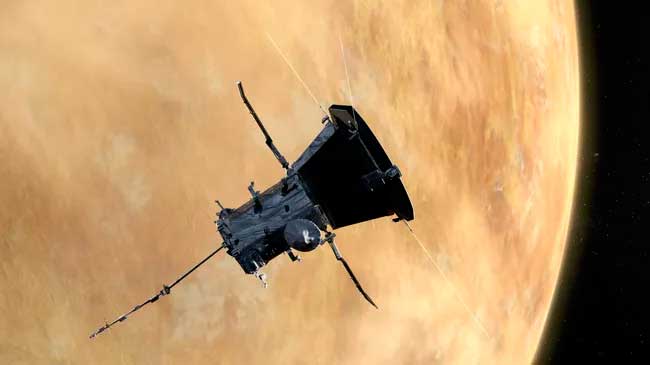
An artist’s concept of NASA’s Parker Solar Probe flying past Venus. NASA/Johns Hopkins APL/Steve Gribben
So, when scientists first noticed whistling waves on Venus in 1978 thanks to the Pioneer Venus spacecraft, it was understandable that they assumed Venus must be awash with lightning. So much so that many experts believed Venus had approximately seven times more lightning than our own planet, according to a statement released in connection with a new study.
“Some scientists, seeing these signs, said, ‘It could be lightning,'” George said. “Others said, ‘Actually, it could be something else.’ And the debate has been going on for decades.”
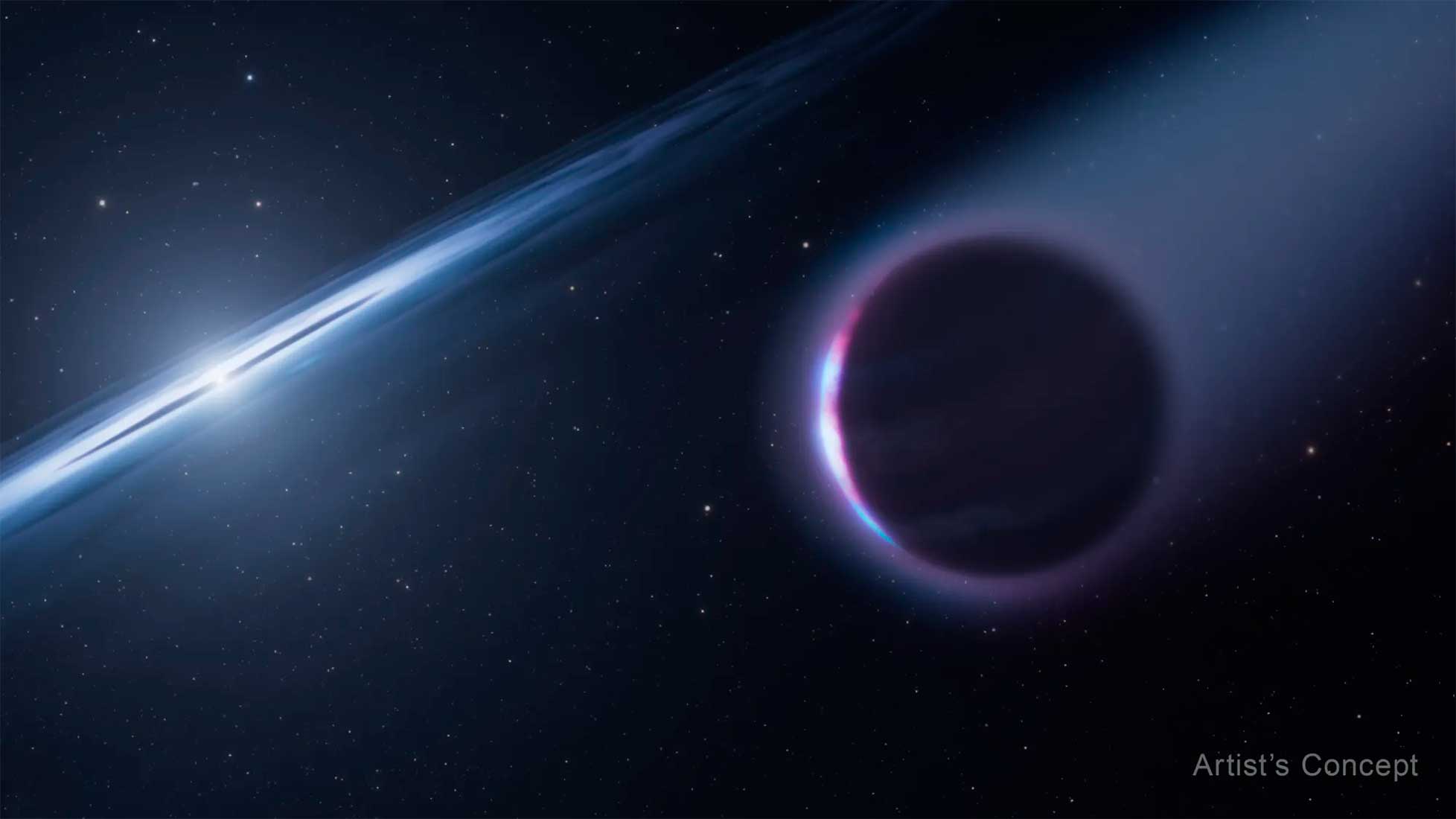
Following Pioneer’s discoveries, the Galileo spacecraft found further evidence of lightning in 1990, but Cassini’s flybys in 1998 and 1999 failed to detect the radio interference expected to accompany lightning on Venus. Then, between 2006 and 2014, Venus Express, the first European orbiter to explore Venus, found promising evidence that, yes, there is lightning on Earth’s “evil twin.” It’s all highly uncertain, but a definitive answer about lightning on Venus may be close—especially because Parker’s data was collected when the probe was a significant distance from the planet. About 2,414 kilometers (1,500 miles) away.
As George explains, whistling waves don’t necessarily have to be caused by lightning—and when the Parker spacecraft flew past the straw-colored planet a few years ago, it got incredibly close and collected data that indeed suggests that whistling waves on Venus are not caused by lightning.
The researchers observed these whistling waves traveling downward toward the planet, rather than outward, as happens with lightning-induced whistling waves on Earth, which propagate through the atmosphere. “They were traveling in the opposite direction to what everyone had imagined for the past 40 years,” said David Malaspina, co-author of the study and an associate professor at LASP.
Based on this, the team theorized that the waves are caused by disturbances in the planet’s magnetic fields. Or, more precisely, the idea is that magnetic field lines around Venus can break and then reconnect, in turn generating bursts of energy that manifest as whistler waves.
Water and acid in the atmosphere of Venus
Billions of years ago, Venus had as much water as Earth, but at some point in its evolution, clouds of carbon dioxide in the planet’s atmosphere triggered the most intense runaway greenhouse effect in the Solar System. This led to a sharp increase in temperature to the levels observed today. This, in turn, caused the planet’s water to evaporate, disappearing into space.
Scientists may have identified the molecule that played a key role in stripping Venus of its water and turning it into the arid, hellish world we see today.
Venus is often called “Earth’s twin” because both planets are roughly the same size and density; furthermore, both are rocky planets located in the inner solar system. Yet, in many important respects, Venus is quite unlike Earth.
While our planet is teeming with life, Venus, the second planet from the Sun, is a living hell. It’s the hottest planet in the Solar System (even hotter than Mercury, which is closest to the Sun), reaching temperatures of around 880 degrees Fahrenheit (471 degrees Celsius). That’s hot enough to melt lead. Furthermore, Venus’s surface experiences quite high pressure.
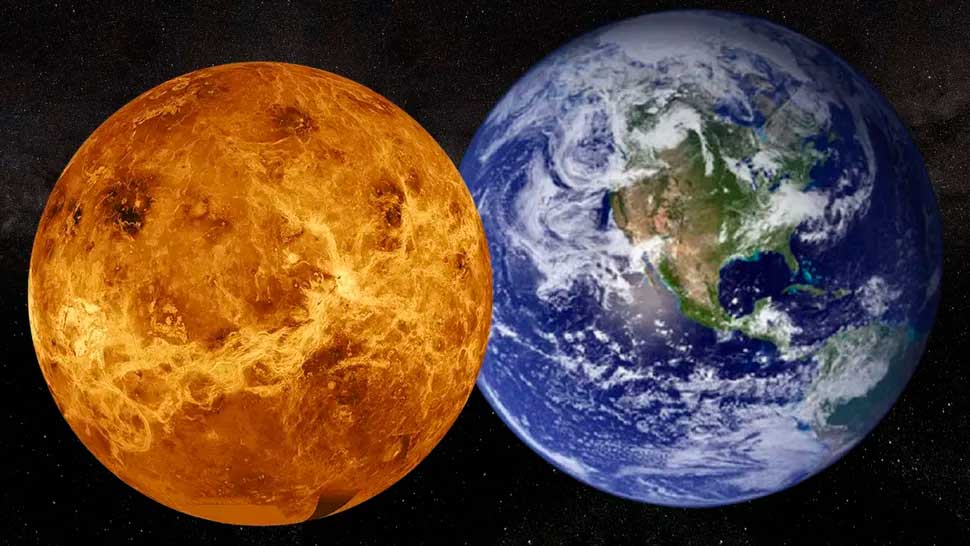
A life-size comparison image of Venus and Earth. NASA/Robert Lea
It’s important to note that Venus also lacks a key element for life that’s abundant here on Earth: water. This is despite the planet being located in the Sun’s so-called “Goldilocks zone,” the region around our star that’s neither too hot nor too cold for liquid water to exist—and despite the fact that scientists know Venus likely once harbored water.
However, even taking this process into account, scientists still don’t know how Venus became so desolate and how it continues to lose its remaining water into space. Now, a team of scientists from the University of Colorado at Boulder may have unlocked the secrets of this process, telling what they call “the story of water on Venus.”
“Water is truly essential for life,” said Erin Kanji, co-leader of the team and a research scientist at the Laboratory for Atmospheric and Space Physics (LASP), in a statement. “We need to understand the conditions that support liquid water in the universe and that may have led to Venus’s current, very dry state.”
“We’re trying to figure out what small changes occurred on each planet that led it to these very different states.”
To illustrate the difference in water content between Earth and Venus, Kanji explained that if all the water on Earth were evenly distributed across its surface, it would create a global layer nearly 3.2 kilometers thick. If the same were done on Venus, removing the remaining water from the atmosphere would yield a global layer just 3 centimeters thick. The team’s results were published on May 6, 2024, in the journal Nature.
“Venus has 100,000 times less water than Earth, despite being nearly the same size and mass,” Michael Chaffin, co-leader of the team and a colleague at LASP, explained in a statement.
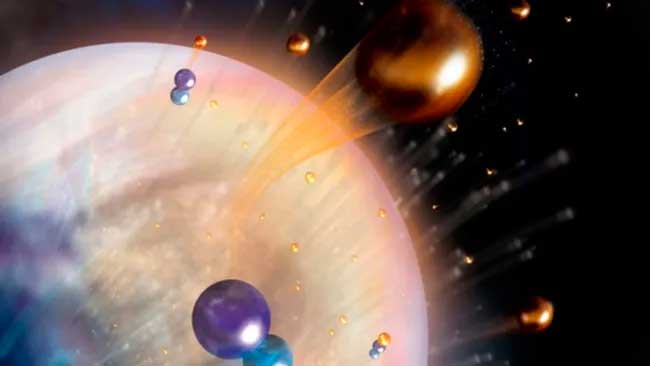
This illustration shows water escaping into space as atomic hydrogen. Urore Simonne / Laboratory for Atmospheric and Space Physics / University of Colorado Boulder
To determine how Venus reached its current state, Kanji, Chaffin, and their colleagues used computer models of the planet, treating it almost like a giant chemistry laboratory. This allowed them to study in detail the diverse reactions occurring in Venus’s swirling atmosphere and identify a possible cause for its water loss.
A team of researchers has discovered that the molecule HCO+, made up of a hydrogen atom, a carbon atom, and an oxygen atom, found high in Venus’s atmosphere, may have been responsible for delivering the last remnants of water from the planet into space.
“As an analogy, imagine I poured out water from my bottle,” Kanji said. “There would still be a few drops left.”
In fact, HCO+ ions can remove these droplets from Venus’s atmosphere. Moreover, the same group of researchers previously suggested that HCO+ ions were the cause of water loss on Mars, Earth’s other neighbor.
Researchers claim that HCO+ ions are constantly being formed in Venus’s atmosphere, but these ions are short-lived. An ion is a positively or negatively charged molecule that acquires its charge either due to a lack of electrons needed to balance the positive charge of protons, or due to the presence of excess electrons, which create a net negative charge in the molecule.
The HCO+ ion lacks the electrons needed to balance the positive charge of the molecule’s protons, and so it has a positive charge (hence the + symbol).
Electrons in Venus’s atmosphere rapidly recombine with HCO+, causing the molecule to split into two. After this, the researchers argue, the hydrogen atoms are rapidly stripped away and possibly even escape into space. The hydrogen atoms form the two components of the water molecule (H2O), which consists of two hydrogen atoms and one oxygen atom, thus depriving Venus of its essential components—water.
A team of researchers believes that for Venus to achieve its extremely dry state, its atmosphere must have contained an excess of HCO+ molecules.
“One of the surprising findings of this work is that HCO+ ions should actually be one of the most abundant ions in the atmosphere of Venus,” Chaffin said.
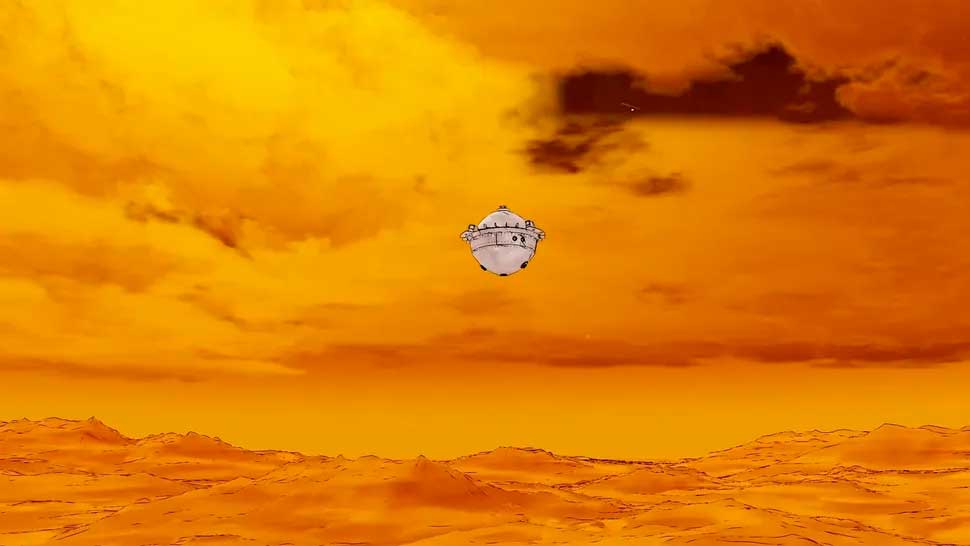
An illustration of the DAVINCI mission’s descent through Venus’s atmosphere. NASA’s Goddard Space Flight Center.
However, this conclusion has one significant drawback. Until now, we have never observed HCO+ ions in the atmosphere of Venus.
Chaffin and Kanji believe this isn’t because the molecule isn’t there, but because humanity lacked the instruments needed to observe it. While Earth’s neighboring planet Mars has been visited by many spacecraft, only a few missions have visited our other neighbor, Venus—and none of them had the necessary equipment to observe HCO+.
However, a number of future space missions are aimed at Venus. NASA’s Venus Noble Gas, Chemistry, and Imaging Survey (DAVINCI) mission is particularly important. However, even DAVINCI will not have the necessary equipment to detect HCO+.
However, the team hopes that DAVINCI (and the European Space Agency’s upcoming EnVision mission) will generate a general interest in Venus, eventually leading to a space mission that can actually detect HCO+, thereby confirming the team’s theory about water loss.
“There have been few missions to Venus,” Kanji concluded. “But new planned missions will leverage decades of collective experience and growing interest in Venus to study the extreme conditions of planetary atmospheres, evolution, and habitability.”
Superrotation and hydraulic jump of the atmosphere of Venus
A 2025 study suggests that the daily tidal cycle in the atmosphere may be a more significant factor driving rapid wind fluctuations on Venus than previously thought.
Imagine the catastrophic winds of a Category 5 hurricane. Now imagine even stronger winds, exceeding 100 meters per second, swirling around the planet and whipping clouds across the sky, with no end in sight. Such a scenario would be astonishing on Earth, but on Venus, everything is as usual, as the atmosphere at cloud level rotates approximately 60 times faster than the planet itself—a phenomenon known as superrotation. In contrast, Earth’s atmosphere at cloud level rotates at roughly the same speed as the planet’s surface. This article was originally published on Eos.
Previous studies have examined the mechanisms driving atmospheric hyperrotation on Venus, but the details remain unclear. The data obtained by Lai et al. suggest that the daily tidal cycle in the atmosphere, fueled by solar heat, contributes much more to the planet’s extreme winds than previously thought.
Rapid atmospheric rotation is often observed on rocky planets, like Venus, that are relatively close to their stars and rotate very slowly. On Venus, one complete rotation takes 243 Earth days. Meanwhile, the atmosphere orbits the planet in just 4 Earth days.
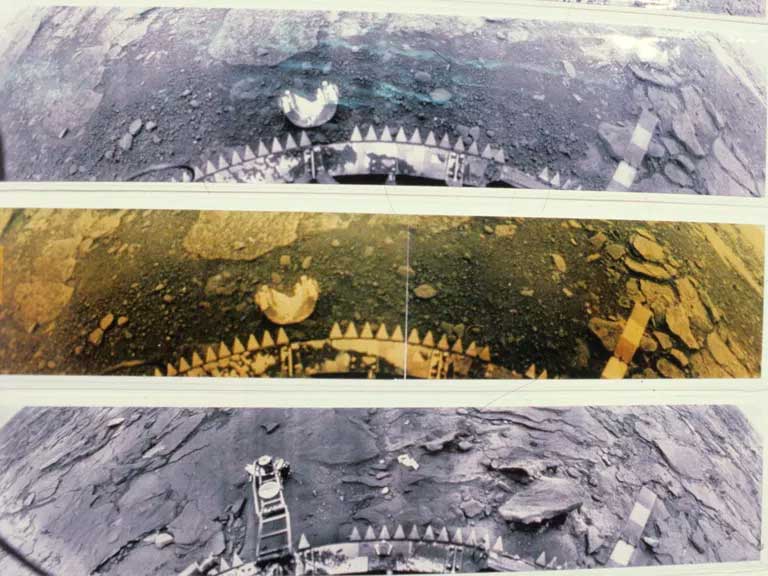
A reproduction of a panoramic image of the surface of Venus, obtained from the Venera-14 lander. RIA Novosti/Boris Prikhodko
To better understand this superrotation, the researchers analyzed data collected between 2006 and 2022 by the European Space Agency’s Venus Express satellite and the Japan Aerospace Exploration Agency’s Akatsuki satellite, which studied the atmosphere of Venus by recording its bending of radio waves. The research team also modeled the superrotation using a numerical model of the Venusian atmosphere.
See also... New method for observing individual atoms confirms century-old quantum mechanical theory |
The analysis focused specifically on thermal tides—one of several atmospheric processes, along with meridional circulation and planetary waves, whose interaction has previously been shown to maintain Venus’s superrotation through momentum transfer. Thermal tides are patterns of air movement that occur when sunlight heats the air on the dayside of the planet. Venusian thermal tides can be divided into two main components: diurnal tides, which follow a cyclic pattern repeating once per Venusian day, and semidiurnal tides, which cycle twice per day.
Previous studies suggested that semidiurnal tides are the primary component of the thermal tides involved in superrotation. However, this study, which includes the first analysis of thermal tides in the southern hemisphere of Venus, shows that diurnal tides play a primary role in transporting momentum to the dense cloud tops of Venus, suggesting that diurnal tides contribute significantly to the high-velocity winds.
While the researchers note that further clarification is needed regarding the contribution of diurnal tides, this work sheds new light on extreme winds on Venus and could aid meteorological studies of other slowly rotating planets.
The vast 3,700-mile (6,000-kilometer) cloud band that circles Venus every few days is formed by rising sulfuric acid vapors pushed high into the atmosphere in a phenomenon essentially the same as water from a running faucet sloshing around your kitchen sink.
In 2016, the Japan Aerospace Exploration Agency (JAXA), as part of its Akatsuki mission to Venus, discovered a cloud cluster at an altitude of approximately 50 kilometers in Venus’s dense atmosphere. This weather system is located along the planet’s equator, but scientists still cannot explain its enormous size, speed, and noticeably sharp leading edge.
However, this mystery remained unsolved for only ten years. By creating mathematical models describing the dynamic flow of gas and the rise of gas clusters, an international team of astronomers finally uncovered the source of this large-scale atmospheric phenomenon. The answer lies in the so-called “hydraulic jump,” which occurs when gas or liquid, moving quickly but shallowly, suddenly slows down and becomes deeper. An example from everyday life: water flowing from a faucet into a kitchen sink. Where it hits the bottom of the sink, it initially moves shallowly but quickly, but as it spreads, it quickly deepens and slows. The team’s research results were published on April 24, 2026, in the Journal of Geophysical Research – Planets.
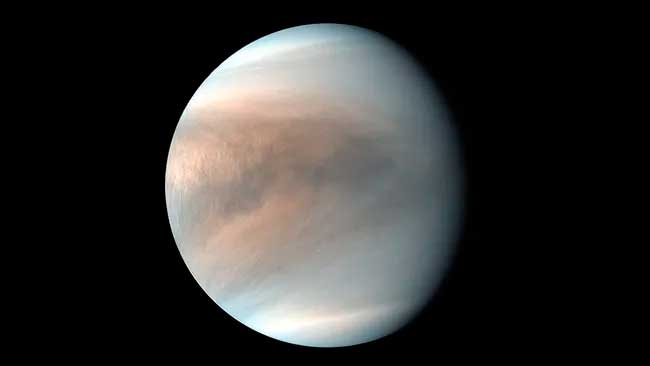
The cloud-covered dayside of Venus, as observed by Japan’s Akatsuki probe in 2016. JAXA
A similar phenomenon is observed in the atmosphere of Venus, which is composed almost entirely of carbon dioxide, along with a small amount of nitrogen and trace amounts of other gases, including sulfur dioxide, which can form clouds. Not too high above Venus’s parched surface, an atmospheric wave extends eastward. This is a planetary wave, meaning it extends for thousands of kilometers and is centered in the planet’s equatorial region. (Venus itself is 7,520 miles/12,104 kilometers in diameter, so a wave 3,700 miles/6,000 kilometers wide is quite significant.)
On Earth, we would call such a wave a “Kelvin wave,” and they can occur in both the ocean and the atmosphere. Of course, with surface temperatures exceeding 860 degrees Fahrenheit (460 degrees Celsius), Venus has no oceans, and its Kelvin wave occurs exclusively in the atmosphere.
When the Kelvin wave on Venus slows, it causes a hydraulic jump, allowing a powerful updraft of sulfuric acid vapor to rise to an altitude of about 50 kilometers, where it condenses into a frighteningly large cloud of sulfuric acid. These clouds then begin to trail behind the Kelvin wave, which marks the leading edge of the cloud mass.
“We can now show that this cloud disruption is caused by the largest known hydraulic jump in the solar system,” said study leader Takeshi Imamura of the University of Tokyo in a statement. “Our discovery of a hydraulic jump on Venus, linking a very large-scale horizontal process with a strong localized vertical wave, is unexpected, as these are not typically related in hydrodynamics.”
This discovery marks the first time a hydraulic jump has been detected on a planet other than Earth. Therefore, the fact that the hydraulic jump on Venus behaves in an unexpected way is perhaps not particularly surprising and serves as a reminder that atmospheric phenomena on other planets can be quite different from what we observe on our own.
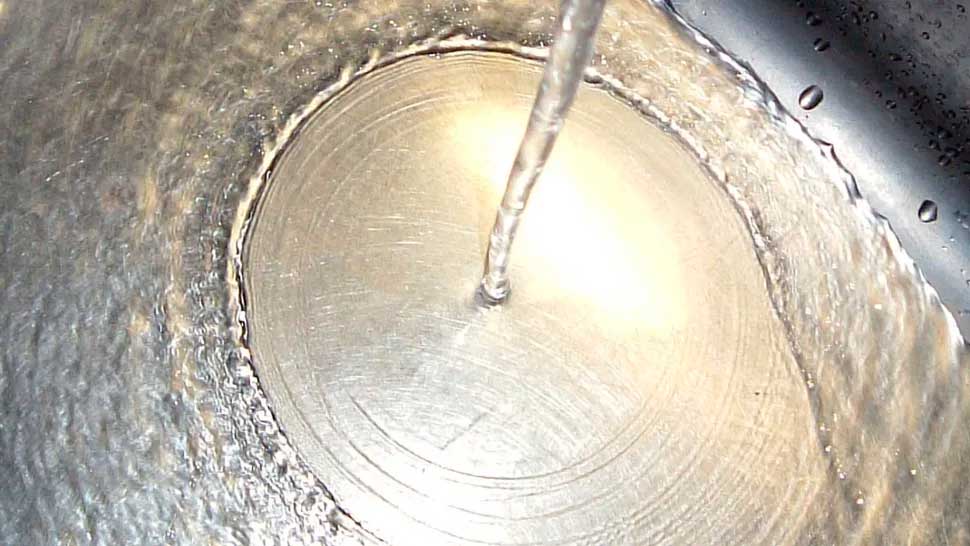
A common example of a hydraulic jump occurs when water flows from a faucet into a sink: where it hits the bottom of the sink, the water initially moves shallowly but quickly, but as it spreads, it quickly deepens and moves more slowly. James Kilfiger/Wikimedia Commons/CC BY-SA 3.0
Venus’s atmosphere is very different from Earth’s – it is rich in carbon dioxide, so oppressive that it creates a crushing surface pressure of 92 bars, and it orbits Venus at a speed faster than Earth’s, so that its atmosphere completes an orbit around the planet in just four Earth days, while Venus’s solid body takes 243 days to complete one revolution.
“Until now, we’ve used a global circulation model for Venus similar to Earth’s, but that model doesn’t include the hydraulic jump we’ve now identified,” Imamura said. “Our next step is to verify this discovery using a more comprehensive climate model that includes other atmospheric processes. We’ll face some challenges due to the enormous computing power required to run such simulations. Even with modern supercomputers, it’s challenging.”
In this sketch taken on April 19, 1977, tall columns of white steam rise from the rocky surface of Venus.
Just over a year later, NASA launched Pioneer Venus 1, the first of two orbiters and a probe designed to study the atmosphere of Venus.
The first American spacecraft to orbit Venus, Pioneer Venus 1, used radar to map the surface of Venus. The probe found that Venus’s surface is generally smoother than Earth’s, despite containing a mountain taller than Mount Everest and a chasm deeper than the Grand Canyon.
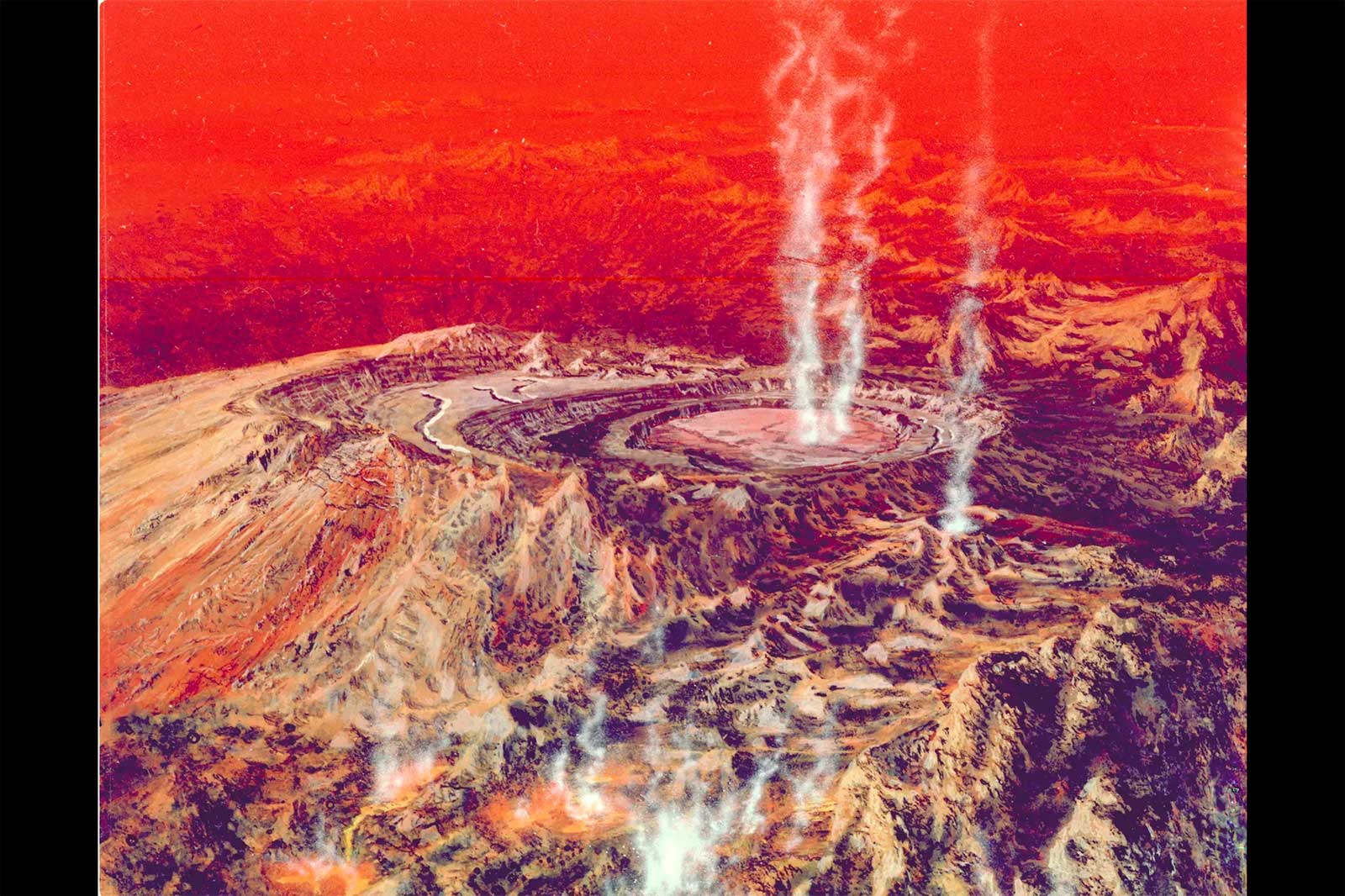
In this artist’s sketch from April 19, 1977, tall columns of white steam rise from the rocky surface of Venus. NASA/Rick Guidice
Thanks to research by Pioneer Venus 1 and other spacecraft like Magellan, Galileo, Cassini, and even Parker Solar Probe, we now have a much better idea of what the surface of Venus looks like.
Comment on Facebook* The owner of the Meta company is recognized as extremist in Russia and is banned.See also... Complete list of HTML/Javascript event handlers with examples List of required documents for a website in the Russian Federation |