When powerful solar storms approach Earth, the planet’s first line of defense is its magnetosphere—a vast magnetic bubble that deflects the bulk of the Sun’s dangerous charged particles. Historically, humanity has only attempted to predict storms and prepare for impacts.
A team of researchers led by Brian Walsh of Boston University has proposed a bold method of actively boosting this natural defense using a fleet of spacecraft designed to mitigate the impact of space weather before it reaches its target.
The concept, dubbed StormWall, uses computer modeling to demonstrate that strengthening the magnetosphere could reduce the intensity of a strong geomagnetic storm by more than half. According to the researchers, if implemented, this system could protect vulnerable satellites, global communications networks, GPS systems, and power grids from potentially catastrophic disruptions, according to the NASA press service.
“People always thought, ‘Space is huge, the Sun is enormous, we just have to sit here and take in everything it gives us,'” Walsh said in a statement. “But we’ve discovered we can influence that.”
During particularly powerful solar flares, Earth’s natural shield can be breached by a process called magnetic reconnection. When magnetic fields carried by the solar wind perfectly align with Earth’s magnetic field, they temporarily connect. This opens a celestial pathway, allowing massive amounts of solar energy to enter near-Earth space and trigger geomagnetic storms.
The StormWall concept aims to disrupt this process. The system envisions launching six spacecraft into geosynchronous orbit. Each satellite would carry a supply of “mass-increasing material”—substances such as barium, lithium, sodium, or calcium—that could be safely stored as a solid or liquid and vaporized on command. More details about the concept were published on June 2, 2026, in the journal Space Weather.
If a dangerous solar storm is detected approaching Earth, mission controllers will command the fleet to jettison the material. Sunlight quickly ionizes the evaporated particles, turning them into a cloud of electrically charged plasma, the study notes.
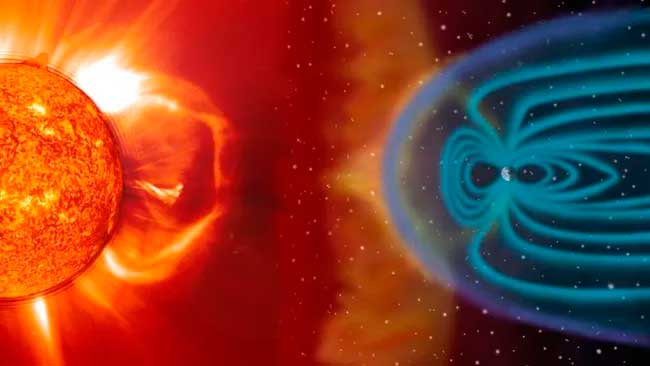
Magnetic field. ESA/NASA
This artificial plasma would drift toward the sun-facing boundary of the magnetosphere, effectively thickening the boundary between Earth and the incoming solar wind. By adding mass to this critical boundary, the team found that it could slow down the effectiveness of magnetic reconnection, causing severe space weather events to bounce off our planet and pass by.
“It’s like villagers watching a river flood—they might be able to predict when it’s going to happen, but it would probably be even better if they could build a dam to protect it,” Walsh said in a statement. “That’s exactly what we’re proposing.”
To test the concept’s viability, the researchers simulated the historic geomagnetic storm of May 2024, often referred to as the Mother’s Day Storm. One model recreated the event under normal conditions, while the second simulated the storm with an active StormWall plasma screen.
The results showed that while StormWall won’t completely eliminate a geomagnetic storm, it can reduce its intensity by more than 50%, the study states. By disrupting the energy flow at the magnetosphere’s boundary, the artificial plasma will essentially cause space weather to reflect off our planet and bypass it, the article notes.
“When you apply really strong laws of physics to this, it works,” Walsh said in a statement. “And the amount of mass we need, the launch capabilities—it’s all within our capabilities.”
According to the statement, to ensure sufficient coverage, the entire fleet of equipment would need to carry the equivalent of approximately a dozen tanker trucks. This would be expensive, and the cost would be further increased by the fact that after launch and photoionization, the system would fail and would be impossible to refill—making it a “one-and-done” solution.
However, as private companies invest billions in orbital infrastructure and consider launching space-based data centers, Walsh and his team argue that the financial calculus may soon tilt in favor of such preemptive defense.
The study also acknowledges that modifying an interconnected system requires careful assessment of unforeseen consequences. The risk of long-term contamination using the StormWall approach is low, it adds, since the artificial plasma would leave the system “relatively quickly,” being carried away by the solar wind within approximately six hours rather than reentering Earth’s atmosphere.
Because the magnetosphere covers the entire globe, the StormWall will serve as a collective shield for the entire planet, the researchers say.
“If you built it and launched it, it would help every person on the planet,” Walsh said in a statement. “You couldn’t build it in a way that would only help one country, one satellite constellation.”
The DimSun mission concept focuses on geoengineering using space-based solar radiation management. DimSun will reduce solar insolation by 1.16% through a controlled dust cloud, composed of 90% hollow spherical particles with a radius of 0.3 micrometers, at the L1 Lagrange point of the Sun-Earth system.
The DimSun project is inspired by previous research aimed at creating a runaway dust cloud of fine regolith particles at the L1 Lagrange point of the Sun-Earth system, which required replenishment every 100 days. The key innovation, worthy of NIAC, is preventing the orbital decay of this dust cloud using repulsive forces from multiple spacecraft, eliminating the need for replenishment, according to NASA’s press service.
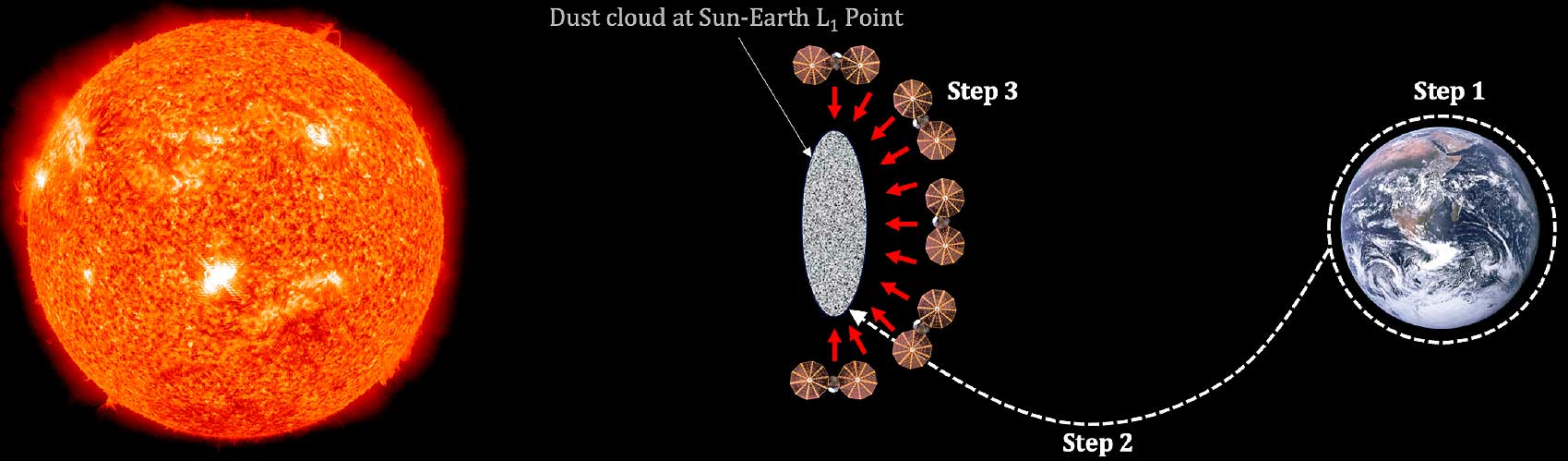
Graphic representation of the concept of “Sun fading” by Saptarshi Bandyopadhyay
DimSun can be reversed by shutting down the control spacecraft, causing the dust cloud to dissipate within 100 days. With an estimated cost of $134 billion (including a 43% margin) and some additional ongoing maintenance costs, DimSun offers the highest efficiency and affordability of all existing geoengineering approaches. For example, DimSun is 150 times cheaper than methods based on space-based solar occulters and six times cheaper than stratospheric aerosol injection in the 21st century.
The main idea of solar geoengineering is to reflect some of the sun’s rays back into space, preventing them from heating the Earth. The most widely discussed method is called stratospheric aerosol injection. The idea is simple: tiny particles, most often sulfur compounds, are sprayed into the upper atmosphere—at an altitude of about 20 kilometers. These particles create a kind of curtain that reflects sunlight.
The idea is based on an effect observed in nature itself: in 1991, Mount Pinatubo erupted catastrophically in the Philippines. It released approximately 20 million tons of sulfur dioxide into the atmosphere. As a result, global temperatures dropped by 0.5°C for a full 1.5 years.
Scientists from Harvard and Yale have calculated that to cool the planet, it would be enough to spray approximately 5 million tons of aerosols annually. They estimate this would cost $2–2.5 billion per year—relatively small by global economic standards.
Why are people talking about “darkening” now? Climatologists are sounding the alarm: we’re passing the point of no return. Natural feedback loops are being triggered: permafrost is melting, releasing methane, and forests are burning, losing their ability to absorb carbon. Scientists estimate that these natural processes will increase global warming by another 30%, creating an uncontrollable greenhouse effect.
The 2015 Paris Agreement aimed to limit global warming to 1.5°C. However, according to the Intergovernmental Panel on Climate Change, we are already close to that mark, and CO2 emissions continue to rise.
See also... New method for observing individual atoms confirms century-old quantum mechanical theory |
However, most academic scientists are categorically opposed to geoengineering, as the risks are colossal. The first problem is the ozone layer. It protects us from harmful ultraviolet radiation. A study published in Nature showed that sulfur aerosols can accelerate ozone depletion, especially over the poles. We spent 30 years restoring the ozone layer after banning CFCs—and now we risk damaging it again.
The second problem is precipitation. Climate models calculated at the Potsdam Institute predict that aerosol dispersion will alter global air circulation. Monsoons in Asia could weaken, threatening crops for billions of people. Africa’s Sahel region could become even drier.
The third and most insidious problem is the reversal effect. If aerosols are sprayed, the planet will cool, but if coal, oil, and gas continue to burn, CO2 in the atmosphere will continue to accumulate. And if for some reason the spraying stops, all the accumulated heat will rapidly collapse onto the planet. According to calculations by scientists from Rutgers University, temperatures could jump by 2–4°C over 10 years.
More than 60 scientists have already signed an open letter calling for an international moratorium on solar geoengineering.
In early December 2025, UN climate talks were held in Nairobi. African diplomats grappled with the contentious issue of whether it was wise to try to cool the planet by dimming the sun’s rays. Although not on the official summit agenda, behind-the-scenes discussions suggested it was time to stop promoting solar geoengineering as a solution to global warming.
African countries have made this statement because they do not want their continent to become a testing ground for unproven schemes to disperse particles into the upper atmosphere to reflect sunlight away from the Earth and achieve a small, uncertain cooling effect. They point to environmental, ethical, and geopolitical risks. This is why the continent is pushing for a global “non-use” agreement that would preclude public funding, open-air experiments, patenting, and official promotion of these technologies.
The reason for the moratorium is obvious: solar geoengineering does not reduce greenhouse gas emissions. Potential side effects include changes in precipitation patterns and, consequently, stress on food systems. Furthermore, there is a risk of a sharp temperature spike if interventions are ever stopped—the so-called “termination shock.”
Scientists have already warned that the UK has become the first “major government” to allocate significant funding to solar radiation modification (SRM) through its Advanced Research and Invention Agency. It is currently supporting scientists in researching “climate cooling” equipment and conducting small-scale field trials. Other scientists describe this move as naive, poorly managed, and scientifically incapable of proving the safety of SRM.
As The Guardian reports, Africa’s call does not weaken climate policy; countries on the continent propose focusing on other measures aimed at solving the climate problem: reducing fossil fuel use, investing in renewable energy sources, and adapting where damage has already been done.
Comment on Facebook* The owner of the Meta company is recognized as extremist in Russia and is banned.See also... Complete list of HTML/Javascript event handlers with examples List of required documents for a website in the Russian Federation |