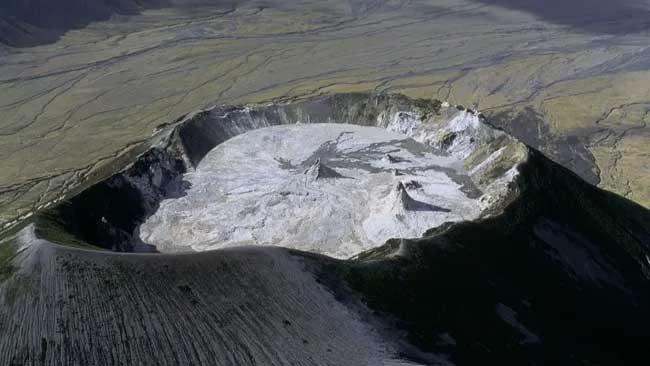
To date, the Shiveluch volcano is known to have erupted in 1790, 1854, 1879-1883, 1896-1898, 1905, 1927-1929, 1944-1950, 1964, 1980-1981, 1993-1995, 2001-2003, 2008-2016. As a result of the 2004-2005 eruption, the height of the volcano decreased by 115 meters. Scientists called the eruption of the Shiveluch volcano in Kamchatka, which began on November 7, “uncharacteristic” and warned that the giant has become even more dangerous. Since the beginning of 2024, seismic and volcanic activity has been growing in Kamchatka.
“Seismic data allow us to reconstruct the picture of this eruption in sufficient detail, the apogee of which occurred at night. The maximum phase of the eruption occurred between 21:00 and 21:30 (12:00 and 13:30 Moscow time) on November 7. After the maximum phase of the eruption, seismic tremors quickly began to decline, and seismic signals returned to the background level. Before this event, the seismicity level was also at the background level, a weak thermal anomaly and steam and gas activity were observed on the volcano. Previously, such events were not typical for Shiveluch, usually the preparation of an eruption was quite clearly reflected in seismic signals. This situation should now be taken into account. Shiveluch has become even more dangerous,” the Kamchatka branch of the Geophysical Service of the Russian Academy of Sciences reports.
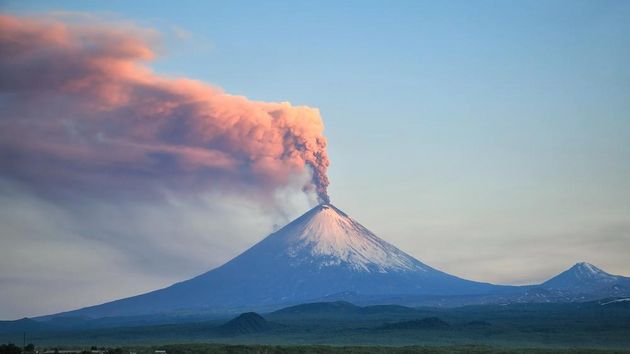
The Shiveluch volcano in Kamchatka began erupting on the evening of November 7. The giant threw ash to a height of about 11 km. On the morning of November 8, according to seismic data, the giant threw ash to a height of up to 13 km. In the Ust-Kamchatsky district of the region, minor ash fall was observed, while the life of populated areas was not disrupted.
The third ash emission in 24 hours on November 8 was produced by the Shiveluch volcano in Kamchatka, the Kamchatka Volcanic Eruption Response Team of the Institute of Volcanology and Seismology of the Far Eastern Branch of the Russian Academy of Sciences reports. This time, the ash emission reached a height of 8.5 kilometers above sea level. The ash plume extended 120 kilometers to the east of the volcano. On the evening of November 7, Shiveluch also emitted ash 11 kilometers above sea level. According to volcanologists, the event was recorded in the area of the new dome named after the 300th anniversary of the Russian Academy of Sciences. In addition to the ash column, a pyroclastic flow consisting of hot gases, slag, and ash descended from the giant. The length of the flow was 11 kilometers.
Before this event, the seismicity level was at the background level, a weak thermal anomaly and steam-gas activity were observed on the volcano. Previously, such events were not typical for Shiveluch, usually the preparation of an eruption was quite clearly reflected in seismic signals. It seems that after the last strong eruption and the discovery of a new eruptive center, changes in the volcano’s regime occurred. This situation should now be taken into account. Shiveluch has become even more dangerous.
Meanwhile, the ash plume from the first emission extended 300 kilometers to the east of the volcano and particles fell in Ust-Kamchatsk. According to the Ust-Kamchatsky District Administration, the volcanic ash fall caused the closure of the Snezhinka and Romashka kindergartens in the village of Ust-Kamchatsk, as well as Secondary School No. 2. Parents are asked to take their children home. Classes at additional education institutions – a sports school and a children’s art school – have also been cancelled. In Ust-Kamchatsk, an open volleyball tournament among men’s and women’s teams for the Cup of the Head of the Ust-Kamchatsky Municipal District, scheduled for tomorrow, November 9, has been cancelled.
Ash fall was recorded in Kamchatka on August 17 after the eruption of the Shiveluch volcano. As a result of the ash emission from the Shiveluch volcano, a small amount of volcanic ash fell in the village of Ust-Kamchatsk. The life of the population was not disrupted by the ash fall.

Explosive eruption of Shiveluch volcano in Kamchatka. IVS FEB RAS/Telegram
According to the Kamchatka Volcanic Eruption Response Team (KVERT) of the Institute of Volcanology and Seismology of the Far Eastern Branch of the Russian Academy of Sciences, an eruption of the cone “300 years of the Russian Academy of Sciences” took place on Shiveluch. Ash columns rose to a height of up to 8 kilometers above sea level. Lightning was recorded above the giant during the dark hours of the day.
Shiveluch is the northernmost active volcano in Kamchatka. It is located 45 kilometers from the villages of Klyuchi and Ust-Kamchatsk.
In mid-January, the Russian Emergencies Ministry warned of increased volcanic activity in the region. On January 18, experts recorded a second ash plume on the Kuril volcano Ebeko, the press service of the Main Directorate of the Russian Emergencies Ministry for the Sakhalin Region reported. The second ash plume on the Ebeko volcano occurred during the day (local time). The Sakhalin Volcanic Eruption Response Team reports that the height of the ash column, like the morning plume, was up to three kilometers above sea level. The plume spread in a northeasterly direction for a distance of more than five kilometers.
According to dispatchers, no ashfall was observed in Severo-Kurilsk, no smell of hydrogen sulfide was felt, and there is no threat to the life of the population.

At the same time, a resident of Severo-Kurilsk told RIA Novosti that after the emission on Ebeko, the snow in the city darkened due to ash.
The 1,156-metre-high Ebeko volcano is located on Paramushir Island, seven kilometres northwest of Severo-Kurilsk in the northern part of the Vernadsky Ridge. Regular emissions (from weak to moderate) have been ongoing since October 20, 2016, which is normal activity for a volcano. The record emission was recorded on August 31, 2018. Then a column of smoke shot up to a height of six kilometres from a new crater of the volcano that formed in 2017.
Seismic activity is growing in Kamchatka, February 2024 publications wrote. Two earthquakes occurred on February 15 off the coast of Kamchatka in Avacha Bay, the Kamchatka branch of the Unified Geophysical Service of the Russian Academy of Sciences reports. The epicenters of the tremors were located close to each other in Avacha Bay. An earthquake with a magnitude of 4.4 occurred 129 kilometers from Petropavlovsk-Kamchatsky, the next tremor with a magnitude of 4.8 – 136 kilometers from the regional center.
These seismic events were not felt in the region’s populated areas. No tsunami threat was announced.
The US Geological Survey recorded a third earthquake in the region. It occurred at 3:10 Moscow time, and its magnitude was 4.9, with the epicenter located 159 km southeast of the settlement of Ust-Kamchatsk Stary.