Two powerful earthquakes in eastern Cuba have caused landslides, damage to homes and power lines, and residents of the affected provinces of Santiago de Cuba and Granma have been advised to remain in open areas, the country’s President Miguel Diaz-Canel Bermudez said.
As RIA Novosti reports, a rescue operation and emergency recovery work have begun in the affected region.
According to local seismologists, tremors measuring 6 and 6.7 occurred off the coast of Cuba within an hour of each other on Sunday. The event occurred in a seismically active zone, on the boundary of tectonic plates to which the island adjoins.

According to the US Geological Survey, the strongest of the earthquakes was recorded at 19:50 Moscow time on November 10. Its epicenter was located 40 km south-southwest of the city of Bartolomeo Maso, Granma province.
Cuba’s national power grid was completely shut down on November 7 due to high winds caused by Hurricane Rafael, grid and generation company Union Electrica said. Contingency protocols are in place.
At midnight on November 6, the Cuban Ministry of Transport suspended the operation of airports, including Havana and Varadero, bus service to the capital, as well as the operation of the railway and some sea transport for 36 hours due to the approach of the hurricane.
Hurricane Rafael, a few hours before making landfall in the southwestern part of Cuba, became a strong hurricane of the third category, and the wind speed in its zone of influence reached 50 m/s. In this state, at 16:20 on November 6, local time, it came ashore in the area of the province of Artemis. For two hours, the center of the hurricane moved across the territory of the island state, after which it left the region, weakening to the second category. The strongest impact of the bad weather on the infrastructure was noted in the provinces of Artemis and Mayabeque. Over the past 24 hours, up to 70 mm of precipitation fell in the region, and in eight settlements the values exceeded 100 mm.
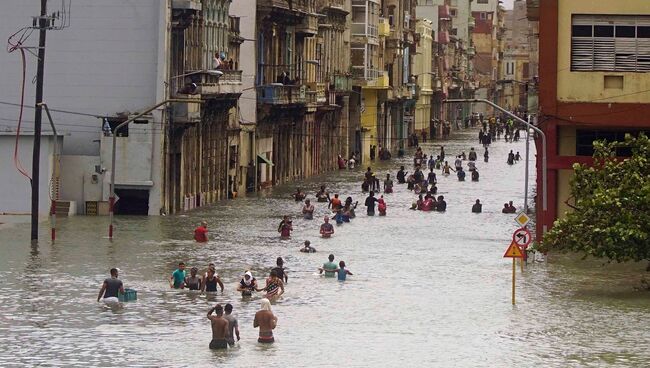
However, the situation remains dangerous for now, as the region continues to experience heavy rainfall and gusty winds, with maximum speeds reaching 40–45 m/s, with a high probability of flash floods and storm surges. Strong winds also persist in the capital of Cuba, especially in its western regions.
The first emergency recovery operations have already begun in the affected areas of Cuba. The Cuban president is expected to visit the affected areas today along with several ministers to assess the damage on the ground and make the necessary decisions. The situation is complicated by the fact that the affected areas have not yet fully recovered from the impact of the previous hurricane, Oscar.
At least six people died in late October 2024 as a result of Hurricane Oscar in eastern Cuba, Associated Press reports, citing President Miguel Diaz-Canel.
“According to preliminary information, six people have died,” the president said. Diaz-Canel said rescue efforts were continuing.
The U.S. National Hurricane Center is warning Tuesday of a risk of flooding and mudslides in eastern Cuba and possible flooding in the southeastern Bahamas.
According to the center’s latest data, Oscar, having lost some of its strength, is now classified as a tropical storm. Wind gusts reach 40 mph (64 km/h). Oscar is moving northeast toward the Bahamas at 9 mph (14 km/h).

Cuba also found itself in a situation of total energy collapse after one of the island’s main power plants was shut down. Repairs are ongoing, but a significant portion of the population remains without a stable power supply.
Hurricane Oscar reached the province of Guantanamo in eastern Cuba on Sunday at 17:50 local time (Monday 00:50 Moscow time). Wind gusts reached 120 km/h. Oscar caused thunderstorms, heavy rains and floods in Cuba.