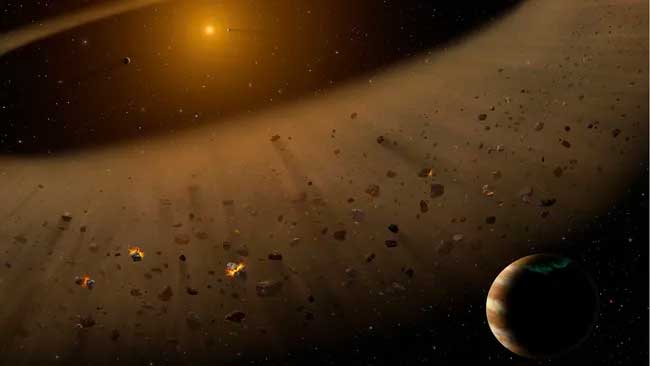
The current debate over Pluto highlights the difficulties in defining the concept of “planet.” The IAU defines a planet as a celestial body orbiting the Sun, having a nearly spherical shape, and having largely cleared its orbital environment of space debris. But even this set of criteria is not universally accepted.
Earth and even Jupiter, despite their large size, haven’t cleared their orbits of many asteroids. Moreover, there are small, round worlds orbiting the Sun that aren’t considered planets, such as Ceres.
Pluto’s so-called downgrading to planetary status raises deeper questions about how to define any object in the solar system, or even in space itself. It demonstrates that science sometimes fails to classify objects into simple categories. After all, if the definition of a planet is expanded again, it will become unclear how to evaluate the numerous non-spherical objects orbiting our Sun. It could even call into question the existence of the asteroid belt, the vast band of small objects between Mars and Jupiter. Or what would happen if a planet somehow broke apart?
Yet, although the Pluto debate began nearly 20 years ago, many still don’t understand all the fuss and why Pluto was displaced from its planetary position. However, the transformation of the Solar System from nine planets to eight (at least by the standard IAU definition) was a long process and clearly demonstrates one of the greatest strengths of science: the ability to change seemingly immutable definitions in light of new data.
The word “planet” dates back to ancient times and comes from the Greek “planetes,” meaning “wandering star.” The five classical planets—Mercury, Venus, Mars, Jupiter, and Saturn—are visible to the naked eye, and their movements across the sky can be observed along strange trajectories compared to more distant background stars. Since the advent of telescopes, astronomers have discovered two new planets, Uranus and Neptune, which are too dim to be seen with the naked eye.
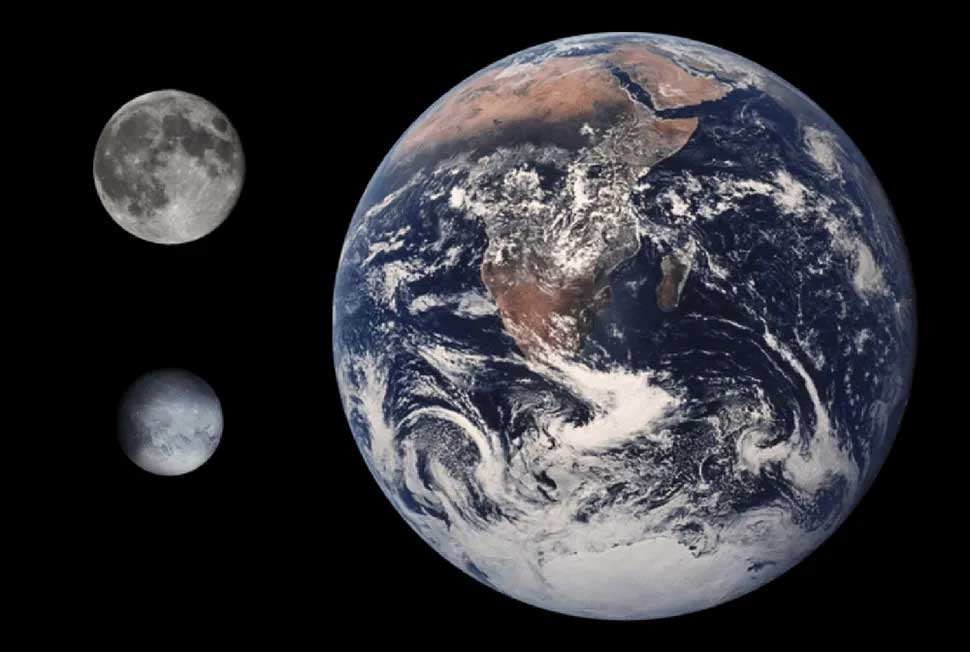
Pluto’s size (bottom left) compared to the Moon and Earth. Tom.Reding, CC BY-SA
When astronomers discovered Ceres, now considered a dwarf planet, it was initially considered a “planet” in scientific circles at the time. But this opinion began to change as further measurements revealed it to be smaller than other planets observed at the time. Ceres was eventually classified as a member of a group of rocky bodies called “asteroids,” of which we now know there are hundreds of thousands in the asteroid belt alone.
Pluto was discovered and classified as a planet in 1930 (the IAU was founded in 1919) when astronomer Clyde Tombaugh of the Lowell Observatory in Arizona, comparing photographic plates of the sky on different nights, noticed a tiny dot shifting back and forth against the background stars. However, this newest candidate for the Solar System was immediately recognized as an oddity. Its orbit is so eccentric—meaning far from circular—that it actually passes closer to the Sun than Neptune during 20 years of its 248-year journey. Furthermore, it is inclined to the ecliptic, the plane in which the other planets of the Solar System orbit.

In 1992, scientists discovered the first Kuiper Belt object, 1992 QB1, a tiny body orbiting close to Pluto and beyond Neptune. Numerous other similar objects were soon discovered, revealing a belt of small, frozen worlds similar to the asteroid belt between Mars and Jupiter. Pluto remained the king of this region, but in July 2005, astronomers discovered the distant body Eris, initially thought to be even larger than Pluto.
Researchers were forced to ask themselves the following questions: If Pluto is a planet, does that mean Eris is also a planet? What about all the other icy objects in the Kuiper Belt or smaller objects in the asteroid belt? Where exactly does the boundary lie for classifying a celestial body as a planet? A word that had seemed simple and straightforward suddenly proved strangely slippery.
A heated debate followed, with many new proposals for defining the planet being put forward.
Near the end of the Prague Conference, the 424 remaining astronomers voted to create three new categories for Solar System objects. From then on, only the planets from Mercury to Neptune would be considered planets. Pluto and its relatives—round objects that shared orbits with other objects—became known as dwarf planets. All other objects orbiting the Sun would be called small Solar System bodies.
The New Horizons spacecraft marked a major turning point in the planetary debate, as its rapid flyby of Pluto revealed that the world is far more dynamic than anyone had imagined. Tall mountains, pockmarked craters, and traces of liquid on its surface indicate that the world has undergone extensive geological changes since its formation. For this reason alone, some scientists argue, Pluto should be considered a planet, as it is a dynamic place, not so static that its surface is disturbed only by micrometeorite impacts.
Views of Pluto’s moon Charon also reveal a highly dynamic location, including a red cap at its pole, which appears to change its appearance in accordance with the slow seasonal changes in such distant reaches of the solar system. Remarkably, Pluto has several moons, while the two known planets, Mercury and Venus, do not. Numerous asteroids and dwarf planets also have moons, further complicating planet identification.
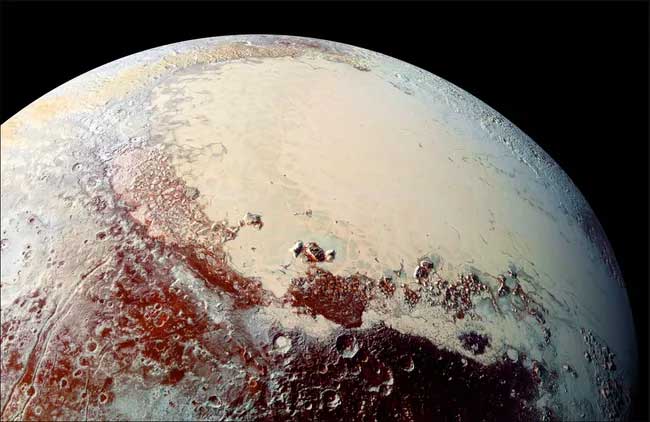
NASA’s New Horizons mission’s flyby of Pluto in 2015 showed scientists that the geologic activity there is far more complex than they expected. NASA/JHUAPL/SwRI
Similar views are shared by many in the public. In 2014, shortly before the flyby, experts from the Harvard and Smithsonian Center for Astrophysics (CfA) in Cambridge, Massachusetts, debated differing definitions of the term “planet.” Science historian Owen Gingerich, who chaired the IAU’s planetary definition committee, argued that “planet is a culturally conditioned word that changes over time.” However, the overwhelming majority of viewers watching the CfA debate chose the other participant’s definition—one that would reinstate Pluto as a planet.
Alternative classification systems continue to emerge. A 2017 proposal defined a planet as “a round object in space smaller than a star.” This would again make Pluto a planet, but the same would apply to Earth’s moon and many other satellites in the Solar System, bringing the total number of officially recognized planets to 110.
To date, over 5,000 exoplanets, or planets outside our solar system, have been discovered, and they represent a vast diversity of worlds. From “super-Earths” between the sizes of Earth and Uranus to “hot Jupiters” orbiting close to suns, and planets of all sizes, the types of planetary environments to consider are rapidly changing.
This diversity of planet formation scenarios demonstrates that each solar system can have its own unique environment. While it’s generally true that stars can form planets from the collapsing gas and dust in their environments, the individual dynamical processes that govern planet formation are far more complex. For example, are multiple stars involved? How much dust is available? Is there a black hole or supernova that is removing the valuable dust and gas needed for planetary growth?
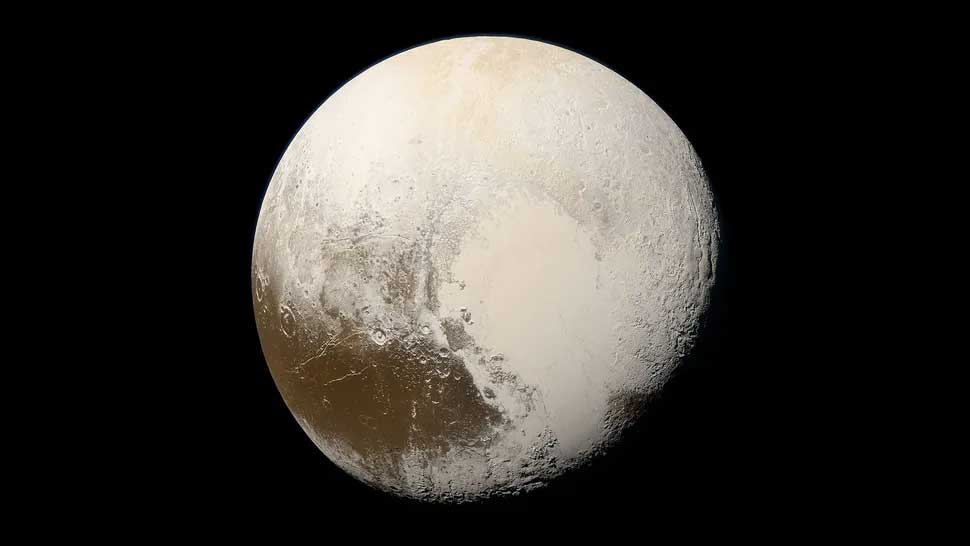
Pluto, as seen by the New Horizons spacecraft as it flew by the planet on July 14, 2015, from a distance of 22,025 miles (35,445 kilometers). NASA/Johns Hopkins University Applied Physics Laboratory/Southwest Research Institute/Alex Parker
Even if planets are fortunate enough to grow, how they interact with other planets during the early stages of their formation is poorly understood. As planets interact, their mutual gravity likely moves the planets closer and further from their parent star, and in some cases even ejects them from the Solar System.
All this suggests that our definition of planet may need to be made more situational to account for the many possible world formation scenarios. Planets may be confined to specific formation conditions or specific zones. All that is certain is that, as more data accumulates, the question of planetarity and the debate sparked by Pluto will continue for quite some time.
See also... New method for observing individual atoms confirms century-old quantum mechanical theory |
The greatest confusion arises with the subtypes of non-planets. If an object is large enough to assume a spherical shape but not clear its orbit, such as Pluto or Ceres, it is called a dwarf planet. Astronomers often use the term “dwarf” to refer to smaller versions of the same type, such as dwarf stars and dwarf galaxies. But dwarf stars are still stars, and dwarf galaxies are still galaxies, they’re just smaller. Dwarf planets are different—they’re definitely not planets.
If an object is too small to assume a spherical shape, it is classified as a “small solar system body.” Asteroids are not officially defined as such, but astronomers commonly use the term to refer to small solar system bodies located in the inner solar system. Comets are also considered small solar system bodies.
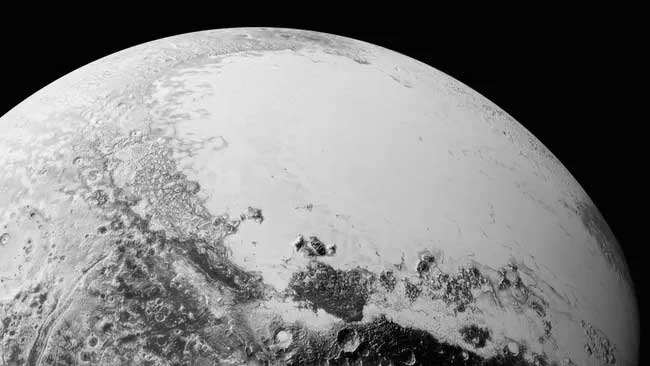
This image of Pluto was taken after the New Horizons spacecraft flew past the dwarf planet on July 14, 2015, from a distance of 80,000 kilometers (50,000 miles). NASA
Next come the “minor planets,” which include dwarf planets and all small Solar System bodies that are not comets. Plutoids—dwarf planets beyond the orbit of Pluto—and trans-Neptunian objects, which include the plutoid planets and other small Solar System bodies orbiting beyond the orbit of Neptune.
Pluto is something of a loner. This dwarf planet is no longer considered a regular planet: its orbit does not lie in the same plane as the eight planets of the Solar System; its orbit is highly elliptical and highly inclined.
In fact, its orbit is much more similar to that of its neighbors in the Kuiper Belt—the doughnut-shaped region beyond Neptune that also contains other dwarf planets like Makemake and Eris, as well as millions of icy objects. But even compared to other Kuiper Belt objects, Pluto’s orbit is quite unusual, Live Science reports.
First, let’s compare Pluto with Earth and the other planets in the solar system. The dwarf planet’s orbital eccentricity (its deviation from a perfect circle) is 0.25. For comparison, Earth’s orbital eccentricity is 0.0167, making it nearly circular. The eccentricities of Saturn and Mars are 0.054 and 0.093, respectively. Pluto’s orbit is tilted by 17.4 degrees, compared to 1.5 degrees for Earth and about 2 degrees for Mercury.
Scientists believe that Neptune’s migration due to gravitational interactions with its giant neighbors plays a role in explaining Pluto’s orbit. At some point, the planets migrated, and Pluto ended up in this orbit because Neptune’s orbit shifted outward… and pulled Pluto into this resonance, which occurs when the gravity of orbiting bodies periodically influences each other as they pass close to each other.
Neptune controls Pluto, despite its odd orbit. For 20 of its 248-year orbit, Pluto is inside Neptune’s orbit. The two planets are in a 3:2 orbital resonance, meaning Pluto completes two orbits for every three Neptune completes.
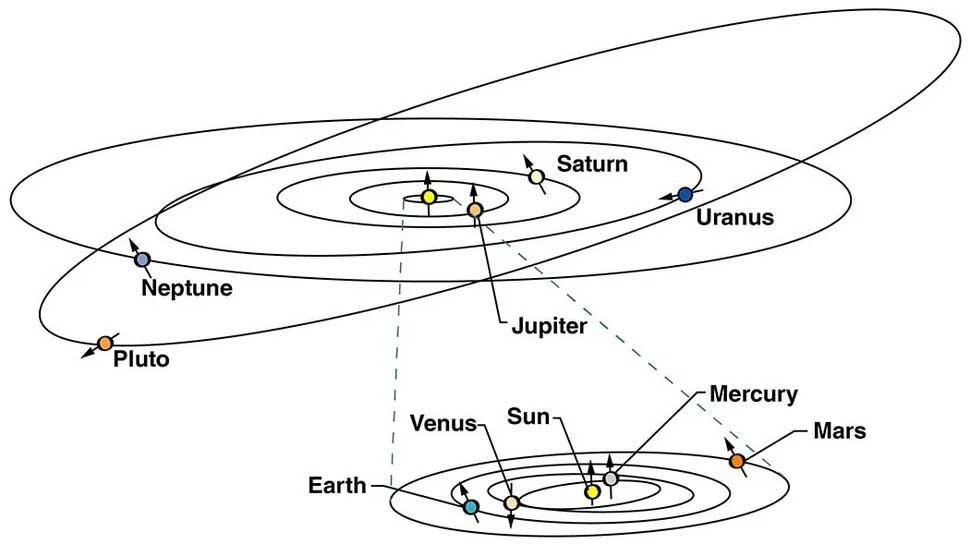
Compared to the eight planets in the solar system, Pluto’s strange orbit is simply off the charts, NASA
There’s another strange aspect of Pluto’s orbit. When the dwarf planet reaches perihelion—its closest point to the Sun—it’s always above the plane of the planets. Typically, planets and other dwarf planets dip above and below the plane over time, something that, according to simulations, Pluto never does. This is caused by the dance between Pluto and the planets Jupiter and Uranus, which prevents Pluto from descending into chaos.
However, Pluto isn’t the only one with such a strange orbit. For example, the dwarf planet Eris has an eccentricity of 0.45 and an inclination of about 43 degrees. This is a much more extreme orbit.
We still have much to learn about how and how quickly the planets migrated. And Pluto’s cosmic environment, the Kuiper Belt, likely holds even more mysteries.
The Kuiper Belt contains more landscapes on objects 100 kilometers (or about 60 miles) in size and larger than the solid surfaces of the rest of the Solar System combined. It’s truly a promising area for exploration.
Comment on Facebook* The owner of the Meta company is recognized as extremist in Russia and is banned.See also... Complete list of HTML/Javascript event handlers with examples List of required documents for a website in the Russian Federation |