Venus is the second planet from the Sun and Earth’s closest planetary neighbor. Venus is the third-brightest object in the sky after the Sun and the Moon. Venus rotates slowly, in the opposite direction to most planets. Several Russian Venera probes have detected particles about a micron in length in the lower layers of Venus’s atmosphere—roughly the same size as a bacterium on Earth.
Venus is similar in structure and size to Earth, and is sometimes called Earth’s evil twin. Its thick atmosphere traps heat through a runaway greenhouse effect, making it the hottest planet in our solar system, with a surface temperature high enough to melt lead—about 872 degrees Fahrenheit (467 degrees Celsius). And the atmospheric pressure at the surface is approximately 93 times higher than at sea level on Earth. Beneath Venus’s dense, permanent clouds lie volcanoes and deformed mountains. Information provided by NASA’s press service.
The ancient Romans could easily see seven bright objects in the sky: the Sun, the Moon, and the five brightest planets: Mercury, Venus, Mars, Jupiter, and Saturn. They named these objects after their most important gods. Venus is named after the ancient Roman goddess of love and beauty, known to the ancient Greeks as Aphrodite. Most of the objects on Venus are named after women. It is the only planet named after a female goddess.
Venus orbits the Sun at an average distance of 67 million miles (108 million kilometers), or 0.72 astronomical units (1 astronomical unit, abbreviated AU, is the distance from the Sun to Earth). It takes sunlight about six minutes to travel from the Sun to Venus, compared to about eight minutes from the Sun to Earth.
Earth’s proximity to Venus is a matter of perspective. The planet is almost the same diameter as Earth. Its diameter at the equator is about 7,521 miles (12,104 kilometers), while Earth’s is 7,926 miles (12,756 kilometers). From Earth, Venus is the brightest object in the night sky after our Moon. Therefore, the ancients attached great importance to it in their cultures, even considering it two objects: the morning star and the evening star. This is where the optical illusion comes in.
Because Venus’s orbit is closer to the Sun than ours, they—from our perspective—never move very far apart. The ancient Egyptians and Greeks saw Venus in two forms: first in one orbital position (morning), then in another (your “evening” Venus), simply at different times of the year.
At its closest point to Earth, Venus is about 24 million miles (approximately 38 million kilometers) away. However, most of the time, the two planets are farther apart. The maximum distance between Venus and Earth is about 162 million miles (261 million kilometers). Mercury, the innermost planet, actually spends more time near Earth than Venus.

Venus has phases, just like our Moon—full moon, crescent moon, quarter moon, and so on. However, a complete cycle, from new moon to full moon, takes 584 days, while our Moon takes only a month. It was this perspective, first observed by Galileo through a telescope, that provided key scientific evidence for the Copernican heliocentric model of the solar system.
Spending a day on Venus would be a rather disorienting experience—assuming, of course, your spacecraft or spacesuit could protect you from the extreme heat and crushing air pressure. First, your “day” would last 243 Earth days—even longer than a Venusian year (one orbit around the Sun), which is only 225 Earth days. Second, due to the planet’s extremely slow rotation, it would take 117 Earth days from sunrise to sunset. And, incidentally, the Sun would rise in the west and set in the east, because Venus rotates backwards compared to Earth.
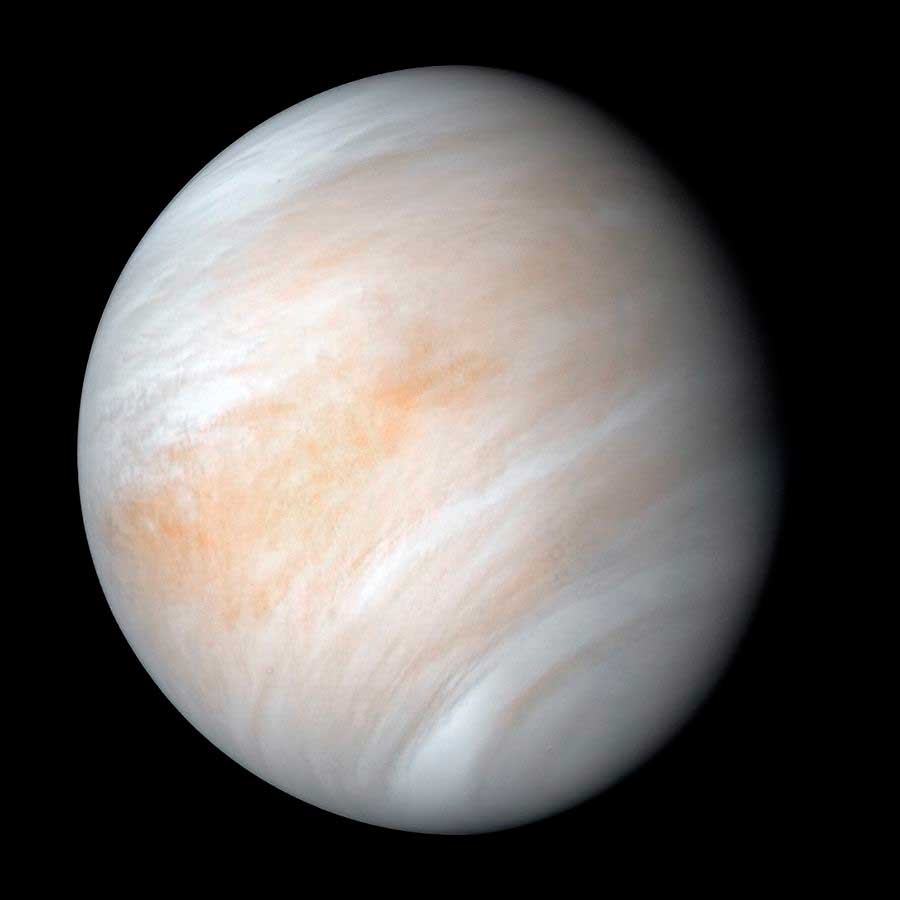
In February 1974, as NASA’s Mariner 10 spacecraft was moving away from Venus, it captured this seemingly peaceful view of Venus. But despite its serene appearance, Venus is a world of unbearable heat, crushing atmospheric pressure, and clouds of corrosive acid. NASA/JPL-Caltech
On Earth, where the axis of rotation is tilted by approximately 23 degrees, summer occurs when our part of the planet (our hemisphere) receives the sun’s rays more directly—a result of this tilt. In winter, the tilt means the rays become less directly directed. Venus doesn’t have this position: its very slight tilt of just three degrees is too small to cause noticeable seasons.
Venus is the hottest planet in our solar system, with a surface temperature of about 872 degrees Fahrenheit (467 degrees Celsius). And the atmospheric pressure at the surface is the same as that found more than 3,000 feet underwater on Earth (930 meters). The Soviet Union sent a series of probes to Venus between 1961 and 1984 as part of its Venera program (Venera is the Russian name for Venus). Ten probes reached the surface, and some of them operated briefly after landing. The longest-lasting probe lasted two hours, the shortest 23 minutes. Photographs taken before the landers overheated show a barren, dull, and rocky landscape and a sky likely a sulfur-yellow hue.
Volcanic activity and tectonic forces likely erased most traces of Venus’s early surface. Newer computer models suggest that surface renewal may have occurred gradually over a long period of time. The average age of surface features may be as little as 150 million years, although older sections are also present.
Venus is dotted with valleys and high mountains, dotted with thousands of volcanoes. Among its surface features—most of which are named after real and mythical women—are Ishtar Terra, a rocky highland region roughly the size of Australia located near the North Pole, and an even larger region, roughly the size of South America, called Aphrodite Terra, stretching across the equator. One mountain reaches a height of 36,000 feet (11 kilometers), higher than Mount Everest. Remarkably, other than Earth, Venus has the fewest impact craters of any rocky planet.
Other notable features of the Venusian landscape include:
– A volcanic crater named Sacajawea after the Native American guide Lewis and Clark.
– A deep canyon named Diana after the Roman goddess of the hunt.
– Pancake-shaped domes with flat tops and steep sides, up to 38 miles (62 kilometers) wide, thought to be formed by the eruption of highly viscous lava.
– “Tick domes” – bizarre volcanoes with radiating spurs that, from above, resemble their bloodsucking namesakes.
– Tesserae – areas with intricate patterns of ridges and furrows that suggest that, due to the scorching heat, the rocks on Venus behave somewhat like peanut butter under a thin, dense layer of chocolate.
The atmosphere of Venus is a combination of extremes. Venus, with the hottest surface in the solar system except for the sun itself, is even hotter than the innermost planet, charred Mercury. The atmosphere consists primarily of carbon dioxide—the same gas that causes the greenhouse effect on both Venus and Earth—with dense clouds of sulfuric acid. Atmospheric pressure at the surface is 93 times greater than at sea level on Earth. At the surface, the hot, high-pressure carbon dioxide is corrosive. But higher in the atmosphere, the temperature and pressure begin to decrease.
If we could cut Venus and Earth in half, pole to pole, and place them side by side, they would look strikingly similar. Each planet has an iron core surrounded by a hot rocky mantle; a thin layer forms the rocky outer crust. On both planets, this thin layer changes shape and sometimes erupts volcanically in response to fluctuating temperatures and pressures deep underground.
On Earth, the slow movement of continents over thousands and millions of years reshapes the surface—a process known as plate tectonics. Something similar may have occurred on Venus early in its history. Today, a key element of this process may be subduction, or the sliding of one continental “plate” beneath another, which can also trigger volcanic eruptions. Subduction is believed to be the first step in the formation of plate tectonics.
NASA’s Magellan spacecraft, which completed a five-year mission to Venus in 1994, used radar to map the scorching surface. Magellan saw a landmass with extreme volcanic activity—a relatively young surface that had recently undergone geological change—and ranges of high mountains.
Despite being similar in size to Earth and having a similarly sized iron core, Venus does not have its own internally generated magnetic field. Instead, Venus has what’s called an induced magnetic field. This weak magnetic field is created by the interaction of the Sun’s magnetic field and the planet’s outer atmosphere. Ultraviolet light from the Sun excites gases in Venus’s outer atmosphere; these electrically excited gases are called ions, and so this region is called the ionosphere (Earth also has an ionosphere). The solar wind—a vortex of electrically charged particles traveling at a million miles per hour, continuously emanating from the Sun—carries the Sun’s magnetic field with it. When the Sun’s magnetic field interacts with Venus’s electrically excited ionosphere, it creates, or induces, a magnetic field there. This induced magnetic field envelops the planet and takes the shape of an elongated teardrop or comet tail as the solar wind blows past Venus and out into the Solar System.
Venus is one of two planets in our solar system without a satellite, but it does have a quasi-satellite, officially named Zoozve. This object was discovered on November 11, 2002, by Brian Skiff as part of the NASA-funded LONEOS (Lowell Observatory Near-Earth-Object Search) project in Flagstaff, Arizona, which concluded in February 2008.
Quasi-satellites, sometimes called quasi-moons, are asteroids that orbit the Sun while remaining close to the planet. A quasi-satellite’s orbit is typically more elliptical and less stable than the planet’s orbit. Over time, the shape of a quasi-satellite’s orbit can change, and it can move away from the planet.
According to the International Astronomical Union (IAU), the organization that names space objects, Zoozve is the first identified quasi-satellite of a major planet. Earth also has quasi-satellites, including a small asteroid discovered in 2016.
Scientists at NASA’s Jet Propulsion Laboratory (JPL) estimate that Zoozve ranges in size from 660 feet (200 meters) to 1,640 feet (500 meters) across.
See also... New method for observing individual atoms confirms century-old quantum mechanical theory |
Interestingly, Zoozwe also orbits relatively close to Earth, but poses no threat to our planet. Over the next 175 years, Zoozwe will make its closest approach to Earth in 2149, when it will be about 2.2 million miles (3.5 million kilometers), or approximately nine times the distance from Earth to the Moon.
After his discovery in 2002, Skiff reported his find to the Minor Planet Center, which is funded by a Near-Earth Object Observations (NEO) program grant from NASA’s Planetary Defense Coordination Office. At the time, the asteroid was given the tentative name 2002 VE68. Skiff said he didn’t realize the asteroid’s significance and forgot about it until a radio show host contacted him in 2023 and suggested naming it Zoozve.
Shortly after Skiff’s discovery, a team of astronomers, including Seppo Mikkola of the University of Turku in Finland and Paul Wiegert of the University of Western Ontario in London, determined that it was the first object of its kind ever discovered. They believe that Zoozwe may have been a satellite of Venus for at least 7,000 years, and that Earth’s gravity helped push Zoozwe into its current orbit.
Juice’s Venus flyby (close-up). ESA
The name Zoozve comes from a children’s poster depicting the solar system. Artist Alex Foster saw “2002 VE68” on a list of solar system objects, wrote “2002 VE,” and then misread his own handwriting as “Zoozve.”
Latif Nasser, co-host of Radiolab on WNYC Studios, with the help of Liz Landau, a senior public affairs specialist at NASA, discovered the cause of the error. Nasser suggested that Skiff petition the IAU to officially name the asteroid Zoozve. Skiff agreed, and the name Zoozve was approved in February 2024.
A critical question for scientists searching for life among the stars: how do habitable planets form? The close similarities between early Venus and Earth, as well as their radically different fates, provide a test case for scientists studying planetary formation. Similar in size and internal structure, both planets harbored oceans in their youth. Yet one has now become a hellish conflagration, while the other is the only known world to harbor abundant life.
The factors that sent these planets on nearly opposite paths likely began in the rotating disk of gas and dust from which they were born. Somehow, 4.6 billion years ago, this disk around our Sun accreted, cooled, and formed the planets we know today. A better understanding of Venus’s formation history may help us better understand Earth and the rocky planets around other stars.
At an altitude of approximately 50 kilometers above the surface of Venus, temperatures range from 30 to 70 degrees Celsius (86 to 158 degrees Fahrenheit). This temperature range could be suitable for life on Earth, for example, for the existence of extremophile microorganisms. Atmospheric pressure at this altitude is similar to that observed on the Earth’s surface.
At the cloud tops of Venus, driven by winds reaching speeds of up to 360 km/h, we observe another transformation. Persistent dark bands appear. Scientists are still unable to explain why these bands remain unchanged even during hurricane-force winds. Furthermore, they possess a strange ability to absorb ultraviolet radiation.
The most likely explanations involve small particles, ice crystals, or even a chemical compound called ferric chloride. While much less likely, another possibility being considered by astrobiologists is that these bands could be composed of microbial life, similar to that on Venus. Astrobiologists note that the ring-shaped bonds of sulfur atoms, known to exist in the atmosphere of Venus, could provide microbes with a kind of coating, protecting them from sulfuric acid. These handy chemical camouflage materials would also absorb potentially harmful ultraviolet radiation and re-emit it as visible light.
Some Russian Venera probes have indeed detected particles about a micron long in the lower layers of Venus’s atmosphere—roughly the same size as a bacterium on Earth.
None of these discoveries provide conclusive evidence for life in Venus’s clouds. But the questions they raise, along with Venus’s vanished ocean, its turbulent volcanic surface, and its hellish history, make a compelling case for missions to explore our capricious sister planet. It seems it has much to teach us.
A hidden population of asteroids orbiting Venus could threaten Earth in a few thousand years, and we might not even notice their approach without better telescopes.
These so-called Venusian co-orbital asteroids are currently undetected due to their orientation in the sky, but they may one day be in Earth’s path, at least according to simulations combining analytical models and long-term orbital integration. The results of the study are described in a paper in the July 2025 issue of the journal Astronomy & Astrophysics.
“Our study shows that there is a population of potentially hazardous asteroids that we cannot detect with current telescopes,” said Valério Carruba, the study’s first author and a professor at the University of São Paulo (UNESP), in a statement.
Unlike the asteroids in the main belt between Mars and Jupiter, these objects orbit the Sun near Venus in a one-to-one resonance, completing one solar revolution in the same amount of time as Venus. Therefore, these asteroids are only visible to a telescope when the telescope is pointed at the Sun, making it very difficult to observe anything other than a bright yellow orb in the sky.
However, despite the existence of 20 known co-orbital objects around Venus, almost all of them have eccentricities greater than 0.38, which partially places them outside the solar blind spots, making them easier to detect during sunrise and sunset observations. Models suggest the existence of many more low-eccentricity bodies orbiting too close to the Sun to be detected by ground-based telescopes—except under very specific conditions.
For example, the recently commissioned Vera K. Rubin Observatory will only be able to detect the brightest of these asteroids if they accidentally tilt more than 20 degrees from the horizon. However, the unstable nature of these objects’ orbits means it’s impossible to predict when this will happen, and Rubin can’t simply stare at the Sun all year long and wait for them to appear.
As a result, researchers propose using space-based instruments, such as NASA’s Near-Earth Object (NEO) Surveyor satellite, to more effectively monitor the region to identify and track these objects in orbit around Earth.
The researchers say their modeling shows that these hidden co-orbitals could contain asteroids as small as 328 yards (300 meters) in diameter, and that the gravitational pull in this region makes the eccentricities of these orbits unstable.
During one of its orbits, the asteroid may remain quite close to Venus, while during later orbits, it may come dangerously close to Earth, perhaps every few thousand years. “During these transition phases, asteroids can move extremely close to Earth’s orbit, potentially crossing it,” says Carruba.
If one of these asteroids ever passes Earth’s path, the impact could create a crater 1.9 to 2.8 miles (3 to 4.5 kilometers) in diameter and release energy on the order of hundreds of megatons.
“An impact in a densely populated area would cause widespread destruction,” Carruba says, adding, “Planetary defense must consider not only what we can see, but also what we can’t yet see.”
Comment on Facebook* The owner of the Meta company is recognized as extremist in Russia and is banned.See also... Complete list of HTML/Javascript event handlers with examples List of required documents for a website in the Russian Federation |