As Jupiter formed and grew to enormous size and its gravitational influence increased, the planet restricted the movement of phosphorus and nitrogen from the inner to the outer Solar System. This meant that when the second generation of planetesimals emerged, those in the inner Solar System had a higher phosphorus-to-nitrogen ratio than their counterparts further out.
NASA-supported scientists have provided new information on how early Earth may have acquired some of the elements necessary for the planet to become habitable. They also suggest a new role for Jupiter in distributing these elements throughout the young solar system.
A study published June 3, 2026, in the journal Science Advances explores this story by examining the ratio of phosphorus to nitrogen in iron meteorites and younger objects known as chondrites. The study suggests that Earth obtained its supply of vital elements—phosphorus and nitrogen—primarily from the inner solar system, with no significant contribution from chondrites in the outer solar system.
Our solar system formed from gas and dust orbiting the proto-Sun more than 4.5 billion years ago. This gas contained the raw materials necessary for the formation of planets, moons, and, ultimately, life as we know it. Two elements of particular importance for life are nitrogen and phosphorus.

An illustration of our solar system. The asteroid belt lies between Mars and Jupiter, dividing our system into what we call the inner and outer regions. NASA/JPL-Caltech
In the earliest stages of the Solar System’s development, gas and dust coalesced into bodies known as planetesimals. In this chaotic environment, as they orbited the young Sun, planetesimals collided, leaving behind debris throughout the system. Many of these fragments eventually became part of the planets and moons. Other fragments survive to this day as asteroids still orbiting the Sun and—if they collided with Earth and were found—as meteorites. These meteorites offer a window into the early Solar System, a time before Earth existed. Chondrites and iron meteorites are two distinct classes of these meteorites.
As the name suggests, iron meteorites are dense metallic objects composed primarily of an alloy of iron and nickel. Chondrites, on the other hand, are rocky objects and make up the majority of meteorites found on Earth.
Each type of meteorite originates from planetesimals formed at different times in our solar system. Iron meteorites originate from the oldest planetesimals. Chondrites originate from the second generation of planetesimals, formed 2-3 million years later.
Understanding how and when Earth formed is important for astrobiologists, who study how and when our planet became habitable as we know it. The young Earth required a supply of life-forming elements, including nitrogen and phosphorus, to form the first living cells.
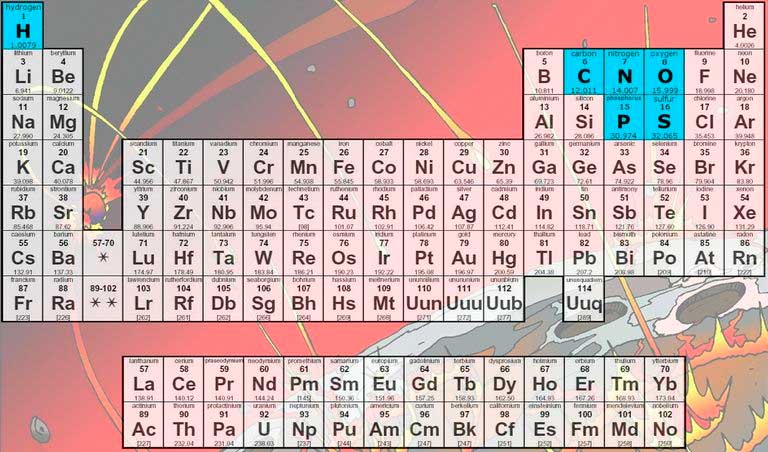
All life on Earth requires the same elements: carbon, hydrogen, nitrogen, oxygen, phosphorus, and sulfur (CHNOPS). These elements came from space, formed inside stars and spread out in clouds of gas and dust. Gravity then forced this material to clump together, forming new stars and smaller objects like planets. NASA
Scientists debate the origins of vital elements on Earth. Some evidence suggests that chondrites from the outer solar system, moving inward, reached the planet late in its formation. However, a new study tells a different story.
Using laboratory experiments and geochemical models, the team reconstructed a map of the phosphorus-nitrogen (P/N) ratio in the early Solar System and found differences between the first (iron meteorites) and second (chondrites) generations of planetesimals.

Experiments and subsequent geochemical modeling showed that the first generation of planetesimals had a higher P/N ratio in the outer Solar System, then decreased toward the inner Solar System. In the second generation of planetesimals, this trend reversed, and the P/N ratio became higher in the inner Solar System.
It is believed that during the formation of the first generation of planetesimals, a material outflow occurred that increased the phosphorus-to-nitrogen ratio in the outer solar system. Then Jupiter emerged.
In our Solar System, the presence of Jupiter and its evolutionary history appear to have played a decisive role in determining the distribution of the essential chemical components needed for habitable worlds.
As Jupiter formed and grew to enormous size and its gravitational influence increased, the planet restricted the movement of phosphorus and nitrogen from the inner to the outer Solar System. This meant that when the second generation of planetesimals emerged, those in the inner Solar System had a higher phosphorus-to-nitrogen ratio than their counterparts further out.
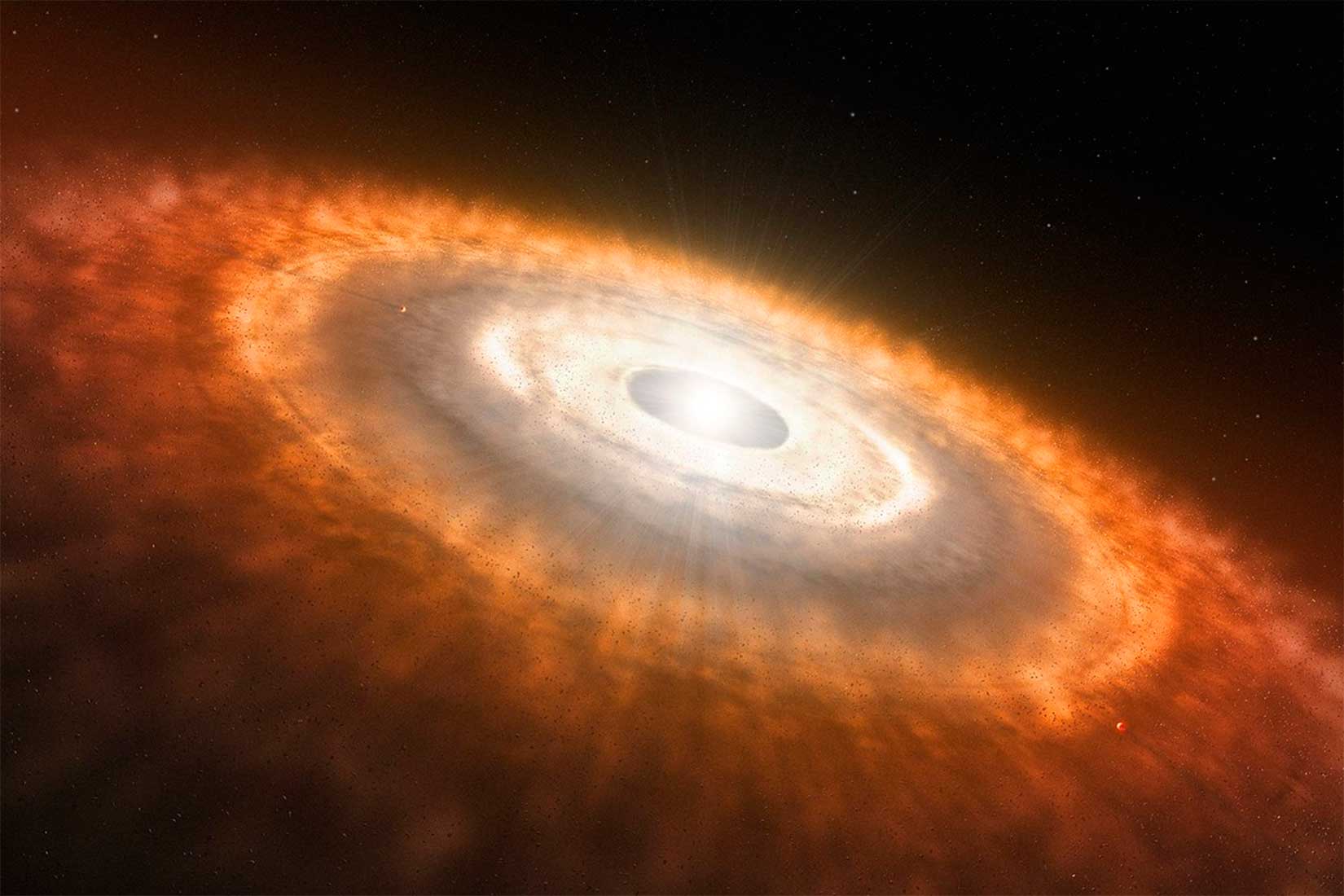
This artist’s impression of a young star surrounded by a protoplanetary disk is apparent. The darker rings in the disk are where objects such as planetesimals are forming, clearing a path through the debris. ESO
“For our solar system, the presence of Jupiter and its evolutionary history appear to have played a decisive role in determining the distribution of essential chemical components necessary for habitable worlds,” said Rajdeep Dasgupta of Rice University in Houston, the study’s senior author. “The question remains whether an Earth-like balance of vital elements could be established without a Jupiter-like planet in the population.”
Geochemical accretion modeling further shows that Earth’s modern P/N signature is best reproduced by inner solar system planetesimals, whether associated with iron meteorites or chondrites.
“The study suggests that Earth obtained its supply of vital elements—phosphorus and nitrogen—primarily from the inner solar system, without significant contributions from chondrites from the outer solar system,” said lead study author Debjit Pathak, a graduate student at Rice University.
The asteroid belt, which played a role in the formation of life on Earth, is steadily losing mass every year and may not be such a permanent feature of the solar system, according to new data.
The asteroid belt, located between Mars and Jupiter, is a vast collection of rocks thought to have formed a planet that never formed. When our solar system formed 4.6 billion years ago, the material in this region should have condensed into a planet, but Jupiter’s gravitational influence prevented this, churning the region so that collisions became destructive rather than constructive. What remains today contains only about 3% of the Moon’s mass, scattered over millions of kilometers.
See also... New method for observing individual atoms confirms century-old quantum mechanical theory |
Jupiter’s influence didn’t stop there. Gravitational resonances—regions in space where asteroids’ orbital periods create regular interactions with Jupiter, Saturn, and even Mars—destabilize asteroid orbits, ejecting fragments either into the inner solar system, where Earth is located, or outward, toward Jupiter’s orbit. Asteroid fragments that fail to escape their orbits are crushed into meteorite dust by mutual collisions. The results of the study were published on the Universe Today website in September 2025.
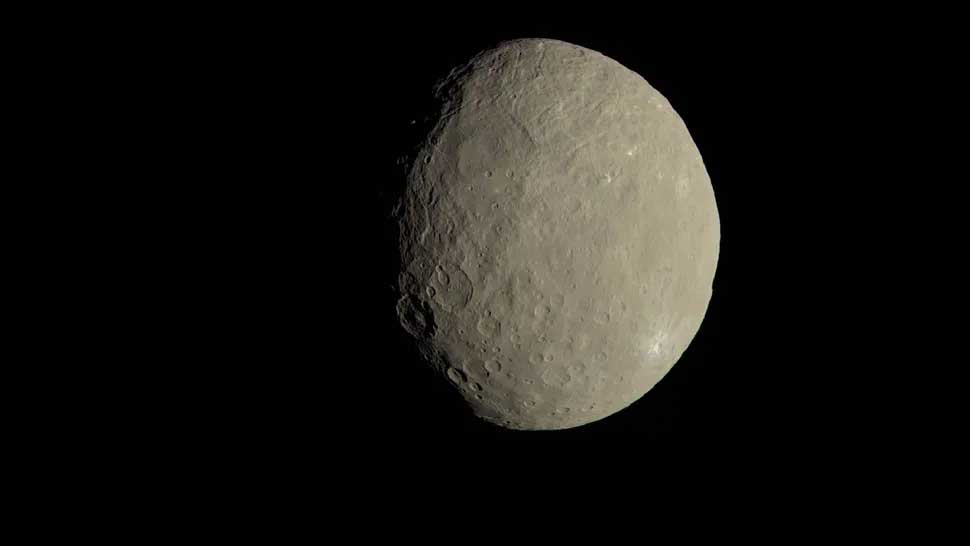
Approximate color image of Ceres. NASA/JPL-Caltech/UCLA/MPS/DLR/IDA
A team of astronomers led by Julio Fernández of the University of the Republic of Uruguay has precisely calculated the rate at which the asteroid belt is losing material. They found that the asteroid belt is currently losing approximately 0.0088% of the portion of the belt still involved in ongoing collisions. This may seem like a small figure, but it represents a significant flow of material when considered on the grand scale of the evolution of the Solar System.
This result is particularly interesting because of how the lost mass is distributed among different objects. About 20% is lost as asteroids and meteoroids, which occasionally cross Earth’s orbit and sometimes spectacularly enter our atmosphere as meteors. The remaining 80% is crushed by collisions into meteoritic dust, which feeds the faint zodiacal dust glow visible in the night sky after sunset or before sunrise. Better-known asteroids such as Ceres, Vesta, and Pallas were excluded from the study because they had existed long enough to no longer contribute to the ongoing mass loss.
Understanding mass loss in the asteroid belt is important and directly impacts Earth’s evolution. Large bodies leaving the belt don’t simply disappear into space; some eventually end up in the inner solar system, where they become potential collision targets. Research suggests that if the current rate of mass loss is extrapolated backwards, about 3.5 billion years ago the asteroid belt could have been approximately 50% more massive, and the rate of mass loss roughly twice as high. This is remarkably consistent with geological data from the Moon and Earth, which demonstrate a decrease in the bombardment rate over the past several billion years.
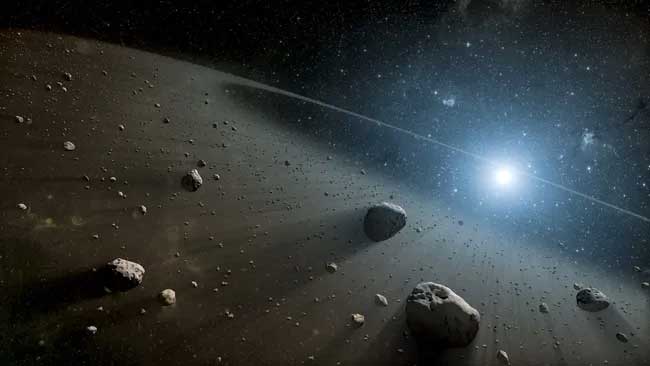
Asteroid belt illustration. Mode-list via Getty Images
The asteroid belt is often considered a permanent part of our solar system, but this study reveals that it is a dynamic structure that has been gradually losing material over billions of years. Layers of glassy spherical particles found in Earth’s rocks testify to a more turbulent past, when a more massive asteroid belt showered us with far more rock. Today, this bombardment has slowed, and the belt continues to slowly disintegrate. Understanding this process not only helps us reconstruct the history of the impacts that shaped Earth’s surface but also provides crucial data for modeling future risks posed by near-Earth objects.
Comment on Facebook* The owner of the Meta company is recognized as extremist in Russia and is banned.See also... Complete list of HTML/Javascript event handlers with examples List of required documents for a website in the Russian Federation |